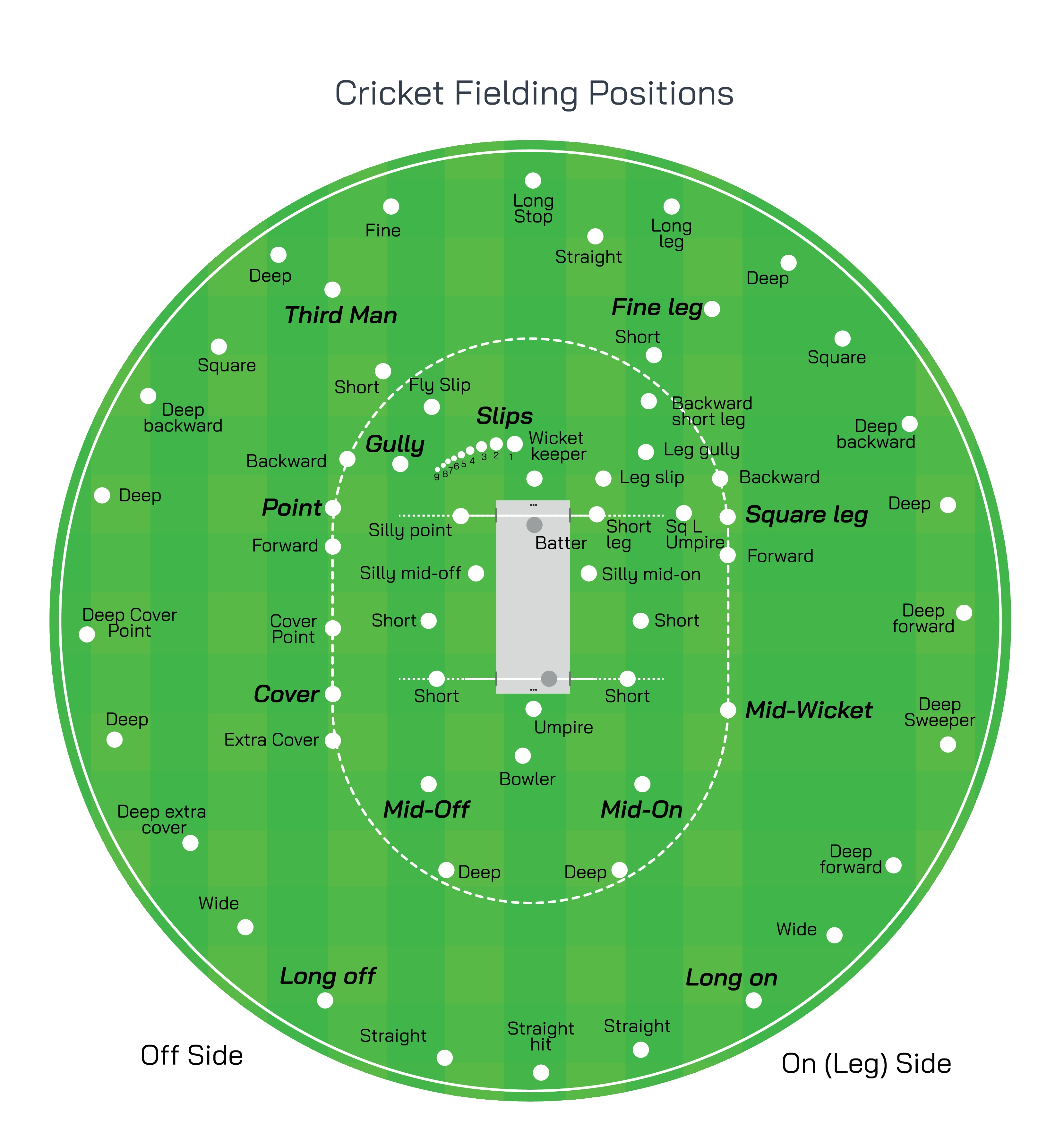
Cricket fielding positions form the tactical foundation of the game and play a decisive role in controlling runs, creating pressure on batters, and taking wickets. The arrangement of fielders around the pitch is not random; instead, it is based on batting technique, bowling style, match format, pitch conditions, and game strategy. A cricket fielding positions diagram provides a complete visual understanding of how the field is divided into specific areas and how each position is named according to its location relative to the batter.
A cricket ground is broadly divided into two halves by an imaginary line running straight down the pitch in the direction the batter is facing. These halves are known as the off side and the leg side. The off side is the side of the field in front of the batter’s body, while the leg side, also called the on side, is behind the batter’s legs. All fielding positions are described with reference to this division, along with distance from the batter and angle from the pitch.
Close-in fielding positions are those placed near the batter, primarily to catch edges or force mistakes. Slips are among the most important close fielding positions on the off side. They stand beside the wicketkeeper in a diagonal line and are numbered sequentially based on distance from the batter. Slips are especially effective against fast bowlers and swinging deliveries, where the ball may edge off the bat. Gully is positioned slightly squarer and wider than slips, catching balls that are played late or rise unexpectedly.
On the off side, point is positioned square of the wicket, guarding cut shots. Depending on strategy, point may be forward, square, or backward. Cover is another crucial off-side position located between point and mid-off, responsible for stopping drives and cover shots. Extra cover lies slightly wider and deeper, protecting the region where batters often place powerful strokes. These positions are essential in limiting scoring opportunities through the off side.
Mid-off is located straight in front of the batter on the off side and is usually closer to the pitch when bowlers are attempting to induce false shots. This position often plays a dual role by stopping straight drives and being ready to take catches. Long-off is the deeper version of mid-off and is used when batters are attempting aerial shots over the infield, particularly in limited-overs cricket.
On the leg side, fielding positions mirror many off-side placements but have unique names due to batting mechanics. Square leg is positioned square of the wicket on the leg side and is vital for stopping pulls and glances. Fine leg stands behind square, close to the boundary, and is responsible for balls deflected off the bat or pad. Fine leg may be shallow or deep depending on the batter’s tendencies.
Mid-on is the leg-side counterpart of mid-off and is placed straight down the ground on the leg side. This position is important for stopping on-drives and straight hits. Long-on is deeper and positioned near the boundary, protecting against lofted shots. Mid-wicket is placed between mid-on and square leg and covers one of the most frequently targeted scoring zones. Deep mid-wicket is used when batters attempt powerful leg-side strokes.
Backward positions are named based on whether they are behind the batter’s line of sight. Backward point and backward square leg guard areas behind square on their respective sides. These positions become crucial when batters play late cuts or glance shots. The backward region is particularly important on fast pitches where the ball travels quickly off the bat.
Very close fielding positions such as silly point, silly mid-on, and leg slip are placed extremely close to the batter. These positions are usually used in slower formats of the game, especially in spin bowling, to apply pressure and force mistakes. These fielders require quick reflexes and protective gear due to the short reaction time involved.
The field is also divided into an inner circle and an outer circle, particularly in limited-overs formats. Fielding restrictions apply within these circles, influencing how captains set their fields. Inner-circle fielders focus on preventing singles and applying pressure, while outer-circle fielders are positioned near the boundary to stop fours and sixes.
Cricket fielding positions are not fixed and often change ball by ball. A captain may adjust the field depending on the batter’s strengths, the bowler’s plan, or the match situation. For example, attacking fields with more close catchers are used when seeking wickets, while defensive fields spread fielders near the boundary to protect runs.
Understanding cricket fielding positions is essential for players, coaches, commentators, and learners. It helps batters identify scoring areas, bowlers plan dismissals, and fielders anticipate where the ball is likely to go. For students and beginners, a labeled cricket fielding positions diagram simplifies learning by clearly showing names and placements.
In professional cricket, field placement reflects deep strategic thinking. Teams analyze data, batter shot patterns, and pitch behavior to optimize field settings. A slight shift in position can be the difference between a catch and a boundary, highlighting the importance of precise placement.
In conclusion, cricket fielding positions represent a structured and strategic layout of players around the pitch, divided into off side and leg side, close and deep areas, and inner and outer circles. Each position has a specific purpose based on batting techniques and bowling plans. The cricket fielding positions diagram provides a comprehensive visual guide to these placements, making it an essential reference for understanding the tactical depth and beauty of the game of cricket.