Cyclones and anticyclones are large-scale atmospheric systems that play a fundamental role in shaping daily weather and long-term climate patterns across the Earth. These systems are defined by differences in atmospheric pressure and the movement of air around pressure centers. Understanding cyclones as low-pressure systems and anticyclones as high-pressure systems is essential for explaining wind patterns, cloud formation, rainfall, storms, and periods of calm or dry weather.
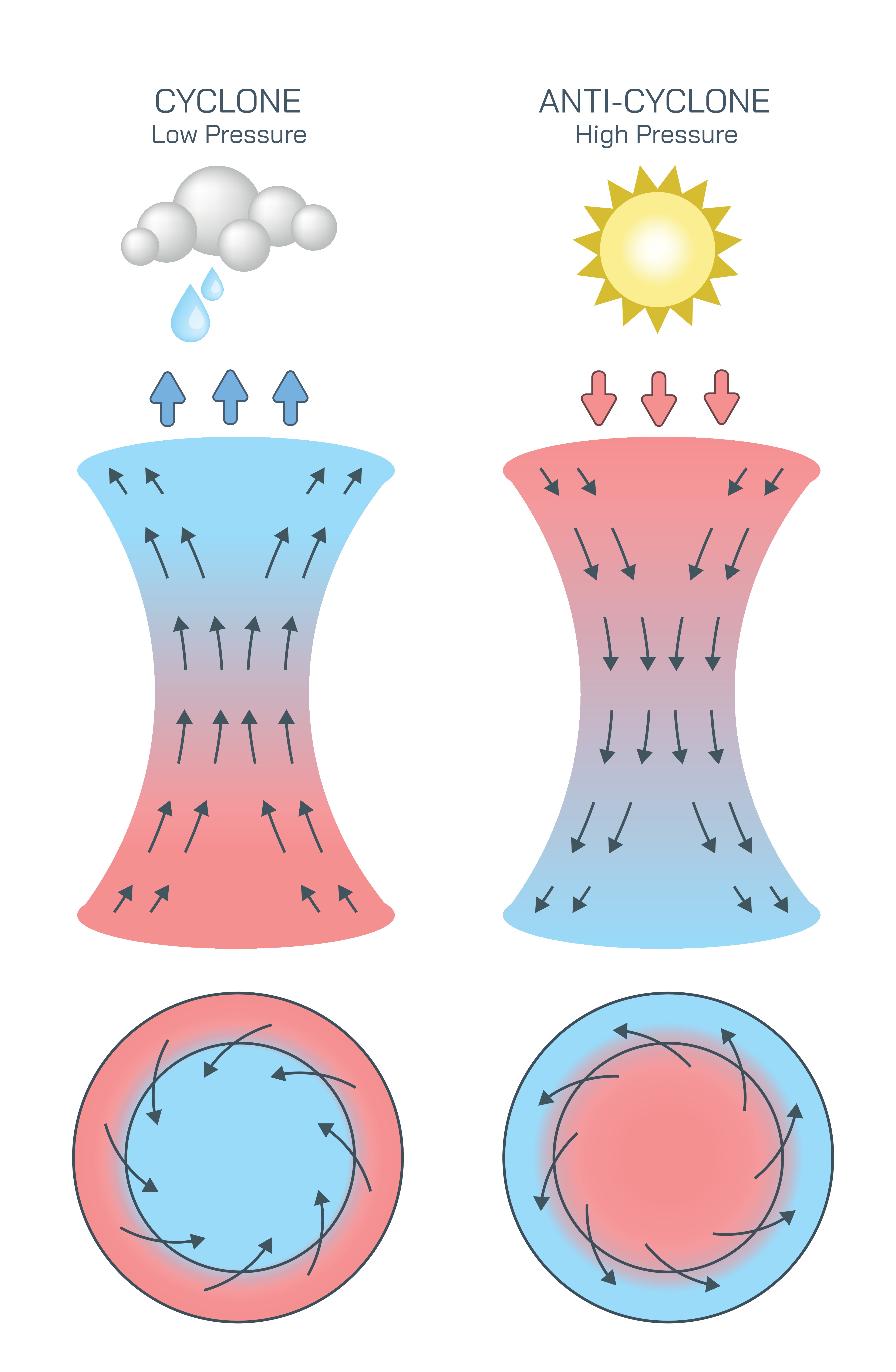
A cyclone is an atmospheric system characterized by low pressure at its center. In a cyclone, air pressure at the center is lower than the surrounding areas. Because air naturally moves from regions of higher pressure to lower pressure, surface air flows inward toward the center of a cyclone. As this air converges, it is forced to rise upward. Rising air expands and cools as it ascends, leading to condensation of water vapor and the formation of clouds. This process is why cyclones are commonly associated with cloudy skies, precipitation, and unsettled weather.
The movement of air within a cyclone is influenced by the rotation of the Earth. Due to the Coriolis effect, air does not flow straight into the low-pressure center but instead spirals inward. In the Northern Hemisphere, this spiraling motion occurs in a counterclockwise direction, while in the Southern Hemisphere it occurs clockwise. This rotational pattern is a defining feature of cyclonic systems and is visible on weather maps and satellite imagery.
Cyclones vary in size, intensity, and origin. Some cyclones form over warm ocean waters, where heat and moisture provide energy that strengthens the system. Others develop over land or along boundaries between air masses of different temperatures. Regardless of type, all cyclones share the fundamental characteristic of inward-moving, rising air that leads to cloud development and precipitation.
Weather conditions associated with cyclones are often dynamic and changing. Cloud cover is usually extensive, ranging from thin layers to thick storm clouds. Rainfall can be light and continuous or heavy and intense, depending on the strength of the system. Strong cyclones may produce gusty winds, thunderstorms, or severe weather. Because of these effects, cyclones are often linked with storms, flooding, and disruptions to daily life.
In contrast, an anticyclone is an atmospheric system defined by high pressure at its center. In an anticyclone, the pressure at the center is higher than in surrounding regions. Air flows outward from the center toward lower-pressure areas. As air moves away at the surface, it is replaced by air descending from higher levels of the atmosphere. This downward movement of air is known as subsidence.
Descending air in an anticyclone becomes compressed and warms as it sinks. This warming process reduces the air’s relative humidity, inhibiting cloud formation. As a result, anticyclones are typically associated with clear skies, dry conditions, and stable weather. Winds within an anticyclone are usually light, and weather conditions can remain unchanged for several days or even weeks.
The rotational direction of air in an anticyclone is opposite to that of a cyclone. In the Northern Hemisphere, air circulates outward in a clockwise direction around a high-pressure center. In the Southern Hemisphere, the circulation is counterclockwise. This outward, spiraling flow combined with sinking air creates conditions that suppress cloud development and precipitation.
Anticyclones are often responsible for periods of fair weather. Clear skies allow sunlight to reach the Earth’s surface during the day, leading to warmer temperatures. At night, the lack of cloud cover allows heat to escape, sometimes resulting in cooler temperatures. In winter, persistent anticyclones can lead to cold, still conditions, while in summer they may cause prolonged heat waves and dry spells.
The formation of cyclones and anticyclones is closely related to the uneven heating of the Earth’s surface. Differences in temperature between land and sea, between equatorial and polar regions, and between air masses contribute to pressure variations. These pressure differences drive atmospheric circulation and lead to the development of large-scale weather systems.
Cyclones and anticyclones often interact with each other as part of broader weather patterns. In many regions, weather changes occur as cyclones move through, followed by anticyclones that bring clearing conditions. This alternating sequence explains why periods of stormy weather are often followed by calm and clear days.
The impact of cyclones and anticyclones extends beyond short-term weather. These systems influence climate patterns, water availability, and agricultural productivity. Cyclones contribute to rainfall that replenishes rivers, reservoirs, and soil moisture. Anticyclones, while providing favorable conditions for outdoor activities, can also lead to drought when they persist for extended periods.
From a meteorological perspective, cyclones are associated with atmospheric instability, while anticyclones represent stability. Rising air in cyclones promotes vertical motion and energy exchange, making the atmosphere more dynamic. Sinking air in anticyclones suppresses vertical movement, resulting in calm and settled conditions.
Understanding the structure of cyclones and anticyclones is essential for weather forecasting. Meteorologists analyze pressure patterns, wind direction, and air movement to predict upcoming weather changes. Weather maps often display pressure centers, allowing forecasters to anticipate storms, rainfall, or clear conditions.
In addition to their basic structure and effects, cyclones and anticyclones also differ in how long they persist and how they evolve over time. Cyclones are generally more transient systems, often forming, intensifying, and dissipating within a few days to a week. Their movement across regions brings rapid changes in weather, such as shifts in wind direction, temperature drops or rises, and varying cloud cover. As a cyclone weakens, its central pressure increases, cloud systems break apart, and precipitation gradually decreases, signaling a return to more stable conditions.
Anticyclones, on the other hand, tend to be more persistent. Once established, a strong high-pressure system can remain nearly stationary for extended periods. This persistence explains prolonged dry spells, heat waves, or cold snaps experienced in many parts of the world. Because anticyclones suppress cloud formation and rainfall, their long duration can significantly influence water availability, soil moisture, and ecosystem health, especially in regions dependent on regular precipitation.
The vertical structure of these systems further highlights their contrasting nature. In cyclones, rising air creates a deep column of upward motion extending through much of the troposphere. This vertical development supports cloud growth at multiple levels, from low-level stratus clouds to towering cumulonimbus clouds capable of producing heavy rain or storms. In anticyclones, downward motion dominates the atmospheric column, creating temperature inversions that trap air near the surface. These inversions can sometimes lead to fog or air pollution buildup, particularly in urban or industrial areas.
Seasonal variations also affect the behavior of cyclones and anticyclones. During warmer months, cyclones may be more intense due to increased atmospheric moisture and stronger heating, leading to heavier rainfall and more energetic weather systems. In colder months, cyclones often bring widespread cloud cover, snowfall, and strong winds, especially in mid-latitude regions. Anticyclones in winter can create clear but cold conditions, while in summer they are often linked to hot, dry weather and increased evaporation.
Geographical location plays a major role in determining the influence of these systems. Coastal regions are especially sensitive to cyclones because moisture from oceans enhances cloud formation and precipitation. Continental interiors often experience stronger effects from anticyclones, where prolonged high pressure can dominate weather patterns and limit rainfall. Mountain ranges can also modify cyclonic and anticyclonic systems by forcing air to rise or sink, further influencing local weather conditions.
From a global perspective, cyclones and anticyclones are essential components of Earth’s atmospheric circulation. They help redistribute heat from warmer regions to cooler ones, maintaining energy balance across the planet. Cyclones transport warm air poleward and cold air equatorward, while anticyclones often reinforce stable air masses and regional climate patterns. Together, they form a dynamic system that drives the continuous movement of air around the Earth.
Human activities and climate change are increasingly affecting the behavior of these atmospheric systems. Rising global temperatures influence pressure patterns, sea surface temperatures, and atmospheric moisture levels, which can alter the frequency, intensity, and paths of cyclones. Changes in anticyclonic behavior may lead to longer dry periods or more extreme heat events. Understanding these shifts is crucial for improving climate models and preparing for future weather-related challenges.
In practical terms, knowledge of cyclones and anticyclones is vital for disaster preparedness and resource management. Accurate forecasting helps communities prepare for heavy rainfall, storms, or prolonged dry conditions. Farmers rely on predictions of these systems to plan irrigation and crop cycles, while water managers monitor them to ensure sustainable use of water resources. Aviation and maritime operations also depend heavily on understanding pressure systems to ensure safety and efficiency.
Overall, cyclones and anticyclones are not just isolated weather phenomena but integral elements of Earth’s atmospheric system. Their formation, movement, and interaction govern the rhythm of weather changes experienced daily and seasonally. By studying these systems in greater depth, scientists gain valuable insight into the complex processes that shape weather and climate, helping societies adapt to natural variability and future environmental change.
In summary, cyclones and anticyclones are fundamental components of Earth’s atmospheric circulation. Cyclones are low-pressure systems characterized by inward-moving, rising air that produces clouds, rainfall, and stormy weather. Anticyclones are high-pressure systems marked by outward-moving, sinking air that leads to clear skies and stable conditions. Together, these systems regulate weather variability, influence climate, and shape the environmental conditions experienced across the globe. Understanding their behavior provides essential insight into how the atmosphere functions and how weather patterns develop and change over time.