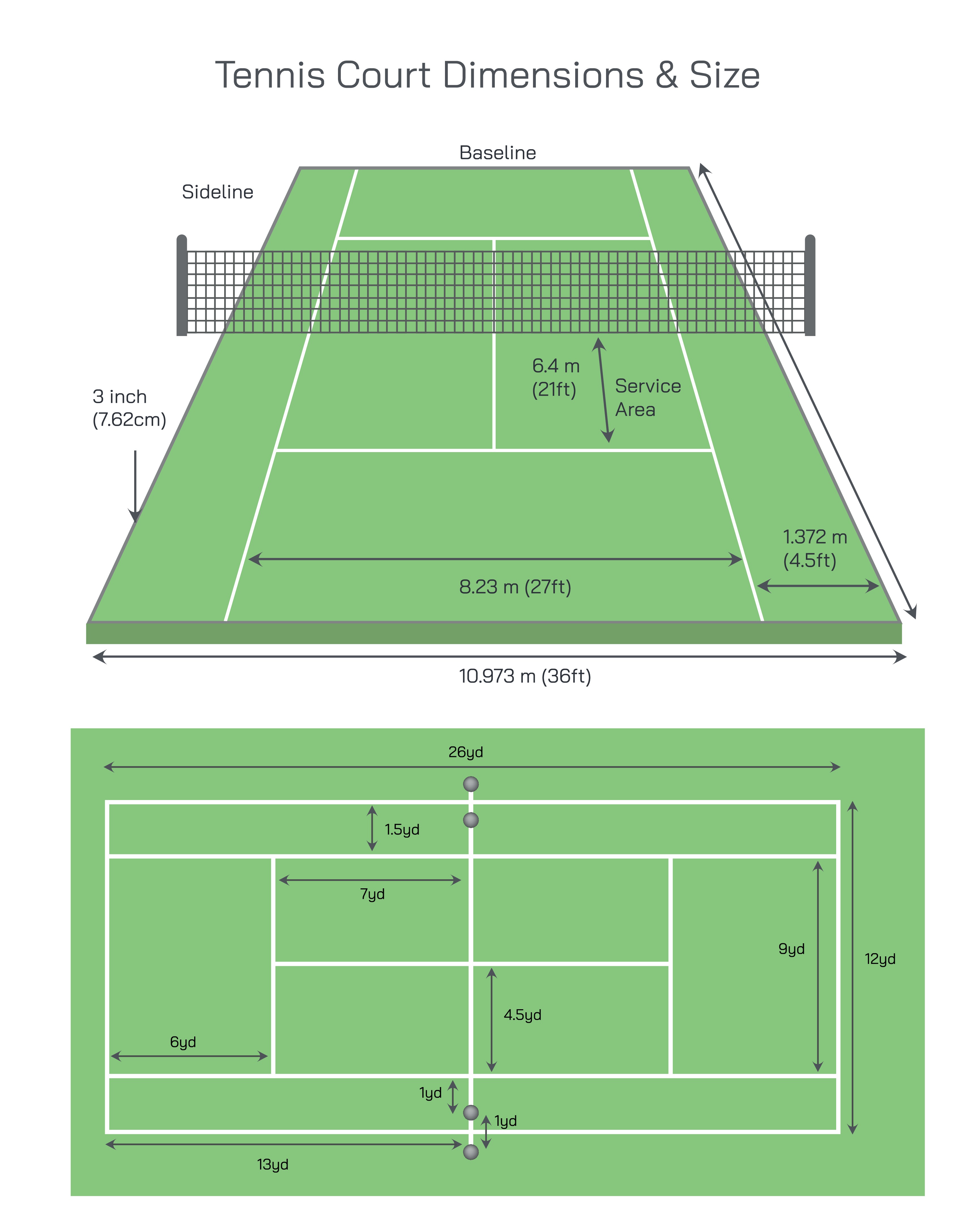
A tennis court is a carefully designed rectangular playing surface with precise dimensions and markings that ensure fair and standardized gameplay across all levels of the sport. Understanding tennis court dimensions and size is essential for players, coaches, officials, students, and facility planners. Whether the game is played recreationally or professionally, the court must follow internationally accepted measurements so that rules, movement, and scoring remain consistent. A tennis court diagram clearly illustrates these dimensions, making it easier to visualize the layout and understand how each area contributes to the game.
The standard tennis court has a total length of 23.77 meters, which is equivalent to 78 feet. This length is measured from one baseline to the other. The baseline runs parallel to the net at each end of the court and marks the back boundary of the playing area. Players usually position themselves behind the baseline during serves and rallies, making it one of the most important reference lines on the court.
The width of a tennis court depends on whether the match is singles or doubles. For singles matches, the court width is 8.23 meters, or 27 feet. For doubles matches, the court width increases to 10.97 meters, or 36 feet. The additional width on each side is known as the doubles alley. These alleys are only used during doubles play and are excluded during singles matches, which is why separate sidelines exist for singles and doubles.
The net divides the tennis court into two equal halves and plays a central role in the game. The net height is 1.07 meters, or 3.5 feet, at the posts and 0.914 meters, or 3 feet, at the center. This slight dip in the middle ensures uniform play and challenges players to control the height and trajectory of their shots. The net stretches across the entire width of the court, including the doubles alleys.
The service area is another critical component of tennis court dimensions. Each half of the court contains two service boxes, making a total of four service boxes on the entire court. The service line is drawn parallel to the net at a distance of 6.4 meters, or 21 feet, from the net. The center service line runs perpendicular to the net and divides the service area into left and right service boxes. During a serve, the ball must land diagonally in the opposite service box for the serve to be considered valid.
The center mark is a small line located at the midpoint of each baseline. It helps players position themselves correctly while serving. Although small, this marking plays an important role in maintaining accuracy and consistency during service.
All tennis court lines have a standard width, usually between 2.5 and 5 centimeters, except for the baseline, which can be up to 10 centimeters wide. Lines are considered part of the court, meaning a ball landing on the line is deemed in play. This rule makes precise markings essential for fair officiating.
The overall playing area is often surrounded by additional clearance space beyond the court lines. This space allows players to move freely and safely while chasing shots. Professional tennis facilities provide ample run-off space behind the baselines and along the sidelines to accommodate fast-paced movement and prevent injuries. Although this surrounding area is not part of the official court dimensions, it is an important consideration in court design.
Tennis courts can be built on different surfaces, such as grass, clay, hard court, or synthetic materials. While the surface affects ball bounce and playing style, the dimensions and markings of the court remain the same across all surfaces. This standardization ensures that players can adapt their skills universally, regardless of where the game is played.
From an educational perspective, tennis court dimensions are often taught in physical education and sports science. Understanding the layout helps beginners learn positioning, serving rules, and movement strategies. For advanced players, precise knowledge of court dimensions enhances tactical play, shot placement, and spatial awareness.
In professional tennis, strict adherence to court dimensions is mandatory. International tournaments follow regulations set by governing bodies to ensure consistency across competitions. Accurate court measurements are crucial for officiating, broadcasting, and maintaining the integrity of the sport.
Tennis court dimensions also play an important role in facility planning and construction. Architects and sports planners must consider not only the court size but also orientation, lighting, drainage, and spectator areas. Proper design ensures optimal playing conditions and longevity of the court.
In conclusion, tennis court dimensions and size are carefully standardized to support fair and consistent gameplay. The court measures 23.77 meters in length, with widths of 8.23 meters for singles and 10.97 meters for doubles. Key features such as baselines, sidelines, service boxes, center marks, and net height all contribute to the structure of the game. Understanding these dimensions provides valuable insight into how tennis is played, taught, and regulated, making the tennis court diagram an essential reference for players, students, and sports professionals alike.