The depth of the ocean is one of the most fascinating and extreme features of planet Earth. Covering more than seventy percent of the Earth’s surface, the oceans contain vast vertical regions that extend far below the surface, forming complex layers defined by light availability, pressure, temperature, and biological activity. Among all oceanic features, the Mariana Trench stands out as the deepest known point on Earth, representing the ultimate frontier of ocean depth and exploration. Understanding ocean depth and the Mariana Trench provides valuable insight into Earth’s geology, marine life, and the extreme conditions that exist far beneath the waves.
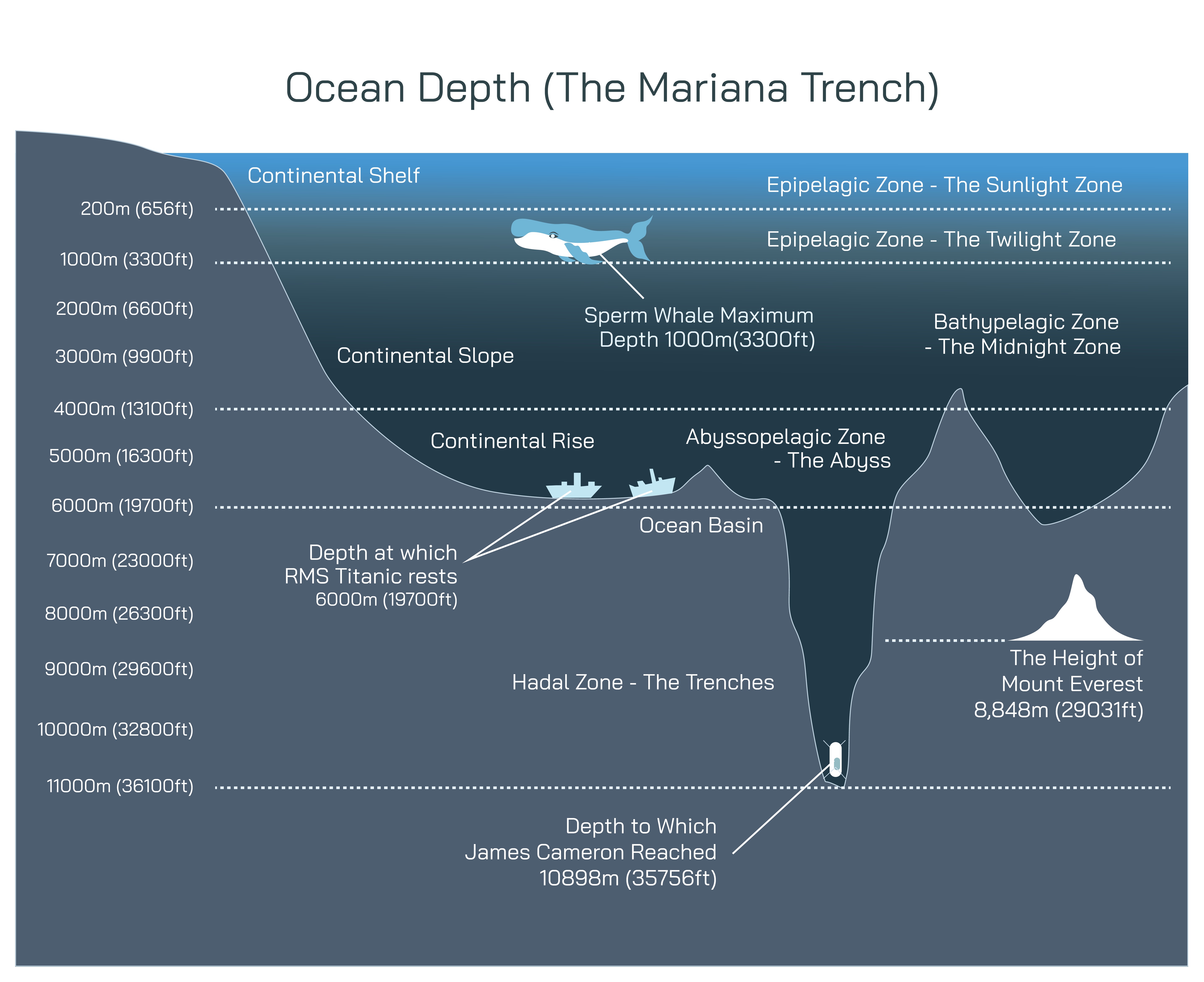
Ocean depth is commonly divided into distinct zones, each characterized by specific environmental conditions. These zones help scientists classify marine ecosystems and understand how life adapts as depth increases. The uppermost layer is the epipelagic zone, often called the sunlight zone. This zone extends from the ocean surface down to about two hundred meters. Sunlight penetrates this layer, allowing photosynthesis to occur. As a result, most marine life, including phytoplankton, fish, and coral reefs, is concentrated here. The epipelagic zone plays a critical role in global oxygen production and the marine food web.
Below the sunlight zone lies the mesopelagic zone, also known as the twilight zone. This region extends roughly from two hundred meters to one thousand meters below the surface. Sunlight is faint and insufficient for photosynthesis, but enough light remains to create dim visibility. Many organisms in this zone have evolved large eyes, reflective tissues, or bioluminescence to survive in low-light conditions. Pressure increases significantly here, and temperatures begin to drop.
Deeper still is the bathypelagic zone, often referred to as the midnight zone. This layer extends from about one thousand meters to four thousand meters below the surface. Complete darkness prevails in this zone, as no sunlight reaches these depths. Water pressure is immense, and temperatures are near freezing. Despite these harsh conditions, life persists. Organisms in the bathypelagic zone often rely on bioluminescence, slow metabolisms, and specialized feeding strategies to survive in an environment with limited food supply.
Beneath the midnight zone lies the abyssopelagic zone, commonly called the abyss. This region stretches from approximately four thousand meters to six thousand meters below sea level. The ocean floor in this zone is relatively flat in many areas, forming vast abyssal plains. The pressure at these depths is enormous, and temperatures remain close to freezing. Life in the abyss is sparse but highly specialized, with organisms adapted to extreme pressure and low energy availability.
The deepest ocean layer is the hadal zone, which includes ocean trenches and extends from about six thousand meters to the deepest points of the ocean. The Mariana Trench lies within this zone and represents the deepest known part of the global ocean. Trenches are formed by tectonic processes, where one tectonic plate is forced beneath another in a process known as subduction. This geological activity creates long, narrow depressions that plunge far below the surrounding seafloor.
The Mariana Trench is located in the western Pacific Ocean and reaches a maximum depth of nearly eleven thousand meters at a point known as Challenger Deep. This depth is so extreme that if Mount Everest were placed inside the trench, its peak would still be submerged by more than a kilometer of water. The pressure at this depth is more than one thousand times greater than atmospheric pressure at sea level. Such conditions were once thought to be incompatible with life.
Despite the crushing pressure, near-freezing temperatures, and complete darkness, life has been discovered in the Mariana Trench. Microorganisms, small crustaceans, and specially adapted fish have been observed at these depths. These organisms have unique cellular structures and biochemical adaptations that allow them to withstand immense pressure. Their discovery has reshaped scientific understanding of the limits of life on Earth.
Exploration of the Mariana Trench has been limited due to the extreme conditions and technical challenges involved. Early explorations used unmanned instruments and deep-sea probes to collect data. Later, specially designed submersibles allowed a small number of human descents. These missions provided valuable information about trench geology, sediment composition, and deep-sea life. Each expedition has revealed new insights into Earth’s most inaccessible environment.
Ocean depth also has a strong influence on temperature and pressure. As depth increases, temperature generally decreases, especially below the surface layers. Pressure increases steadily with depth due to the weight of the water above. These factors shape the distribution of marine organisms and determine which species can survive at different depths. The Mariana Trench represents the extreme end of this gradient, where only the most pressure-tolerant life forms can exist.
From a geological perspective, the Mariana Trench offers important clues about Earth’s internal processes. Subduction zones like this trench are sites of intense tectonic activity. They play a role in recycling Earth’s crust and influencing volcanic and seismic activity. Studying these regions helps scientists better understand plate tectonics and the dynamic nature of the planet.
The study of ocean depth and deep-sea trenches also has implications for environmental science. Deep ocean regions store large amounts of carbon and play a role in regulating Earth’s climate over long time scales. Understanding how these systems function is essential for accurate climate modeling and long-term environmental planning.
In educational contexts, diagrams of ocean depth zones are widely used to illustrate how the ocean is structured vertically. These diagrams clearly show the progression from sunlit surface waters to the dark, high-pressure depths of the Mariana Trench. They help learners visualize the immense scale of the ocean and appreciate how small the explored portion of the deep sea remains.
In conclusion, ocean depth represents a journey from light-filled surface waters to one of the most extreme environments on Earth. The ocean is divided into distinct zones based on depth, light, pressure, and biological activity. At the deepest end of this spectrum lies the Mariana Trench, a geological marvel that reaches nearly eleven thousand meters below sea level. Despite extreme pressure, darkness, and cold, this region supports life and offers invaluable insights into Earth’s geology and biology. Understanding ocean depth and the Mariana Trench highlights the complexity of our planet, the adaptability of life, and the vast mysteries that still lie hidden beneath the ocean surface.