A football field, also known as a football pitch or soccer field, is a rectangular playing surface designed with precise dimensions and standardized markings to ensure fair and consistent gameplay across all levels of the sport. Understanding football field area and size is essential for players, coaches, referees, students, and sports planners, as the dimensions directly influence playing style, tactics, fitness demands, and rule enforcement. A clearly labeled football field diagram helps visualize how the pitch is organized and how each marking contributes to the structure of the game.
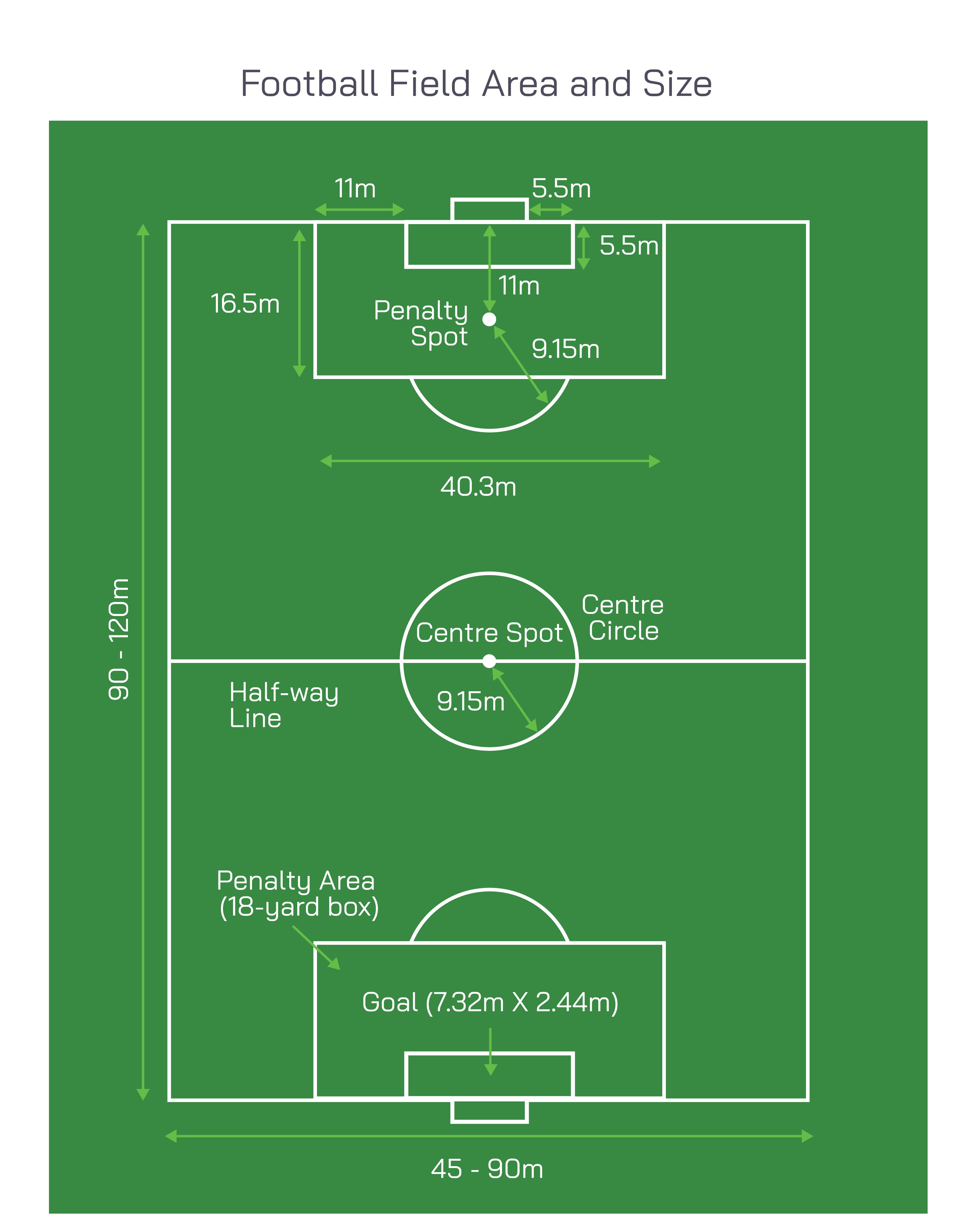
The overall shape of a football field is rectangular, with the length always greater than the width. The longer boundary lines are called touchlines, while the shorter boundary lines are known as goal lines. According to international standards, the length of a football field typically ranges between 90 and 120 meters, while the width ranges between 45 and 90 meters. For professional and international matches, the commonly preferred size is around 105 meters in length and 68 meters in width. This range allows flexibility while maintaining uniformity across competitions.
The total area of a football field depends on its exact dimensions. Using the widely accepted international standard of 105 meters by 68 meters, the total playing area is approximately 7,140 square meters. Smaller pitches used for training, youth matches, or local competitions may have a reduced area, but they must still follow the rectangular shape and proportional markings defined by the laws of the game.
At the center of the football field lies the halfway line, which divides the pitch into two equal halves. This line plays a crucial role during kick-off and helps organize team positioning. At the midpoint of the halfway line is the center spot, which marks the exact location where the ball is placed to start or restart the match. Surrounding the center spot is the center circle, which has a radius of 9.15 meters. During kick-off, players from the opposing team must remain outside this circle until the ball is in play.
One of the most important regions on the football field is the penalty area, often referred to as the eighteen-yard box. This rectangular area extends 16.5 meters from the goal line into the field and spans 40.3 meters in width. The penalty area is significant because it defines where the goalkeeper is allowed to handle the ball and where certain fouls result in penalty kicks. Inside the penalty area is the penalty spot, located 11 meters from the goal line, from which penalty kicks are taken.
Within the penalty area is a smaller rectangle called the goal area, or six-yard box. This area extends 5.5 meters from the goal line into the field and is 18.3 meters wide. The goal area is primarily used to position the ball for goal kicks and helps referees make decisions related to fouls and restarts near the goal.
The goal itself is positioned at the center of each goal line. A standard football goal measures 7.32 meters in width and 2.44 meters in height. The goalposts and crossbar form a rigid frame that the ball must fully cross to count as a goal. The size of the goal remains constant across all levels of professional football, ensuring consistency in scoring conditions.
Boundary markings are a critical aspect of football field design. All lines on the pitch must be of the same width, usually not exceeding 12 centimeters. These lines are considered part of the area they enclose, meaning a ball touching the line is still in play. This rule makes accurate field marking essential for fair officiating and match integrity.
The four corners of the football field each contain a quarter-circle with a radius of 1 meter. These corner arcs mark the area from which corner kicks are taken. The placement of these arcs ensures correct positioning and standardization during restarts of play.
The surface of a football field can vary, including natural grass, artificial turf, or hybrid surfaces. While the playing surface affects ball movement and player traction, it does not alter the official dimensions or markings of the field. Regardless of surface type, all measurements and layout features must remain consistent with the laws of the game.
The size of the football field has a direct impact on how the game is played. Larger pitches provide more space for passing, movement, and tactical buildup, favoring possession-based play. Smaller pitches tend to create faster-paced games with more physical challenges and direct play. Coaches and teams often adapt their strategies based on pitch size, making an understanding of field dimensions important for tactical planning.
In educational and training contexts, football field diagrams are widely used to teach positioning, formations, and movement patterns. Knowing the exact distances between key areas helps players improve spatial awareness and decision-making. Referees also rely on their understanding of pitch dimensions to correctly judge offsides, fouls, and restarts.
From an infrastructure perspective, football field size plays an important role in stadium design and sports facility planning. Adequate run-off areas beyond the touchlines and goal lines are required to ensure player safety. These additional spaces are not part of the official playing area but are essential for professional venues.
In international competitions, football field dimensions are regulated to maintain fairness and consistency. While slight variations are allowed, all pitches must fall within the approved range. This balance between flexibility and standardization allows football to be played globally while respecting local conditions.
Understanding football field area and size also helps spectators and analysts better appreciate the game. Television broadcasts often use field markings to explain tactics, player positioning, and key moments such as offsides or set-piece routines. The pitch serves as the stage on which the entire game unfolds, making its design fundamental to football itself.
In conclusion, the football field area and size are carefully defined to support fair, dynamic, and globally consistent gameplay. A standard football pitch is rectangular, typically measuring around 105 meters in length and 68 meters in width, with a total area of approximately 7,140 square meters. Key features such as the halfway line, center circle, penalty area, goal area, and goals are precisely marked to regulate play. Understanding these dimensions provides valuable insight into how football is played, taught, officiated, and enjoyed worldwide, making the football field diagram an essential reference for anyone involved in the sport.