The octopus is one of the most extraordinary and mysterious creatures in the marine world, known for its intelligence, unusual body structure, advanced camouflage abilities, and complex behavior. As a soft-bodied marine invertebrate, the octopus challenges traditional ideas about intelligence and survival in animals. Despite lacking bones, shells, or a centralized body plan like vertebrates, octopuses have evolved into highly efficient predators and problem solvers, perfectly adapted to life in oceans across the globe.
The evolutionary origin of the octopus dates back hundreds of millions of years. Octopuses belong to the class Cephalopoda within the phylum Mollusca, making them relatives of squids, cuttlefish, and nautiluses. Ancient cephalopods were among the earliest complex predators in prehistoric seas. Over evolutionary time, octopuses lost their external shells, a change that allowed greater flexibility, faster movement, and improved ability to hide in tight spaces. This shell loss marked a significant shift toward intelligence-based survival rather than physical armor.
There are hundreds of recognized octopus species, each adapted to specific marine environments. Some species inhabit shallow coral reefs, while others live on sandy ocean floors or in deep-sea regions where sunlight never reaches. Differences among types include body size, arm length, coloration patterns, habitat preference, and behavioral traits. Despite this diversity, all octopuses share core characteristics such as eight arms, suction cups, a beak-like mouth, and highly developed nervous systems.
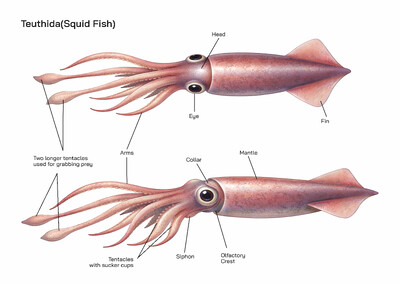
The anatomy of an octopus is unlike that of any vertebrate animal. Its body is divided into a rounded mantle and eight flexible arms radiating outward. The mantle houses vital organs, including the heart, gills, and digestive structures. Octopuses have three hearts—two that pump blood through the gills and one that circulates blood throughout the rest of the body. Their blood contains a copper-based pigment that functions efficiently in low-oxygen environments, supporting survival in deep or poorly oxygenated waters.
Each arm of an octopus is lined with suction cups that function independently and contain sensory receptors. These suckers allow octopuses to taste, smell, and feel their surroundings through direct contact. Remarkably, a large portion of the octopus nervous system is distributed throughout the arms, allowing them to perform complex movements even without direct signals from the brain. This decentralized neural design contributes to their exceptional coordination and problem-solving ability.
One of the most remarkable characteristics of octopuses is their ability to change color, texture, and even body shape. Their skin contains specialized cells that expand or contract to produce rapid changes in appearance. Through this mechanism, octopuses can blend perfectly with rocks, coral, sand, or plants within seconds. This camouflage is used for hunting, hiding from predators, and communication. Some species can also raise bumps or alter skin texture to mimic their surroundings more accurately.
Octopuses are carnivorous predators with highly specialized feeding behavior. Their diet consists mainly of crabs, shrimp, shellfish, small fish, and other marine organisms. They capture prey using their arms and suction cups, then use a strong beak to break through shells or flesh. Some species inject venom to immobilize prey, making feeding more efficient. Octopuses are patient hunters, often ambushing prey rather than chasing it.
In terms of lifestyle, octopuses are primarily solitary animals. Unlike many marine species that form groups, octopuses prefer living alone, occupying dens made from rocks, shells, or coral fragments. These dens provide protection and serve as resting sites between hunting activities. Octopuses are highly territorial and may aggressively defend their shelters from intruders.
Movement in octopuses is achieved through multiple methods. They can crawl slowly along the ocean floor using their arms, allowing precise and silent movement. When threatened, they use jet propulsion by expelling water forcefully through a siphon, enabling rapid escape. This combination of slow stealth and sudden speed gives octopuses exceptional control over their mobility.
Defense mechanisms in octopuses are highly advanced. In addition to camouflage, they can release clouds of dark ink that confuse predators and provide time to escape. Some species also display threatening postures or sudden color changes to startle attackers. Arm regeneration is another important survival trait, allowing octopuses to recover from injuries caused by predators.
Octopus intelligence is among the highest observed in invertebrates. They demonstrate learning ability, memory retention, problem solving, and curiosity. Experiments have shown that octopuses can open jars, navigate mazes, recognize patterns, and learn by observation. Their intelligence is not instinct-based alone but involves adaptation and decision-making, which is rare among animals without backbones.
Emotion-like behaviors have also been observed in octopuses. They show signs of curiosity, exploration, and even play, interacting with objects in ways unrelated to feeding or defense. Stress responses, avoidance learning, and individual personality differences have been documented, suggesting complex internal states.
Reproduction in octopuses is unique and biologically intense. Most species reproduce only once in their lifetime, a strategy known as semelparity. Males transfer sperm to females using a specialized arm, after which females lay large numbers of eggs. Female octopuses guard and clean the eggs continuously, often refusing food during this period. After the eggs hatch, the female usually dies shortly thereafter, marking the end of her life cycle.
Octopuses generally have short lifespans, often ranging from one to three years, depending on species. Despite this, they grow rapidly and reach maturity quickly. Their brief lives are filled with intense activity, learning, and reproduction, making their intelligence even more remarkable given the limited time available for experience.
Ecologically, octopuses play a vital role in marine food webs. As predators, they regulate populations of crustaceans and small fish. At the same time, they serve as prey for larger marine animals, contributing to energy transfer within ocean ecosystems. Their presence reflects healthy marine environments and balanced ecosystems.
Beyond what has already been discussed, the octopus continues to fascinate scientists because of how differently its intelligence is organized compared to that of vertebrates. Rather than relying on a single dominant brain to control every action, an octopus distributes much of its decision-making capacity across its arms. Each arm is capable of independent exploration, manipulation, and reaction, almost as if it possesses its own localized awareness. This creates a form of intelligence that is fundamentally alien to human experience, challenging the idea that complex cognition must be centralized. Researchers often describe octopus intelligence as “embodied,” meaning that thinking and movement are deeply intertwined rather than separated into mind and body.
The sensory world of an octopus is also extraordinarily rich. Vision plays an important role, and octopuses possess highly developed eyes that evolved independently from those of vertebrates. Their eyes are capable of detecting polarized light, a feature that enhances contrast in underwater environments and helps them spot prey or predators more effectively. Unlike humans, octopuses are thought to be largely color-blind, yet their ability to control skin coloration far surpasses that of any color-seeing animal. This paradox highlights how their camouflage system is driven by neural pattern recognition rather than visual color matching alone.
Touch is perhaps the most dominant sense in an octopus’s life. As its arms probe the environment, the animal gathers immense amounts of information through direct contact. Objects are not merely grasped; they are examined, manipulated, and tested. This tactile exploration allows octopuses to learn about textures, shapes, and resistance, building a detailed understanding of their surroundings. Such behavior is especially important in dark or murky waters where vision is limited.
Octopus camouflage is not only about hiding but also about communication. Rapid color flashes, shifting patterns, and changes in body posture are used to signal aggression, submission, or warning. In interactions with rivals or potential mates, these visual displays can convey information faster and more effectively than physical confrontation. Some species even use deceptive signaling, appearing smaller or less threatening before suddenly changing form to escape or intimidate.
Another remarkable aspect of octopus biology is their problem-solving flexibility. When faced with obstacles, octopuses rarely rely on repetitive trial-and-error alone. Instead, they often experiment with new strategies, showing adaptability that resembles insight. In laboratory and natural settings alike, they have been observed stacking objects, using tools such as coconut shells for shelter, and modifying their behavior based on past outcomes. These abilities suggest a capacity for planning, even if only in short-term contexts.
The relationship between octopuses and their environment is highly dynamic. Unlike animals that passively inhabit a space, octopuses actively modify their surroundings. They rearrange rocks, collect shells, and construct elaborate dens that provide both protection and strategic advantage. These modified habitats often reflect the individual preferences of the octopus, further reinforcing the idea that each animal has a distinct behavioral profile.
Octopuses also demonstrate remarkable resilience in harsh conditions. Many species can tolerate changes in temperature, pressure, and oxygen availability better than most marine animals. Deep-sea octopuses, in particular, have adapted to extreme environments where food is scarce and darkness is permanent. Their slow metabolism and efficient use of energy allow them to survive in conditions that would be lethal to many other organisms.
From a scientific perspective, octopuses have become important subjects in neuroscience, robotics, and artificial intelligence research. Their flexible arms inspire the design of soft robots capable of navigating complex environments without rigid structures. Their decentralized nervous system offers alternative models for computing and control that differ radically from human-engineered systems. By studying octopuses, researchers gain insight into how intelligence can arise through entirely different biological pathways.
Culturally, octopuses have long captured human imagination. They appear in myths, folklore, art, and literature across many civilizations, often symbolizing mystery, adaptability, or hidden power. Ancient sailors feared them as sea monsters, while modern science portrays them as symbols of cognitive sophistication and evolutionary innovation. This shift reflects how deeper understanding can transform fear into fascination.
Ethical considerations surrounding octopuses have also grown in recent years. Because of their advanced intelligence and capacity for suffering, many scientists argue that octopuses deserve higher welfare standards in research and captivity. Some countries now include cephalopods under animal welfare regulations, acknowledging that their cognitive and sensory complexity requires careful treatment and respect.
Beyond their already remarkable abilities, octopuses reveal even deeper layers of complexity when their daily rhythms and decision-making patterns are closely observed. Unlike many marine animals that rely heavily on instinctual routines, octopuses display a surprising degree of behavioral flexibility. They adjust hunting times, movement strategies, and shelter use based on local conditions, prey availability, and perceived threats. This adaptability allows them to thrive in environments that change rapidly, such as tide pools, coral reefs, and coastal regions affected by human activity.
Octopus learning is not limited to simple reward-based behavior. Studies suggest that they can form mental maps of their surroundings, remembering the locations of dens, food sources, and escape routes. This spatial awareness reduces unnecessary risk and energy expenditure. When an octopus explores a new area, it does not wander aimlessly; instead, it gradually builds familiarity and later navigates with purpose. Such behavior hints at an internal representation of space, a cognitive skill once thought to be largely exclusive to vertebrates.
The skin of an octopus deserves special attention as one of the most advanced biological interfaces in the animal kingdom. It functions simultaneously as camouflage, sensory organ, and communication tool. Each patch of skin is directly connected to the nervous system, enabling instantaneous responses to environmental stimuli. Texture changes can make the skin appear smooth, rough, spiky, or rocky, allowing the octopus to physically blend with its surroundings, not just visually. This dynamic skin control blurs the boundary between body and environment, effectively making the octopus a living extension of its habitat.
Octopuses also demonstrate a unique relationship with risk and curiosity. While they are cautious animals, they are not passive. Many individuals actively investigate unfamiliar objects, sometimes repeatedly, as if testing their properties. This curiosity is a double-edged trait: it enhances learning and adaptability but can also expose octopuses to danger. In captivity and in the wild, octopuses have been observed dismantling equipment, opening containers, and escaping enclosures, suggesting an intrinsic drive to explore beyond immediate survival needs.
Social interaction in octopuses, though limited, is more nuanced than once believed. While they are generally solitary, encounters between individuals are not always aggressive. Some species exhibit tolerance when resources are abundant, and brief interactions may involve displays rather than combat. These interactions rely heavily on visual signals and posture, reducing the need for physical confrontation. Such behavior indicates that octopuses can assess situations and choose responses based on context rather than instinct alone.
The short lifespan of octopuses adds another layer of intrigue to their biology. Knowing that they live only a few years, their rapid growth and accelerated learning take on greater significance. Every experience must be absorbed quickly, and mistakes can be fatal. This compressed timeline of development makes their intelligence even more striking, as they achieve advanced cognitive abilities in a fraction of the time taken by many vertebrates.
Environmental challenges pose increasing threats to octopus populations worldwide. Climate change, ocean warming, pollution, and habitat destruction alter the delicate balance of marine ecosystems. While octopuses are adaptable, they are not immune to these pressures. Changes in water temperature affect growth rates, reproduction, and prey availability. Plastic pollution and chemical contaminants can interfere with sensory perception and health. Protecting octopus habitats therefore contributes not only to their survival but also to the stability of broader marine food webs.
From a philosophical perspective, octopuses challenge human-centered definitions of mind and consciousness. Their intelligence evolved independently from ours, following a completely different biological path. This suggests that cognition is not a rare accident but a natural outcome of complex interactions between organisms and their environments. By studying octopuses, humans are forced to confront the idea that intelligence does not require familiarity, similarity, or even sociality to exist.
In many ways, the octopus represents an alternative blueprint for life. It survives without bones, communicates without sound, thinks without a centralized brain, and thrives without social structures. Its success demonstrates that evolution favors not a single ideal form but a diversity of solutions shaped by ecological pressures. Each octopus is both a master of disguise and a silent thinker, navigating the ocean with a blend of instinct, learning, and creativity.
As scientific exploration of the oceans continues, octopuses remain among the most compelling subjects of study. Every new observation seems to raise more questions than answers, reinforcing their reputation as enigmas of the sea. Their presence reminds us that much of Earth’s intelligence exists beyond human perception, hidden beneath waves and shaped by millions of years of evolution. Understanding octopuses more deeply is not merely an academic pursuit; it is an invitation to broaden our view of life, intelligence, and the countless ways nature solves the challenge of survival.
Ultimately, the octopus stands as a powerful reminder that intelligence is not a single, uniform trait but a spectrum shaped by evolution, environment, and survival needs. Its short life, profound learning ability, and unique body design demonstrate that complex awareness can emerge in forms vastly different from our own. By continuing to study and protect octopuses, humanity not only preserves an extraordinary marine species but also expands its understanding of what it truly means to be intelligent in the natural world.
In conclusion, the octopus is a truly unique marine animal shaped by ancient evolution, extraordinary anatomy, and advanced intelligence. With multiple species adapted to diverse habitats, octopuses survive through flexibility, learning, camouflage, and behavioral sophistication rather than physical armor. Their solitary lifestyle, complex nervous system, powerful hunting skills, and emotional depth place them among the most fascinating creatures of the ocean. Understanding octopuses offers profound insight into alternative paths of intelligence and adaptation in the natural world, highlighting the vast diversity of life beneath the sea.