A Penning trap is a sophisticated scientific device used in experimental physics to confine and study charged particles such as ions or electrons for extended periods of time. It plays a crucial role in high-precision measurements and fundamental research, particularly in atomic physics, particle physics, and mass spectrometry. The Penning trap works by using a carefully arranged combination of electric and magnetic fields to hold charged particles in a small region of space without any physical contact. This contact-free confinement allows scientists to observe particle behavior with exceptional accuracy.
The basic idea behind a Penning trap is rooted in the motion of charged particles in electromagnetic fields. A charged particle placed in a magnetic field experiences a force that causes it to move in a circular or spiral path. At the same time, an electric field can be used to control the particle’s motion along a specific direction. By combining these two fields in a precise configuration, the Penning trap prevents the particle from escaping in any direction, effectively trapping it in space.
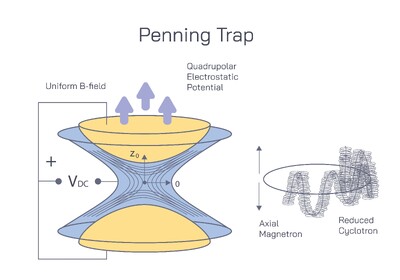
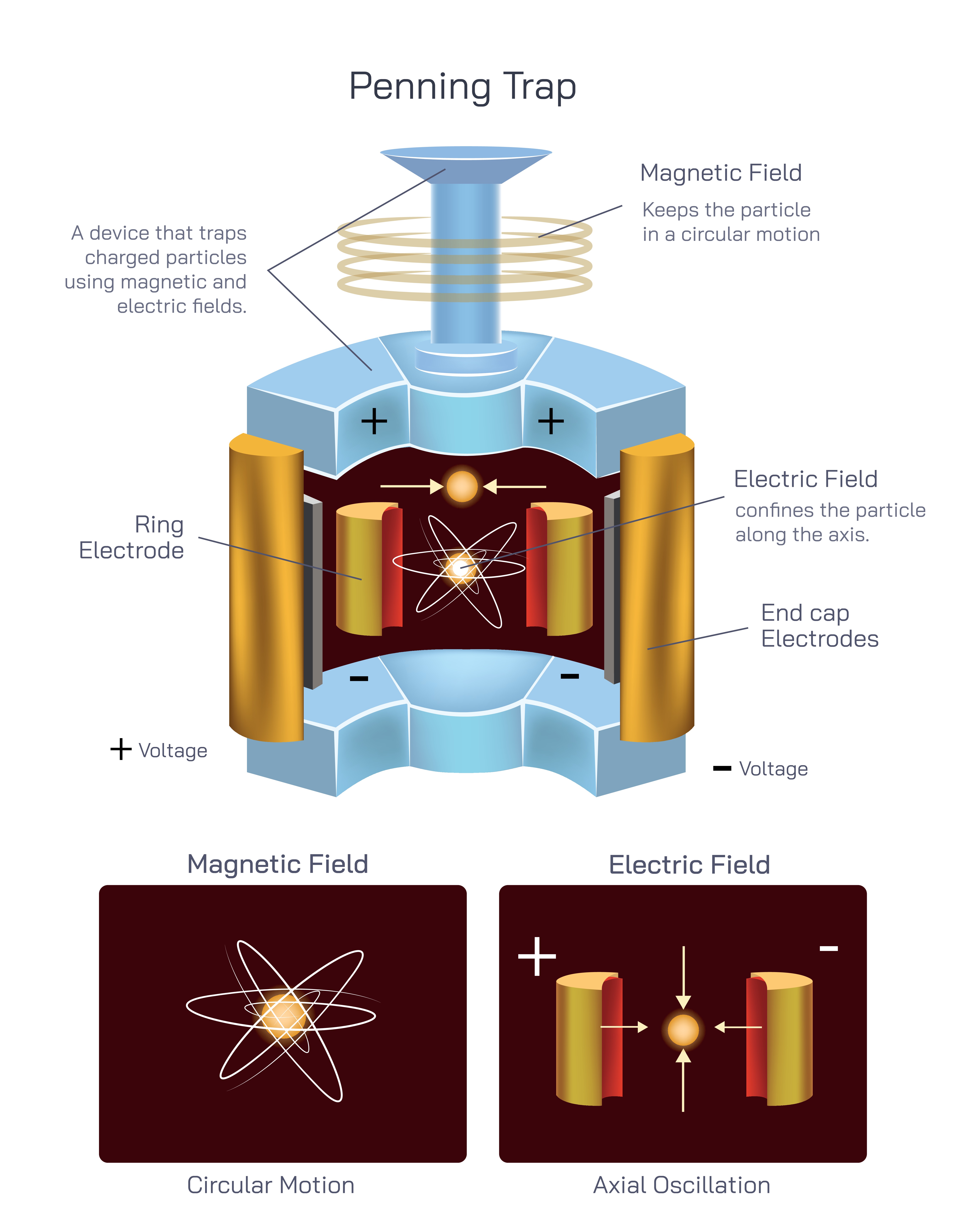
Structurally, a Penning trap consists of three main electrodes arranged symmetrically: a ring electrode and two end-cap electrodes. These electrodes are typically placed inside a high-vacuum chamber to eliminate collisions with air molecules, which could disturb the trapped particles. A strong, uniform magnetic field is applied along the central axis of the trap, usually generated by a powerful superconducting magnet. This magnetic field is constant in time and provides radial confinement of the charged particles.
The electric field in a Penning trap is created by applying a voltage difference between the ring electrode and the two end-cap electrodes. This produces an electric quadrupole field that confines particles along the axial direction. The electric field pushes charged particles back toward the center whenever they move too far along the axis of the trap. Together, the magnetic and electric fields create a stable three-dimensional confinement region.
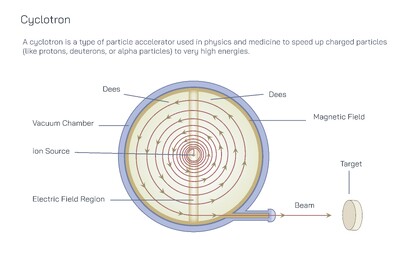
To understand how the Penning trap works in detail, it is helpful to examine the motion of a charged particle inside it. When a charged particle enters the trap, the magnetic field forces it to move in a circular path perpendicular to the field direction. This motion, known as cyclotron motion, keeps the particle from moving outward and escaping radially. The radius and frequency of this circular motion depend on the particle’s charge and mass, making the Penning trap especially useful for precise mass measurements.
In addition to cyclotron motion, the particle also experiences a slower radial motion called magnetron motion. This motion arises from the interaction between the electric and magnetic fields and causes the particle to drift slowly around the center of the trap. The combination of cyclotron motion and magnetron motion ensures stable radial confinement over long periods.
Along the axis of the trap, the electric field dominates particle behavior. When a charged particle moves toward one of the end-cap electrodes, the electric field pushes it back toward the center. This results in an oscillatory motion along the axis, known as axial oscillation. The frequency of this oscillation depends on the strength of the electric field and the particle’s properties. The superposition of axial oscillation, cyclotron motion, and magnetron motion creates a complex but stable trajectory that keeps the particle confined.
One of the most important features of a Penning trap is its ability to confine particles for extremely long times, ranging from seconds to months. Because the particles do not touch any material surface, energy loss is minimal, and external disturbances are greatly reduced. This makes the Penning trap ideal for high-precision experiments where even tiny perturbations could affect the results.
Penning traps are widely used in mass spectrometry to measure the masses of ions with extraordinary accuracy. By analyzing the cyclotron frequency of a trapped ion in a known magnetic field, scientists can determine its mass-to-charge ratio with extreme precision. This has important applications in chemistry, nuclear physics, and the study of fundamental constants. Accurate mass measurements help refine atomic models and improve our understanding of matter at the most basic level.
In fundamental physics research, Penning traps are used to study the properties of elementary particles and antiparticles. By trapping particles such as protons, electrons, or their antimatter counterparts, researchers can compare their properties in detail. These experiments test fundamental symmetries of nature and help verify theoretical predictions. The stability and precision of the Penning trap make it one of the most powerful tools for such investigations.
Penning traps are also used in precision spectroscopy, where the energy levels of trapped ions are measured with great accuracy. This allows scientists to probe quantum mechanical effects and test theories related to atomic structure. In plasma physics, Penning traps help study confined charged particle systems under controlled conditions, contributing to a deeper understanding of collective particle behavior.
The working environment of a Penning trap is carefully controlled. Ultra-high vacuum conditions are maintained to prevent unwanted interactions, and temperature stability is ensured to reduce noise. Advanced detection systems are used to monitor particle motion without disturbing the trap. These systems can detect tiny electrical signals induced by the motion of charged particles, allowing precise measurements without direct observation.
In summary, a Penning trap is a highly specialized device designed to confine charged particles using a combination of static magnetic and electric fields. The magnetic field provides radial confinement through circular particle motion, while the electric field ensures axial stability through oscillatory behavior. Together, these fields create a stable trapping environment that enables long-term confinement and precise measurement of particle properties. Penning traps are essential tools in modern physics, supporting research in mass spectrometry, atomic and particle physics, quantum studies, and fundamental constant determination. Their ability to isolate and control charged particles with exceptional precision makes them one of the most important experimental instruments in advanced scientific research.