The classical cyclotron represents one of the most significant technological breakthroughs in the history of physics, marking the beginning of controlled high-energy particle acceleration. Before its invention, scientists had no practical way to propel charged particles to sufficiently high speeds to probe the structure of atomic nuclei or induce nuclear reactions in a laboratory setting. By combining magnetic fields and alternating electric fields into a compact, cyclic design, the classical cyclotron transformed the landscape of nuclear research, medicine and materials science, allowing experiments that were once only theoretical to become real.
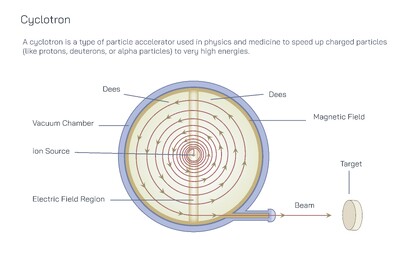
The cyclotron is based on the elegant relationship between magnetic force and electric force. When a charged particle moves through a magnetic field, it experiences a sideways force that bends its path into a circular arc. When a charged particle crosses a region of electric field, it accelerates and gains kinetic energy. The classical cyclotron unifies these two effects into a repeating cycle of bending and acceleration. The device consists of two hollow, semi-circular metal chambers shaped like the letter “D,” known as dees, mounted face to face with a narrow gap between them. The dees sit inside a vacuum chamber to remove air resistance and are placed between the poles of a powerful magnet so that a uniform magnetic field passes perpendicularly through them.
When the cyclotron operates, a charged particle—commonly a proton or alpha particle—is injected near the center of the apparatus. A radio-frequency power source delivers an alternating electric potential across the gap between the two dees. Each time the particle crosses that gap, the electric field accelerates it. Inside the hollow region of the dees, the electric field is absent, so the particle experiences only the magnetic force and follows a semicircular path. Because the particle gains speed with each acceleration pulse, the radius of its circular path becomes progressively larger. This causes the particle to spiral outward along an expanding trajectory until it reaches the edge of the cyclotron, where a deflector electrode finally extracts the beam and directs it toward a target.
One of the most brilliant features of the classical cyclotron is the phenomenon of frequency resonance. As long as the particle remains at nonrelativistic speeds, the time it takes to traverse a semicircle depends only on the magnetic field strength and the particle’s mass-to-charge ratio—not on how fast the particle is traveling. This means the cyclotron can operate at a fixed radio-frequency that always accelerates the particle at exactly the right moment when it crosses the gap. There is no need to adjust the timing during acceleration; the physical design automatically synchronizes electric pulses with particle motion. For this reason, the classical cyclotron produces rapid, repeated acceleration, building particle energy efficiently within a relatively small space.
The vacuum system inside the cyclotron is essential for maintaining particle momentum. Without a vacuum, particles would collide with air molecules and lose energy quickly, preventing meaningful acceleration. The magnetic field strength, radio-frequency of the alternating electric field, dee voltage and cyclotron radius collectively determine the maximum kinetic energy the device can impart to charged particles. Once the particles reach the outer edge, the beam is extracted and can be used to bombard targets for research or production purposes.
The earliest cyclotrons were built during the 1930s and quickly became revolutionary scientific instruments. They enabled researchers to study the nucleus by firing accelerated particles into target materials, initiating nuclear reactions. New elements and isotopes were discovered using cyclotron beams, and the field of nuclear physics became experimental rather than purely theoretical. The ability to accelerate particles gave scientists access to a deeper understanding of matter, radiation and nuclear forces.
It did not take long for cyclotron technology to extend from scientific discovery into medicine. By directing accelerated particles onto specific target materials, cyclotrons can produce radioisotopes that are vital for medical imaging and cancer therapy. Hospitals now rely on compact cyclotrons for producing isotopes used in PET scans and targeted radiotherapy. In this way, the classical cyclotron became both a tool for understanding nature and a tool for saving lives. Today, thousands of people worldwide benefit from cancer diagnostics and treatment made possible by cyclotron-generated radioisotopes.
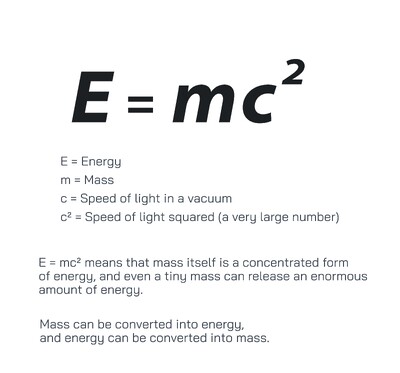
Despite its remarkable capabilities, the classical cyclotron faces limitations rooted in relativity. As a particle approaches extremely high velocity, its effective mass increases. Once the particle becomes sufficiently relativistic, its circular motion no longer matches the fixed radio-frequency of the accelerating electric field. The particle passes the gap later than expected, losing synchronization and thus ceasing to accelerate efficiently. For this reason, classical cyclotrons cannot accelerate particles beyond moderate energies. Scientists later designed the synchrocyclotron, which varies radio-frequency during acceleration, and the isochronous cyclotron, which adjusts magnetic field distribution to preserve resonance even at high speeds. These later innovations paved the way for the massive modern accelerators used in today’s high-energy research.
Nonetheless, the classical cyclotron remains a scientifically and historically irreplaceable invention. Its design captures the essence of engineering efficiency—using simple physical laws to achieve powerful results. Even now, classical cyclotrons continue to serve in research environments where compact size, reliability and moderate energies are sufficient for experimental goals or isotope production. They also play a major role in physics education, providing students with a visible and intuitive demonstration of the interplay between magnetic forces, electric fields and particle motion.
The legacy of the classical cyclotron reaches far beyond its physical design. It marks the moment when human curiosity about the atomic world transitioned into hands-on experimental capability. It stands as the foundation of modern particle-accelerator development, ultimately leading to the enormous synchrotrons and colliders that explore the deepest layers of matter. Whether used to unlock nuclear physics, generate lifesaving isotopes or teach new generations of scientists, the classical cyclotron remains a powerful symbol of discovery—proving that even the smallest magnetized chamber can reshape our understanding of the universe.