Ocean waves are one of the most visible and dynamic natural movements on Earth, constantly shaping coastlines and influencing marine environments. Their rolling motion across the sea surface appears simple at first glance, yet ocean waves are the result of complex interactions between wind, water, gravity, and the shape of the seafloor. Understanding the characteristics of ocean waves, their formation, and how they continue moving over long distances reveals the powerful processes that operate within the world’s oceans.
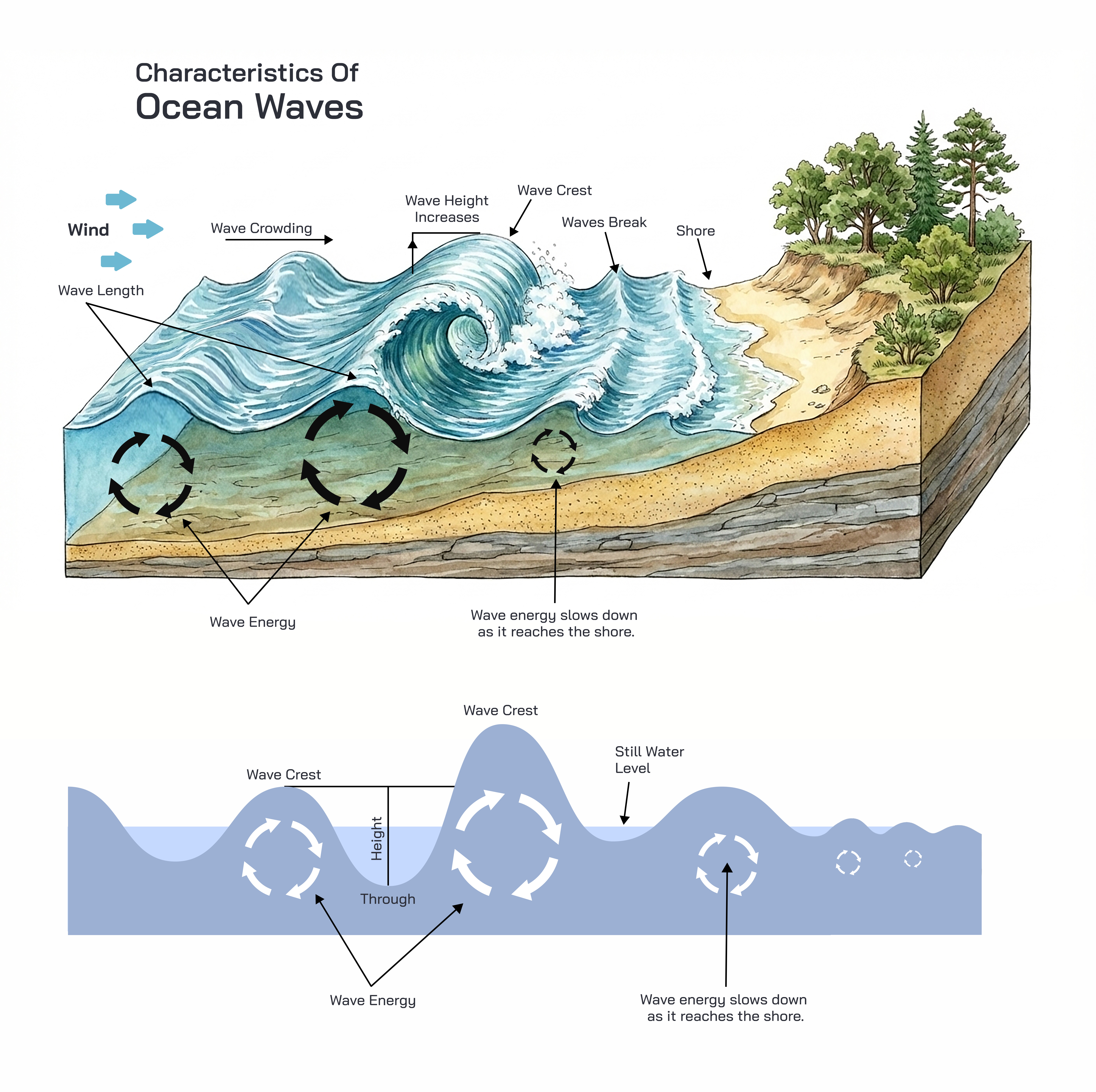
The most noticeable characteristic of ocean waves is their rhythmic rise and fall, which creates the familiar pattern of crests and troughs across the water surface. A crest represents the highest point of a wave, while a trough is the lowest point between two crests. The vertical distance between a crest and a trough defines wave height, which is often associated with the perceived strength or roughness of the sea. Larger wave heights usually indicate stronger winds or storms occurring either locally or far out at sea.
Another defining feature of ocean waves is wavelength, which refers to the horizontal distance between two consecutive crests. Closely spaced crests indicate shorter wavelengths, while widely spaced crests represent longer wavelengths. Along with wavelength, wave period plays a crucial role in wave behavior. The period is the time it takes for two successive crests to pass a fixed point. Waves with longer periods tend to carry more energy and travel farther without losing strength, making them particularly influential when they reach coastlines.
Ocean waves form primarily due to the action of wind blowing across the surface of the sea. As wind moves over water, friction transfers energy from the air to the water surface. This energy causes small ripples to appear, which gradually grow into larger waves as wind speed increases. The size and strength of waves depend on three main factors: wind speed, the duration of the wind, and the distance over which the wind blows, known as fetch. Stronger winds blowing for longer periods over greater distances produce larger and more powerful waves.
Once formed, ocean waves do not transport water forward in the same way as a flowing current. Instead, energy moves through the water while individual water particles follow circular or elliptical paths. In deep water, these circular motions decrease rapidly with depth, meaning that wave energy is concentrated near the surface. This is why deep ocean waves can travel thousands of kilometers across the sea without significantly disturbing deeper water layers.
As ocean waves move away from their area of formation, they often organize into smooth, uniform wave groups known as swells. Swell waves are typically generated by distant storms and can travel across entire ocean basins. These waves are characterized by long wavelengths, consistent spacing, and a steady appearance. Their ability to maintain energy over long distances demonstrates the efficiency of wave energy transfer across open oceans.
The continuation of wave motion becomes especially noticeable as waves approach shallow coastal waters. When waves begin to interact with the seabed, their behavior changes dramatically. The lower part of the wave slows down due to friction with the ocean floor, while the upper part continues moving at its original speed. This causes the wave to increase in height and become steeper, a process known as wave shoaling. At this stage, wave energy becomes more concentrated, and the wave shape transforms visibly.
As the wave steepens further, it eventually reaches a point where it can no longer support itself and breaks. Breaking waves release energy in the form of surf, which plays a major role in shaping coastlines. This breaking action contributes to coastal erosion, sediment transport, and beach formation. The location and intensity of wave breaking depend on factors such as wave height, wave period, and the slope of the seabed.
Despite breaking near the shore, the motion of ocean waves does not abruptly end. After breaking, wave energy continues to move landward as swash and backwash, pushing water up the beach and pulling it back toward the sea. This repeated motion redistributes sand and sediment along the shoreline, constantly reshaping coastal landscapes. Over time, this continuous interaction between waves and land leads to the formation of beaches, sandbars, and coastal features.
Ocean waves also exhibit characteristics such as refraction and diffraction, which influence how they travel around obstacles and across varying depths. Refraction occurs when parts of a wave slow down in shallow water while other parts remain faster in deeper water, causing the wave to bend. This process helps distribute wave energy along the coastline rather than focusing it in a single area. Diffraction allows waves to spread out after passing through narrow openings or around barriers, further demonstrating their dynamic nature.
The continuous movement of ocean waves is ultimately driven by gravity. After wind transfers energy to the water surface, gravity acts to restore the water to equilibrium, creating the oscillating motion that defines waves. Even when the wind stops, gravity continues to sustain wave motion, allowing waves to travel far from their point of origin. Over long distances, wave energy gradually dissipates due to friction, turbulence, and interaction with the atmosphere and seabed.
Ocean waves are among the most powerful and persistent natural phenomena on Earth, continuously shaping coastlines, influencing weather patterns, and regulating energy exchange between the atmosphere and the oceans. Although waves appear as simple rolling motions on the sea surface, they are the visible expression of complex physical processes involving wind, gravity, water depth, Earth’s rotation, and seafloor topography. A deeper understanding of ocean waves reveals how energy travels vast distances across the planet and how this energy interacts with marine and coastal environments over both short and geological timescales.
At their core, ocean waves are disturbances that transfer energy across the surface of the water rather than transporting water itself. The familiar up-and-down motion is created by oscillating water particles that move in circular or elliptical paths. Near the surface, these circular motions are largest, gradually diminishing with depth. In deep ocean waters, wave motion becomes negligible beyond a certain depth, known as wave base, which is typically about half the wavelength. This explains why large waves at the surface do not disturb deep-sea organisms or sediments far below.
The structure of an ocean wave includes several key components beyond crests and troughs. Wave height, wavelength, and period together define a wave’s energy and behavior. Wave speed is closely related to wavelength and water depth. In deep water, longer wavelengths travel faster than shorter ones, allowing waves to naturally organize themselves as they move away from storm systems. This sorting effect is why distant swells arriving at coastlines often appear smooth, evenly spaced, and powerful, even when local winds are calm.
Wind-generated waves dominate most ocean surfaces. Their formation begins when wind blowing across the water creates friction, producing tiny ripples known as capillary waves. These small ripples increase surface roughness, allowing the wind to transfer more energy to the water. As wind speed, duration, and fetch increase, waves grow larger and more organized. Fetch is particularly important because it determines how long waves have to absorb energy. Open oceans with long fetch distances produce the largest waves on Earth.
Not all ocean waves are created by wind. Some waves originate from sudden disturbances such as underwater earthquakes, volcanic eruptions, or landslides. These events generate seismic sea waves, commonly known as tsunamis. Unlike wind waves, tsunamis have extremely long wavelengths and travel at very high speeds across the ocean, often unnoticed in deep water. Their destructive power becomes evident only when they reach shallow coastal areas, where their height increases dramatically due to wave shoaling.
Another important category of waves includes tidal waves, which are driven by gravitational interactions between the Earth, Moon, and Sun. While often confused with tsunamis, tidal waves are fundamentally different and operate on much longer time scales. Internal waves also exist beneath the ocean surface, forming along density boundaries between layers of water with different temperatures and salinity. Though invisible from above, internal waves play a critical role in ocean mixing and nutrient transport.
As waves approach coastlines, their interaction with decreasing water depth alters their behavior significantly. Wave shoaling causes waves to slow down, shorten in wavelength, and increase in height. This concentration of energy leads to breaking waves, which occur when the wave crest moves faster than the base can support. Different types of breaking waves form depending on seabed slope. Gentle slopes create spilling breakers, while steep slopes result in plunging or surging breakers. Each type has distinct effects on sediment movement and coastal erosion.
Wave breaking is one of the primary forces shaping coastal landscapes. The energy released during breaking erodes cliffs, redistributes sand, and forms beaches, sandbars, and coastal terraces. Longshore currents generated by waves approaching the shore at an angle transport sediment parallel to the coastline, gradually reshaping beaches over time. This process explains why some beaches grow while others erode, even along the same stretch of coast.
Ocean waves also demonstrate complex behaviors such as refraction, diffraction, and interference. Refraction causes waves to bend as they slow down in shallow water, aligning wave crests more parallel to the shoreline. This spreads energy more evenly along the coast and helps protect certain areas from intense erosion. Diffraction allows waves to spread out after passing through gaps or around obstacles such as islands, harbors, or breakwaters. Interference occurs when waves intersect, combining to form larger or smaller waves depending on their phase relationship.
Beyond coastal shaping, ocean waves play a vital role in Earth’s climate system. Waves enhance the exchange of gases between the ocean and atmosphere, influencing oxygen and carbon dioxide transfer. They contribute to ocean mixing, helping distribute heat and nutrients throughout the upper layers of the sea. This mixing supports marine ecosystems by bringing nutrients from deeper waters to the surface, where they fuel phytoplankton growth, forming the base of the marine food web.
Ocean waves are also an important source of renewable energy. Wave energy contains significant power due to the density of water and the persistence of wave motion. Many coastal regions are exploring wave energy converters to harness this natural movement for electricity generation. Although technological challenges remain, wave energy represents a promising and environmentally friendly resource for the future.
Human interaction with ocean waves is deeply rooted in history and culture. Waves have shaped navigation, fishing practices, coastal settlement, and recreation. Surfing, sailing, and maritime trade all depend on an understanding of wave behavior. At the same time, waves pose natural hazards. Storm surges, rogue waves, and coastal flooding threaten lives and infrastructure, particularly as sea levels rise due to climate change.
The continuous motion of ocean waves ultimately reflects a balance between energy input and dissipation. Wind supplies energy, gravity organizes it into oscillatory motion, and friction gradually dissipates it through turbulence, breaking, and interaction with the seabed. Even when waves fade, their influence remains embedded in the shape of coastlines, the distribution of sediments, and the functioning of marine ecosystems.
Ocean waves are far more than surface ripples rolling across the sea; they are powerful carriers of energy that link the atmosphere, oceans, and land into one continuous system. Their constant motion reflects the balance between wind energy, gravitational forces, Earth’s rotation, and the physical structure of the ocean basin. By examining ocean waves in greater depth, it becomes clear that they influence not only coastlines and marine life but also global climate patterns, weather systems, navigation, and human civilization itself.
At a fundamental level, ocean waves represent the ocean’s response to disturbances. While wind is the most common cause, the ocean behaves like a massive energy reservoir that absorbs, stores, and redistributes motion across vast distances. Once energy is transferred from wind to water, waves become self-sustaining systems governed primarily by gravity. Gravity continually attempts to restore the disturbed water surface to equilibrium, resulting in oscillations that propagate outward as waves. This interaction between wind input and gravitational restoration is what gives waves their characteristic rhythm and persistence.
Water particles within waves do not travel long distances horizontally. Instead, they move in circular or elliptical orbits, returning close to their original position after each wave passes. Near the surface, these orbits are nearly circular, while deeper below, they flatten into elongated ellipses and eventually disappear. This explains why floating objects such as buoys bob up and down rather than drifting rapidly across the ocean. The energy of the wave moves forward, but the water itself largely stays in place, highlighting the distinction between wave motion and ocean currents.
Ocean waves are commonly classified based on their origin and behavior. Wind waves are generated directly by local winds and tend to be irregular, short-period, and chaotic. As these waves travel away from their source, they evolve into swells, which are smoother, more organized wave systems with longer wavelengths and periods. Swells can travel thousands of kilometers with minimal energy loss, often reaching distant coastlines days after the storms that created them have dissipated. This long-range energy transport demonstrates the efficiency of wave motion across open oceans.
Beyond wind-driven waves, other wave types play significant roles in ocean dynamics. Tsunamis are generated by sudden vertical displacement of large volumes of water, usually due to underwater earthquakes or landslides. Unlike wind waves, tsunamis involve the movement of the entire water column from the surface to the seabed. Their immense wavelengths allow them to travel at jet-like speeds across deep oceans. While barely noticeable offshore, they become devastating near coastlines as shallow water forces them to grow in height.
Internal waves occur beneath the ocean surface along boundaries between water layers of different density, caused by variations in temperature and salinity. Although invisible from above, these waves can be larger than surface waves and are essential for mixing nutrients and regulating ocean circulation. Tidal waves, driven by gravitational interactions between Earth, the Moon, and the Sun, operate on predictable cycles and influence coastal water levels, estuaries, and marine ecosystems.
As waves approach shorelines, their interaction with the seafloor transforms them dramatically. Decreasing water depth causes waves to slow, shorten, and increase in height through a process called shoaling. This process concentrates wave energy, making nearshore waves far more powerful than those in deep water. Eventually, the wave crest becomes unstable and collapses, releasing energy as a breaking wave. The form of breaking depends on seabed slope, producing spilling, plunging, or surging breakers, each with different erosional impacts.
Wave action is a dominant force in shaping coastlines. The repetitive impact of breaking waves erodes rocky cliffs, while sediment transport redistributes sand along beaches. Longshore drift, created when waves strike the shore at an angle, moves sediment parallel to the coastline and reshapes beaches over time. Seasonal changes in wave energy can dramatically alter coastal profiles, building beaches during calm periods and eroding them during storms. Over geological timescales, wave action contributes to the formation of bays, headlands, barrier islands, and coastal plains.
Ocean waves also interact with coastal and offshore structures, influencing engineering and human activity. Harbors, breakwaters, and seawalls are designed to manage wave energy through reflection, refraction, and dissipation. Poorly designed structures can amplify wave forces and worsen erosion, demonstrating the importance of understanding wave behavior in coastal planning. Offshore platforms, ships, and renewable energy installations must also withstand constant wave loading, making wave dynamics a critical consideration in marine engineering.
From an ecological perspective, waves play a vital role in sustaining marine life. Wave-driven mixing brings oxygen into surface waters and distributes nutrients essential for plankton growth. In coastal zones, waves influence habitat structure, shaping coral reefs, rocky shores, and sandy bottoms. Many marine organisms have evolved to withstand or exploit wave energy, using it for feeding, reproduction, or dispersal. Intertidal ecosystems, in particular, are defined by wave exposure, with species adapted to either high-energy or sheltered environments.
Ocean waves are also deeply connected to Earth’s climate system. By enhancing air–sea exchange, waves influence the transfer of heat, moisture, and gases between the ocean and atmosphere. This exchange affects weather patterns, storm development, and long-term climate regulation. Waves contribute to the formation of sea spray aerosols, which play a role in cloud formation and atmospheric chemistry. In this way, wave activity indirectly influences global temperature and precipitation patterns.
Human societies have always been shaped by ocean waves. Historically, waves determined navigation routes, ship design, and maritime trade. Coastal cultures learned to read wave patterns for fishing, travel, and survival. In modern times, waves are both a source of recreation and risk. Surfing, sailing, and coastal tourism depend on predictable wave conditions, while extreme waves and storm surges pose serious threats to coastal populations. Climate change and rising sea levels are intensifying these risks by increasing wave-driven flooding and erosion.
Ocean waves also represent a growing opportunity for renewable energy. Wave energy is highly concentrated and predictable in many regions, making it an attractive alternative energy source. Technologies designed to convert wave motion into electricity aim to harness this constant movement with minimal environmental impact. Although still developing, wave energy has the potential to contribute significantly to sustainable energy systems in coastal nations.
In essence, ocean waves are a dynamic expression of energy in motion, linking atmospheric forces with oceanic and terrestrial systems. They shape coastlines, sustain ecosystems, influence climate, and impact human activity on multiple scales. From gentle swells rolling across open seas to powerful breakers crashing onto shorelines, waves embody the continuous interaction between wind, water, gravity, and Earth’s structure. Understanding ocean waves is not only a matter of scientific curiosity but a necessity for managing coastal environments, protecting communities, and appreciating the powerful natural processes that shape our planet every moment.
In summary, ocean waves are far more than surface-level movements of water. They are dynamic carriers of energy that connect the atmosphere, oceans, and land in a continuous exchange. From their formation by wind and gravity to their transformation near coastlines and their role in climate regulation, waves are fundamental to Earth’s natural systems. Understanding ocean waves provides insight into coastal processes, marine life, renewable energy potential, and the powerful forces that shape our planet every day. Ocean waves are defined by characteristics such as height, wavelength, period, and energy. They form when wind transfers energy to the sea surface and continue moving as energy waves rather than flowing water. Their journey from open ocean to shoreline involves transformation through shoaling, breaking, and coastal interaction. This continuous process highlights the powerful role ocean waves play in shaping marine environments, influencing coastlines, and maintaining the dynamic balance of Earth’s ocean systems.