Types of Fractions: Proper, Improper, Mixed, and Equivalent Fractions Explained
Fractions are a fundamental concept in mathematics that represent parts of a whole. Understanding the types of fractions is essential for learning arithmetic, problem-solving, and advanced mathematical operations. Fractions consist of a numerator (the top number) representing the part and a denominator (the bottom number) representing the total number of equal parts in the whole. Fractions are categorized into different types based on the relationship between the numerator and denominator and how they are represented.
1. Proper Fractions:
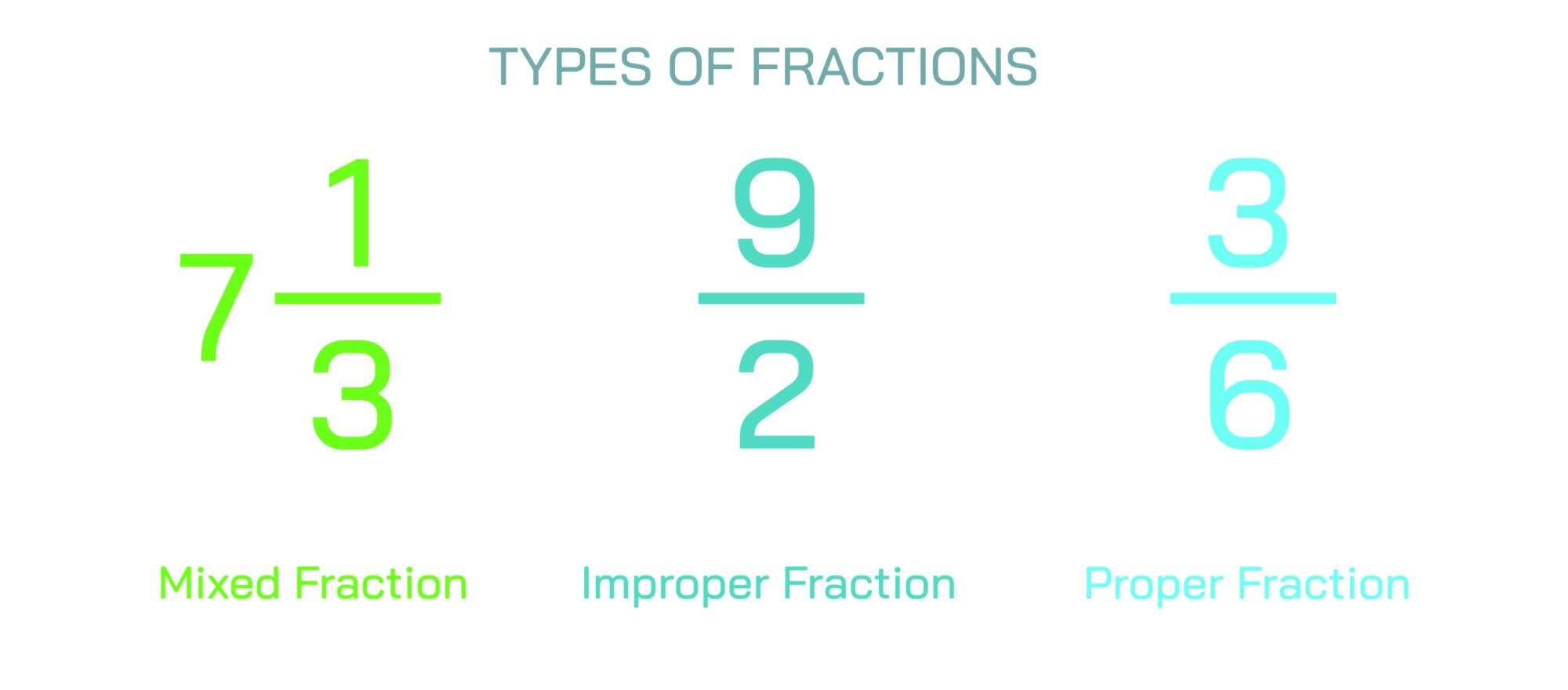
A proper fraction is a fraction where the numerator is smaller than the denominator, meaning the value is less than one. Examples include 3/4, 5/8, and 2/5. Proper fractions are used to represent parts of a whole in everyday life, such as slices of a pizza or segments of a pie chart.
2. Improper Fractions:
An improper fraction has a numerator equal to or greater than the denominator, resulting in a value equal to or greater than one. Examples include 7/4, 9/3, and 5/5. Improper fractions are often converted into mixed fractions for easier interpretation in practical applications.
3. Mixed Fractions:
A mixed fraction combines a whole number and a proper fraction. For example, 1 3/4 or 2 5/6. Mixed fractions are useful in measurements, cooking, and everyday calculations where quantities exceed a single whole unit.
4. Equivalent Fractions:
Equivalent fractions represent the same value even though the numerator and denominator are different. For instance, 1/2 is equivalent to 2/4, 3/6, or 50/100. Recognizing equivalent fractions is essential for simplification, comparison, and performing operations such as addition or subtraction of fractions.
Applications and Importance:
Understanding different types of fractions helps in arithmetic operations, algebra, geometry, and data interpretation. Fractions are widely used in measurement, finance, statistics, and scientific calculations, making this knowledge practical beyond the classroom. Learning fractions visually through diagrams, charts, and vector illustrations reinforces comprehension and ensures students can quickly identify, compare, and convert fractions.
In conclusion, knowing the types of fractions—proper, improper, mixed, and equivalent—provides a foundation for mathematical literacy, problem-solving, and numerical reasoning. Mastery of these fractions equips learners with essential skills for academic success and practical applications in everyday life, from cooking and shopping to measurements and data analysis.