Order of Operations in Mathematics Explained: BODMAS and PEMDAS Rules Illustrated
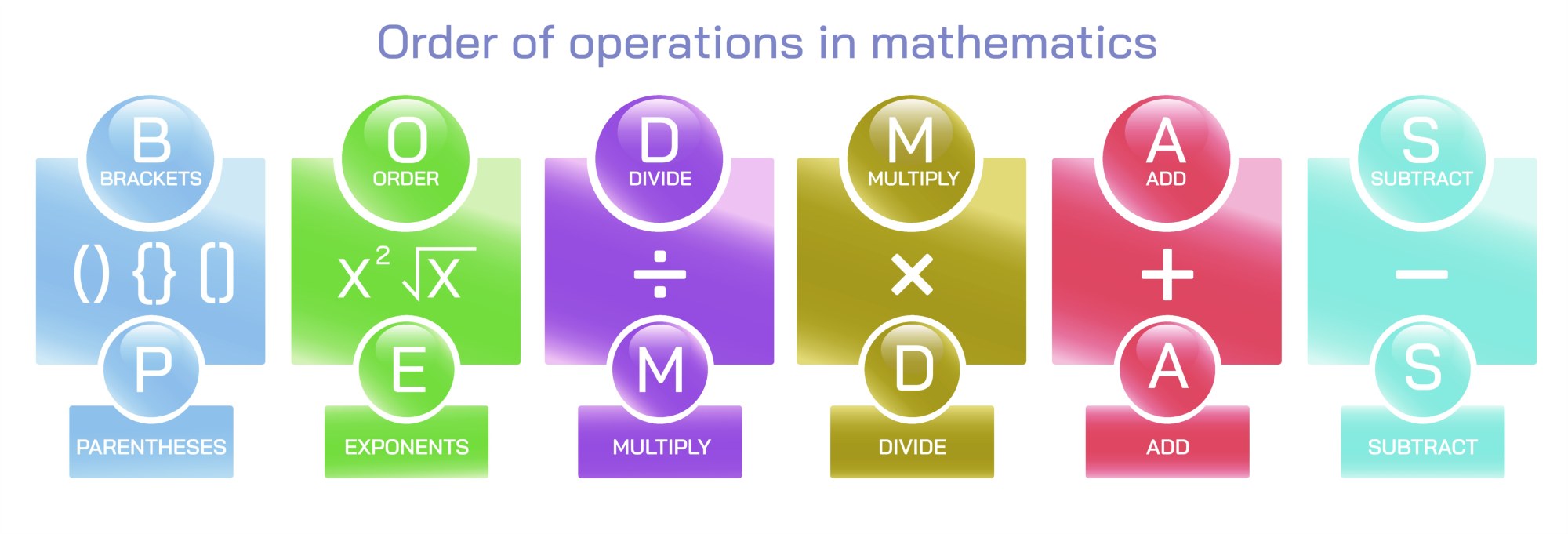
The order of operations is a foundational concept in mathematics that determines the sequence in which arithmetic operations should be performed to ensure consistent and accurate results. Without a standard hierarchy, calculations with multiple operators could yield conflicting outcomes. The BODMAS (Brackets, Orders, Division/Multiplication, Addition/Subtraction) and PEMDAS (Parentheses, Exponents, Multiplication/Division, Addition/Subtraction) rules are universally adopted conventions guiding the evaluation of mathematical expressions. A vector illustration of the order of operations typically integrates stepwise problem-solving, labeled operations, color-coded hierarchy, and example calculations, providing a visually clear and educational representation of BODMAS and PEMDAS principles. By combining labeled brackets, arithmetic symbols, and directional arrows, such illustrations allow learners to understand and apply these rules systematically in computations.
At the center of the illustration is a tiered diagram showing the hierarchical structure of operations. The highest tier represents Brackets (Parentheses), which must always be evaluated first, as they explicitly group operations to indicate priority. Labels clarify that brackets include parentheses (), square brackets [], and braces {}, emphasizing that the innermost grouping is addressed first. Arrows indicate the stepwise reduction from inner to outer brackets, visually reinforcing the concept of nested operations. Color coding may highlight the brackets in bright colors, distinguishing them from other arithmetic symbols for emphasis.
The second tier represents Orders (Exponents or Powers) or Indices, highlighting that powers and roots are evaluated after brackets. Labels indicate examples such as squares, cubes, and square roots. Vector arrows demonstrate how exponents are applied to the base values before other operations proceed. Color gradients along numbers may visualize sequential evaluation, helping learners see the flow from base calculation to exponentiation.
The third tier focuses on Division and Multiplication, performed sequentially from left to right as they appear in the expression. Labels indicate that division and multiplication are of equal priority, and learners must process them in order of appearance rather than arbitrarily prioritizing one over the other. Arrows along a sample equation demonstrate left-to-right evaluation, while color-coded highlights differentiate these operations from addition and subtraction in subsequent tiers.
The fourth and final tier emphasizes Addition and Subtraction, also performed from left to right as they occur in the expression. Labels highlight that these operations are evaluated after all higher-priority operations are complete. Arrows indicate left-to-right computation, and shaded overlays show cumulative totals after each operation. Optional insets may include examples where improper sequencing leads to incorrect results, reinforcing the necessity of following BODMAS or PEMDAS strictly.
Vector illustrations often include worked-out example problems. For instance, an expression such as 7 + (6 × 5^2 – 3) may be broken down stepwise, with arrows pointing to each operation performed in sequence according to BODMAS. Each step is labeled and color-coded: brackets first, then exponents, followed by multiplication, subtraction, and finally addition. This stepwise visualization allows learners to track the operation order, understand reasoning, and verify outcomes.
Additional features may include side-by-side BODMAS and PEMDAS comparisons, demonstrating that the rules are equivalent in practice but differ in terminology. Labels identify the corresponding terms in each mnemonic, helping learners bridge understanding across regional or curriculum variations. Arrows may connect BODMAS terms (Brackets, Orders, Division, Multiplication, Addition, Subtraction) to PEMDAS terms (Parentheses, Exponents, Multiplication, Division, Addition, Subtraction), reinforcing conceptual alignment.
Magnified insets may also show nested and complex expressions, illustrating how multiple layers of brackets, exponents, and mixed operations are resolved sequentially. Color-coded arrows, numerical highlights, and labeled steps emphasize hierarchical processing, allowing learners to tackle advanced expressions with confidence. Examples may include fractions, roots, and combined operations to demonstrate universal applicability of the rules.
By combining hierarchical tier diagrams, stepwise worked examples, labeled operations, color-coded mnemonics, and directional arrows, a vector illustration of the order of operations provides a comprehensive understanding of BODMAS and PEMDAS. Color differentiation, labeled tiers, and sequential arrows make the evaluation process visually intuitive, reinforcing the importance of adhering to established operation priorities.
Ultimately, an order of operations vector illustration demonstrates the logical and standardized approach to evaluating mathematical expressions, linking theoretical rules to practical computation. Through labeled brackets, exponents, multiplication/division, addition/subtraction, and stepwise problem-solving arrows, the diagram transforms abstract arithmetic principles into an educational, visually engaging, and intuitive tool for students, teachers, and mathematics learners.