Different Types of Slope — Positive, Negative, Zero, and Undefined
Slope is a fundamental concept in mathematics, particularly in coordinate geometry, representing the steepness or incline of a line. Understanding different types of slope is essential for analyzing linear relationships, graphing equations, and solving real-world problems involving gradients, inclines, or rates of change. Slope is defined as the ratio of the change in the vertical direction (rise) to the change in the horizontal direction (run) between two points on a line.
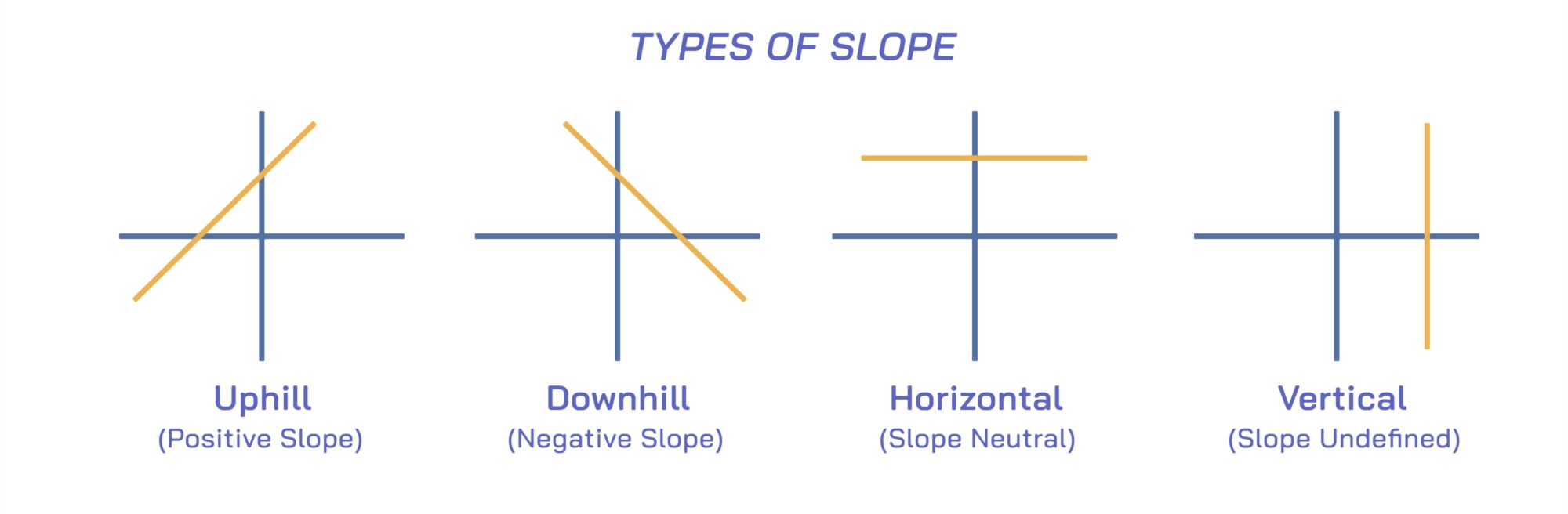
A positive slope occurs when a line rises from left to right on a graph. This indicates that as the x-coordinate increases, the y-coordinate also increases, reflecting a direct relationship between variables. Positive slopes are commonly observed in rising roads, ramps, and increasing trends in data. Conversely, a negative slope occurs when a line falls from left to right. Here, as the x-coordinate increases, the y-coordinate decreases, representing an inverse relationship. Negative slopes are found in declining roads, decreasing trends, and certain financial graphs.
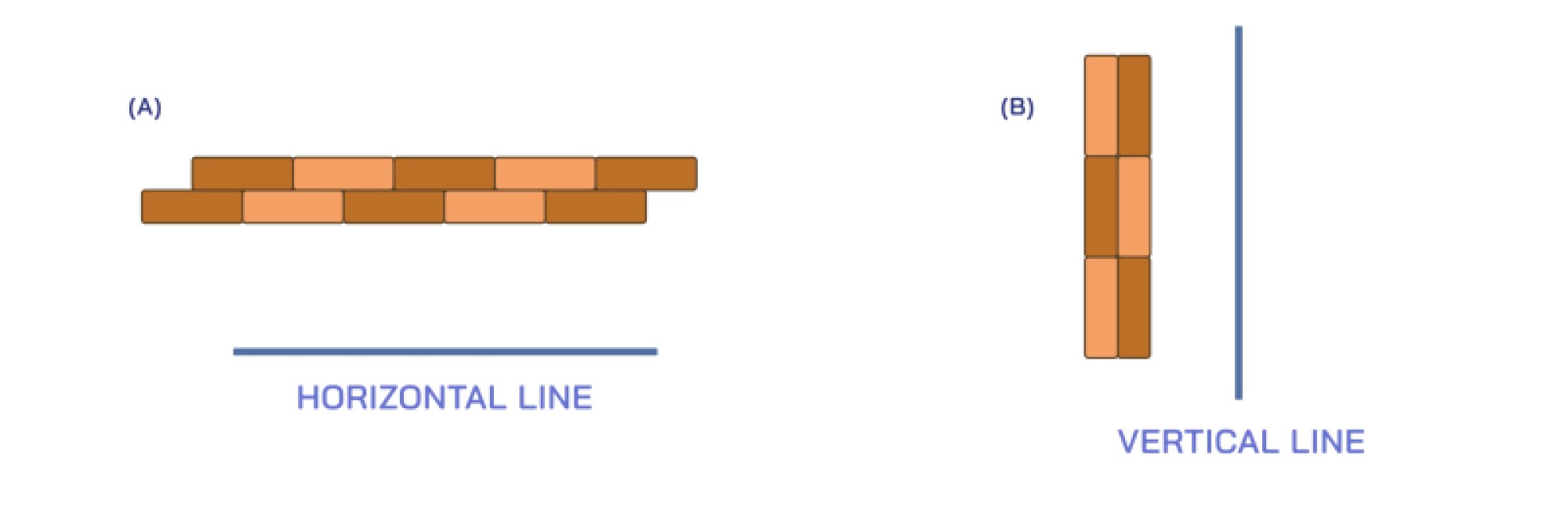
A zero slope describes a perfectly horizontal line where there is no vertical change regardless of the horizontal movement. Such lines indicate constant values, with no increase or decrease in y. Examples include level surfaces, flat roads, and constant temperature or pressure graphs. An undefined slope occurs in a perfectly vertical line where the horizontal change is zero, making the slope calculation impossible due to division by zero. Vertical slopes appear in walls, cliffs, and vertical structures in physics or engineering contexts.
Understanding slope types helps in solving algebraic equations, plotting linear functions, and interpreting graphs across science, engineering, and economics. Slope also plays a crucial role in calculus, physics, and construction, where gradient and incline analysis is necessary. Graphical representation of slope provides a visual understanding of linear relationships and rates of change, enhancing problem-solving skills.
In conclusion, the different types of slope—positive, negative, zero, and undefined—provide essential insight into the behavior of lines in coordinate geometry. Recognizing and calculating slope allows students, engineers, and scientists to interpret linear trends, design structures, analyze data, and understand relationships between variables. Mastery of slope concepts ensures a solid foundation in mathematics, supporting higher-level studies in algebra, geometry, calculus, and applied sciences.