Types of Motion in Physics: Linear, Circular, Rotational, Oscillatory, and Random Motion Explained
Motion is a fundamental concept in physics, describing the change in position of an object with respect to time. Understanding the types of motion is essential in studying kinematics, mechanics, and dynamics. Motion can be categorized based on the path followed by the object, its speed, periodicity, and the forces involved.
1. Linear Motion:
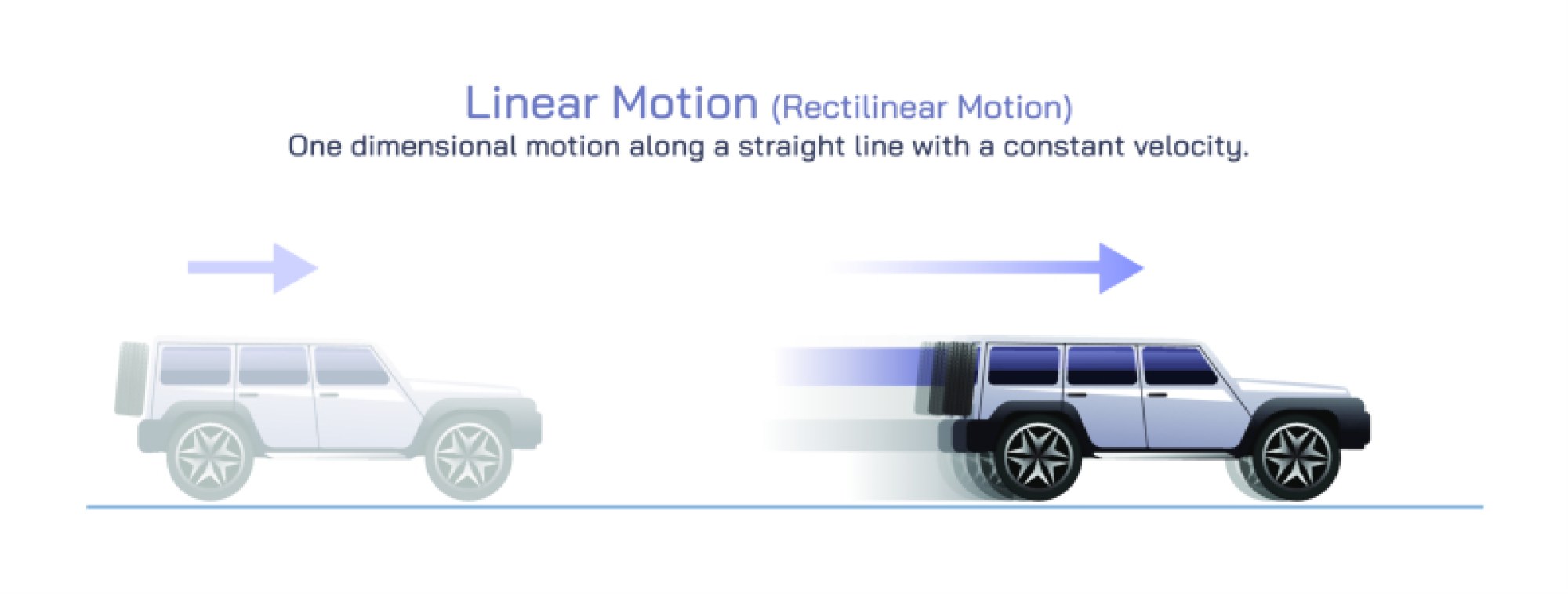
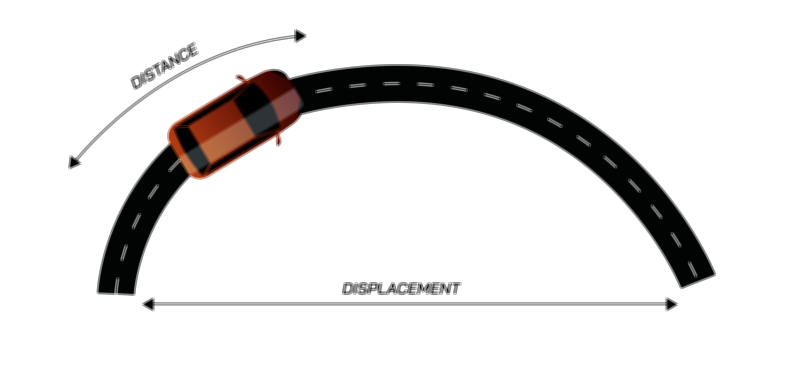
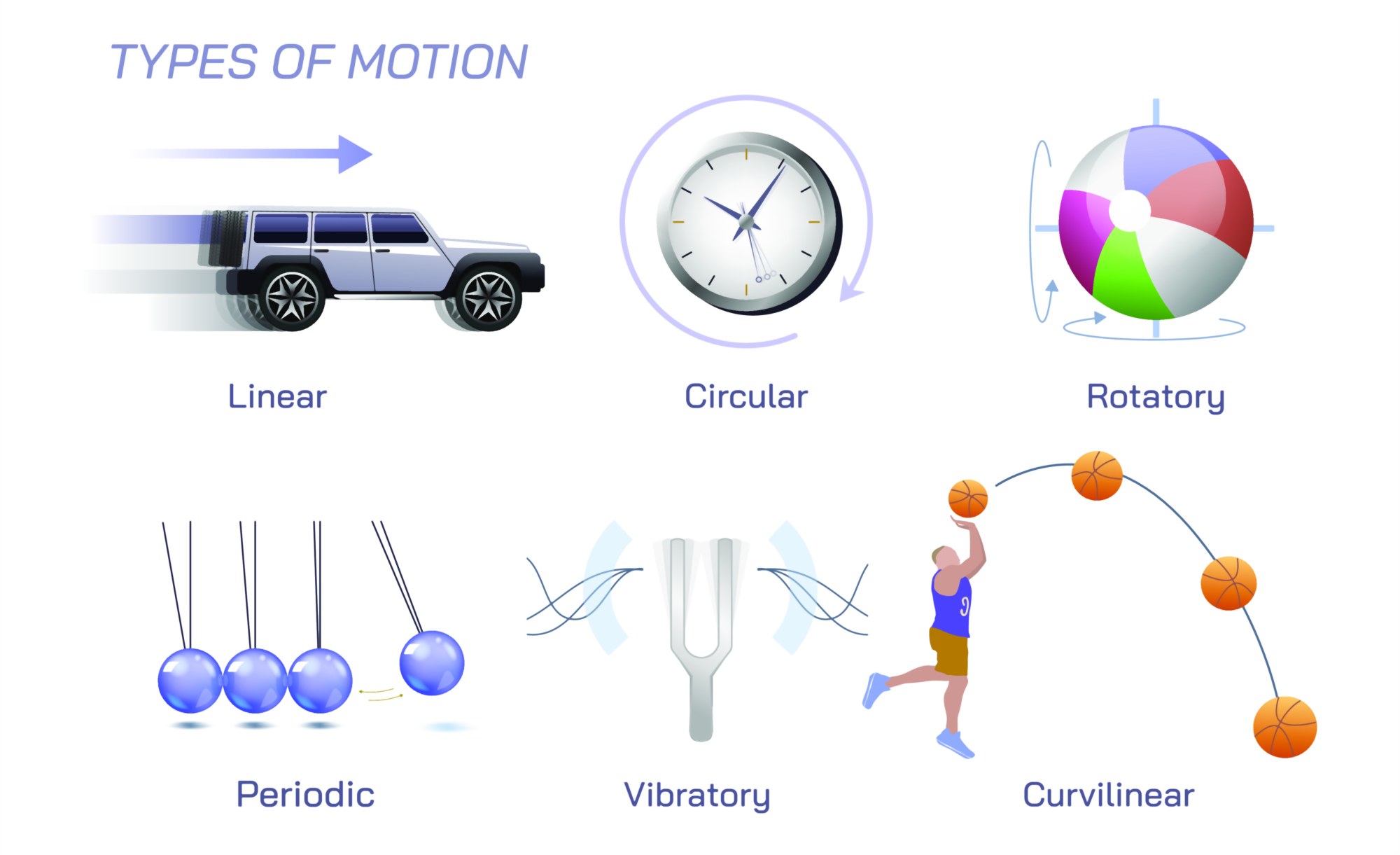
Linear motion occurs when an object moves along a straight path. It can be uniform (constant velocity) or non-uniform (changing velocity). Examples include a car moving on a straight road or a ball rolling on a flat surface. Linear motion is characterized by parameters like displacement, velocity, and acceleration, and it is foundational in understanding basic physics principles.
2. Circular Motion:
Circular motion occurs when an object moves along a circular path around a fixed point. Examples include a Ferris wheel or a satellite orbiting the Earth. Circular motion involves concepts like centripetal force, angular velocity, and radius of curvature, which are critical for understanding planetary motion, engineering systems, and rotational dynamics.
3. Rotational Motion:
Rotational motion involves the spinning of an object around its own axis. Examples include a spinning top, a rotating fan, or Earth’s rotation. Rotational motion is characterized by angular displacement, angular velocity, and angular acceleration, and is crucial in studying torque, moment of inertia, and mechanical energy in rotating systems.
4. Oscillatory Motion:
Oscillatory motion is the repeated back-and-forth motion of an object about a central equilibrium position. Examples include a pendulum, a spring-mass system, or a vibrating guitar string. Oscillatory motion is often periodic, characterized by amplitude, frequency, period, and phase, and is foundational in understanding waves, vibrations, and harmonic motion.
5. Random Motion:
Random motion refers to motion without a definite path or predictable pattern. Examples include Brownian motion of particles in a liquid or gas. Random motion is important in statistical mechanics, thermodynamics, and molecular physics, illustrating microscopic interactions and energy distribution.
Applications and Importance:
Understanding different types of motion is vital for physics experiments, engineering designs, technological applications, and daily life phenomena. Linear and circular motions are used in transportation and machinery, rotational and oscillatory motions are key in mechanical and structural systems, while random motion helps explain molecular behavior and diffusion processes. Visualizing motion through diagrams and vectors enhances comprehension and enables quantitative analysis of speed, acceleration, forces, and energy.
In conclusion, the types of motion in physics—linear, circular, rotational, oscillatory, and random—provide a complete framework for understanding how objects move in different contexts. Mastery of these motion types equips learners with the knowledge to analyze, predict, and apply physical principles in scientific, technological, and everyday scenarios, forming the foundation of classical mechanics and modern physics.