The Carnot cycle is a fundamental concept in thermodynamics that describes the most efficient possible heat engine operating between two temperature reservoirs. Named after Sadi Carnot, this theoretical cycle provides the foundation for understanding engine efficiency, energy conversion, and entropy changes. A Carnot cycle diagram visually represents the four sequential processes that make up the idealized cycle, usually plotted on a Pressure-Volume (PV) or Temperature-Entropy (TS) graph for clarity.
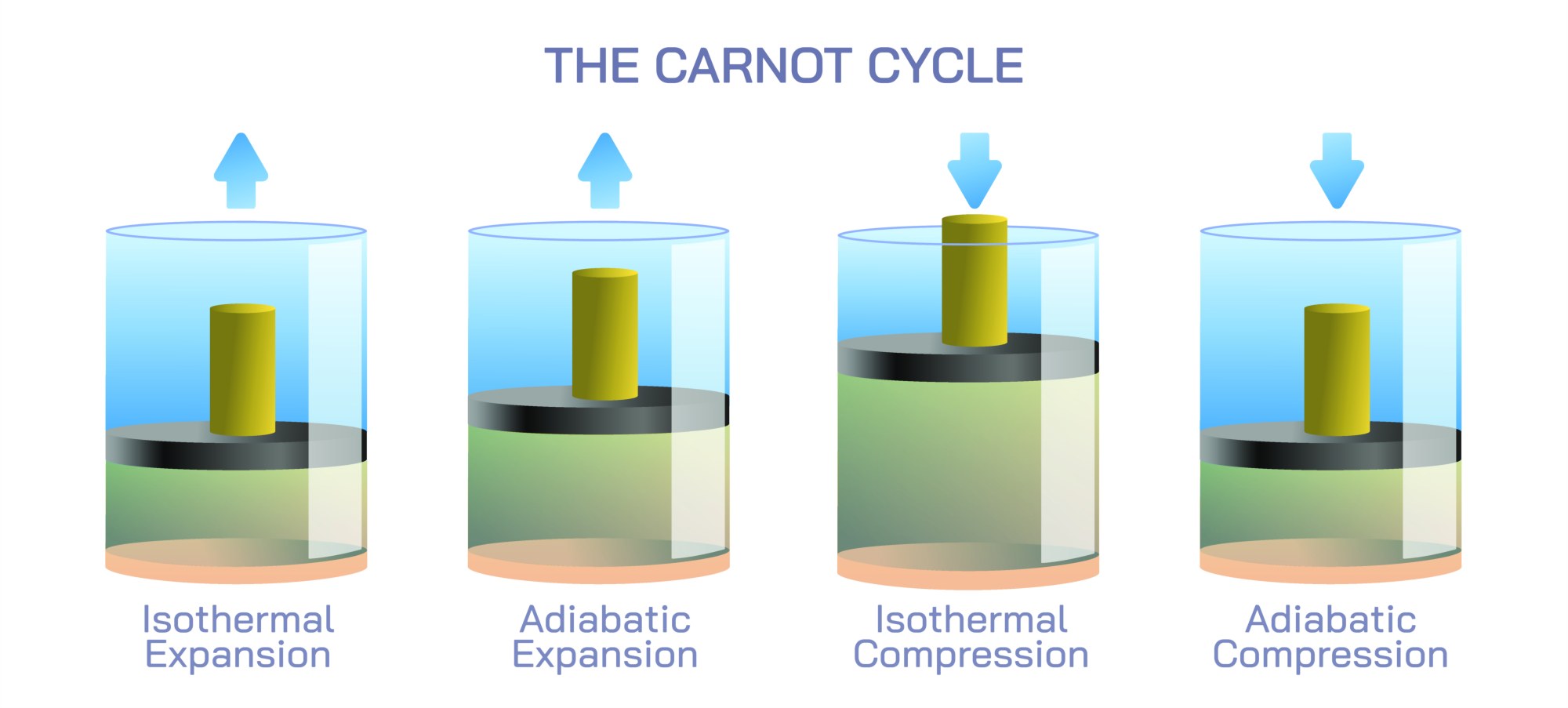
The first stage, isothermal expansion, occurs when the working substance, typically an ideal gas, absorbs heat from a high-temperature reservoir at a constant temperature. During this process, the gas expands and performs work on the surroundings while maintaining its temperature. The second stage, adiabatic expansion, follows immediately, in which the gas continues to expand without any heat exchange. As the gas does work on the surroundings, its internal energy decreases, causing the temperature to drop until it reaches that of the cold reservoir.
The third stage, isothermal compression, involves compressing the gas at a constant lower temperature, causing heat to flow out of the system into the cold reservoir. Work is done on the gas, but its temperature remains constant, allowing for reversible heat transfer. The final stage, adiabatic compression, compresses the gas further without heat exchange. During this phase, the internal energy of the gas increases, raising its temperature back to that of the high-temperature reservoir, completing the cycle.
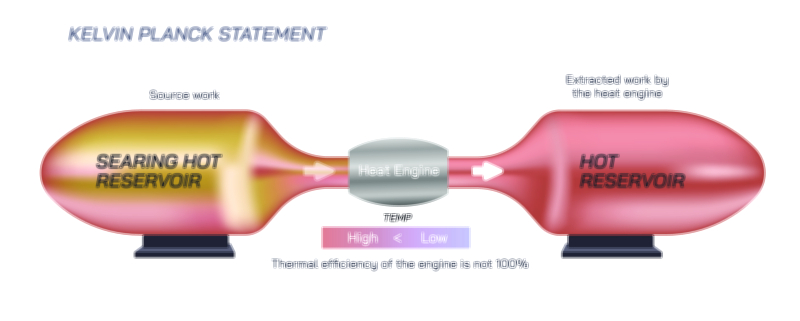
Carnot cycle diagrams illustrate these processes effectively, with the PV diagram showing the work done during expansion and compression, and the TS diagram emphasizing the heat transfer and entropy changes, demonstrating that total entropy remains constant in a reversible cycle. Carnot’s theorem establishes that no engine operating between two thermal reservoirs can exceed the efficiency of a Carnot engine, and all reversible engines operating between the same temperatures achieve identical efficiency. The efficiency of a Carnot engine depends solely on the temperatures of the hot and cold reservoirs, calculated as η = 1 – (TC/TH).
Understanding the Carnot cycle is crucial for students, engineers, and physicists because it sets the theoretical benchmark for all heat engines, heat pumps, and refrigeration systems. While real engines cannot achieve the ideal efficiency of a Carnot engine due to practical limitations, studying this cycle provides deep insights into energy conservation, work, heat transfer, and the principles of thermodynamic reversibility. The Carnot cycle remains an essential topic in thermodynamics, illustrating the idealized relationship between heat, work, and entropy, and serving as a guide for designing efficient energy systems.