Carnot Engine Showing Thermodynamic Cycle, Heat Flow, and Work Conversion in an Ideal Heat Engine
The Carnot engine represents one of the most important conceptual models in thermodynamics because it demonstrates how heat can be converted into mechanical work with maximum efficiency, not through mechanical ingenuity alone but through a perfectly balanced sequence of thermodynamic transformations. Even though no real heat engine can ever match the perfection of a Carnot system, this model defines the theoretical upper limit of efficiency that any heat engine—whether a steam turbine, internal combustion engine, or modern power generator—can achieve when converting thermal energy into usable work. The Carnot cycle teaches that the performance of an engine depends not simply on its mechanical parts but on the temperatures at which heat is absorbed from a hot reservoir and rejected into a cold reservoir. The deeper one studies the Carnot engine, the clearer it becomes that efficiency arises not from eliminating heat loss entirely, which is physically impossible, but from orchestrating heat flow so that energy transfer occurs in a reversible sequence of compression and expansion without wasteful dissipation. For this reason, the Carnot engine is not merely a theoretical drawing in physics textbooks but the conceptual foundation of thermodynamic science and the benchmark by which every real-world energy system is ultimately measured.
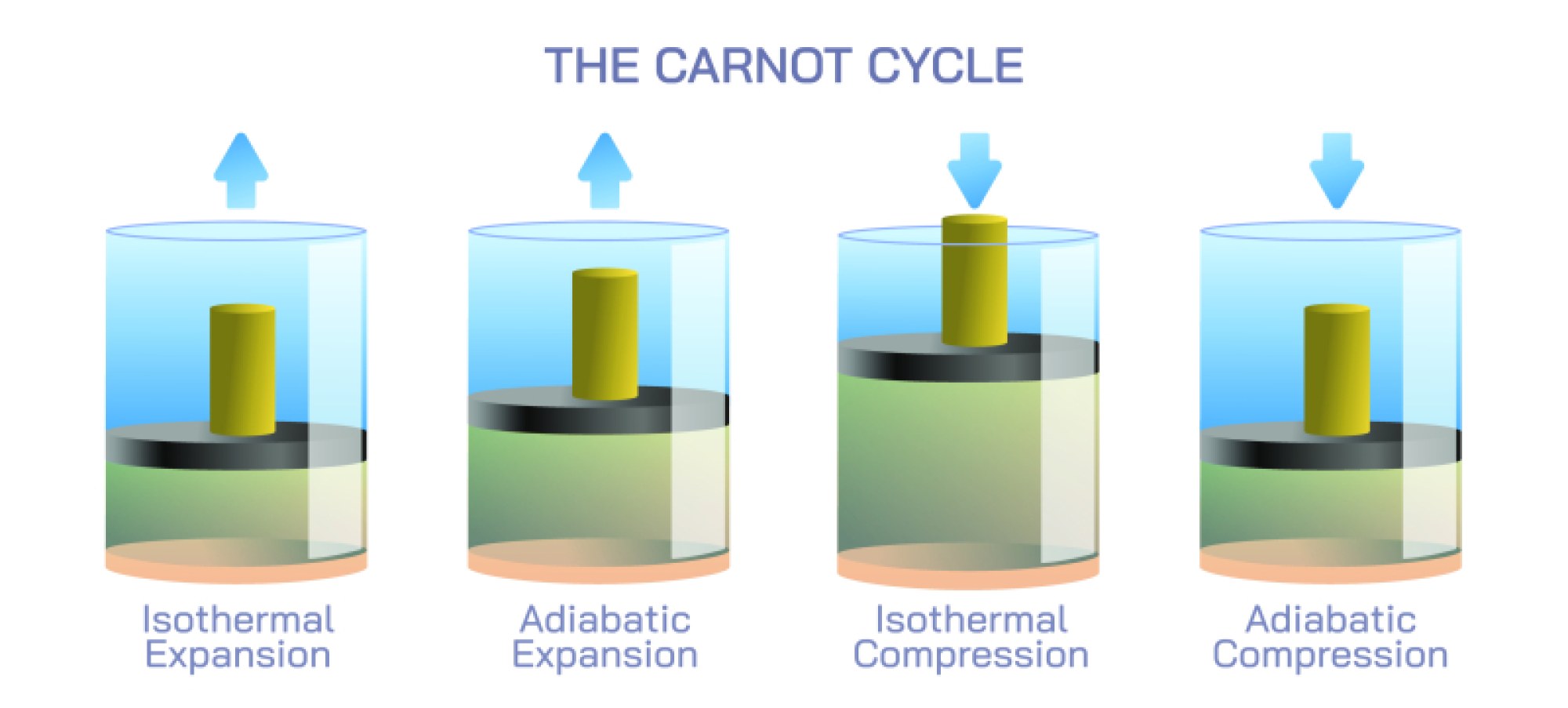
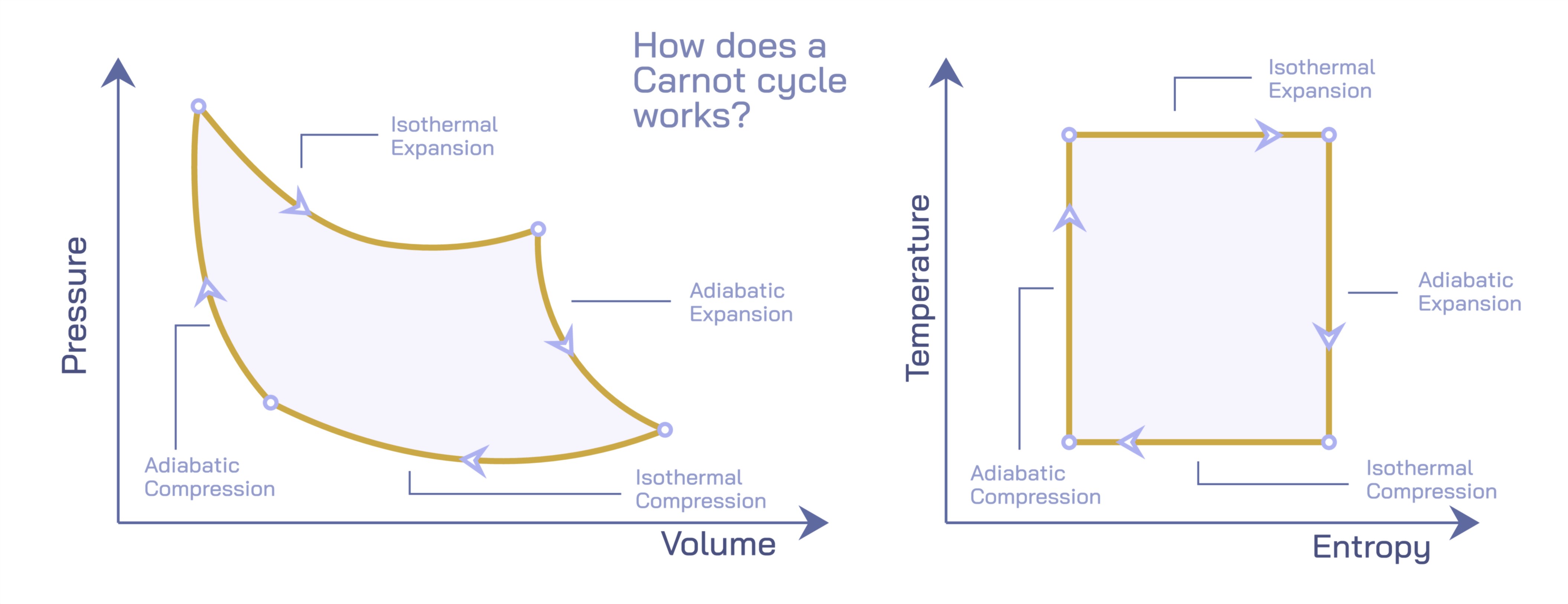
The operation of the Carnot engine is based on a four-stage thermodynamic cycle in which a working substance, often illustrated as an ideal gas confined in a frictionless and insulating cylinder, repeatedly undergoes changes in pressure, temperature, and volume while interacting with a hot and a cold heat reservoir. Although the illustration of the cycle is usually presented through a simple diagram, the physical sequence inside the engine follows a highly coordinated and reversible path that allows heat to be transformed into work without unnecessary losses. In the first stage, the working substance comes into thermal contact with the hot reservoir and absorbs heat while expanding slowly. This expansion is not forced or rapid; instead, it is controlled so that the temperature of the gas remains constant throughout the process. During this stage, the system does work by pushing against a piston or equivalent mechanical boundary, and the source of this work is the incoming heat from the hot reservoir. In this way, the external mechanical motion of the piston becomes the physical manifestation of heat transforming into work. The temperature remains constant because the expansion is precisely matched by the heat entering from the hot reservoir, stabilizing internal energy and maintaining equilibrium.
In the second stage, the gas continues to expand, but this time it is thermally insulated from both reservoirs so that no heat enters or leaves. The gas uses its own internal energy to continue powering the expansion, and as it expands without external heat input, its temperature falls. This process is reversible and slow, ensuring that molecular motion decreases uniformly without generating turbulence or unwanted friction. At the end of this adiabatic expansion, the temperature of the gas reaches the level of the cold reservoir. At this point, the working substance has completed the part of the cycle in which heat is converted into work, having delivered mechanical output while shifting from a hotter internal state to a cooler one.
The third stage begins when the working substance is brought into contact with the cold reservoir. Now, instead of absorbing heat, the gas releases energy into the reservoir while being slowly compressed. The compression is carefully controlled so that the temperature of the gas remains equal to that of the cold reservoir despite the decrease in volume. The system still has to be compressed because it must return to its initial state before the cycle can restart, but this compression is assisted rather than opposed by heat leaving the system. The heat expelled into the cold reservoir does not contribute to mechanical work and represents the unavoidable waste energy inherent in all heat-driven processes. However, since the engine follows a perfectly reversible path, the amount of heat lost is the minimum physically possible for a given temperature difference, illustrating the fundamental thermodynamic constraint that perfect conversion of heat into work can never be achieved.
In the fourth and final stage, the working substance is compressed without exchanging heat with the surroundings. Because the system is thermally isolated during this compression, all the mechanical input used to compress the gas increases its temperature, restoring it to the level of the hot reservoir. At the end of the compression, the gas returns to its initial state, and the cycle is ready to repeat. The net effect of the complete Carnot cycle is that heat taken from the hot reservoir is partially converted into work while the remaining portion is discharged into the cold reservoir. The quantitative difference between the heat absorbed and the heat expelled represents the mechanical work produced over one full cycle. Visually, a diagram of the Carnot engine captures this entire process through a loop showing sequential expansion and compression controlled by alternating heat contact and insulation.
What elevates the Carnot engine from mechanical curiosity to foundational scientific principle is the insight that its efficiency depends exclusively on the temperatures of the reservoirs and not on the working material, mechanical configuration, or specific fluid involved. In practical terms, this means that the highest possible efficiency arises when the temperature of the hot reservoir is maximized and the temperature of the cold reservoir is minimized. Increasing the temperature difference widens the thermodynamic window in which heat can perform work before it becomes unavailable. Real engines, from industrial turbines to automobile engines, attempt to mimic this principle by operating at extremely high combustion temperatures while exhausting heat into much cooler surroundings. Yet no real machine can maintain truly reversible processes due to friction, turbulence, thermal gradients, and material limitations, which is why no physical engine can surpass the theoretical efficiency defined by the Carnot cycle. Nevertheless, every innovation in thermal machinery—improved materials, better combustion strategies, superior lubrication, or advanced cooling systems—ultimately helps real systems move closer to Carnot efficiency by reducing irreversible losses.
The study of the Carnot engine highlights an essential truth about heat and work: energy quality matters as much as energy quantity. Heat at a high temperature is more valuable than heat at a low temperature because high-temperature heat has the potential to do work, whereas low-temperature heat cannot be fully transformed. This understanding explains why a power plant cannot convert all its combustion heat into electricity and why waste heat must be released through cooling towers or exhaust systems. It also clarifies why engines run more efficiently in cooler environments, why refrigeration demands energy to move heat from cold spaces to warm ones, and why thermodynamic laws shape everything from climate systems to metabolic energy use in living organisms. Through the elegantly simplified structure of the Carnot cycle, physics expresses the deeper principle that energy transformations obey natural boundaries—not because of mechanical shortcomings but because of the intrinsic nature of thermal energy.
The Carnot engine, therefore, is not merely a model but a conceptual cornerstone linking heat, temperature, entropy, and work. It represents the ideal balance between ordered and disordered energy flow, the threshold that no real engine can surpass, and the benchmark toward which every designer of energy systems inevitably strives. A diagram of the Carnot cycle visually distills these ideas into four repeating strokes—expansion with heat absorption, expansion without heat exchange, compression with heat release, and compression without heat exchange—each step defining how carefully controlled thermal interactions produce mechanical output. Although purely theoretical, the Carnot engine provides the intellectual foundation for modern power generation, refrigeration, climate control, and thermal management, demonstrating that the laws of thermodynamics set the limits of what is possible while simultaneously guiding every practical attempt to convert heat into useful work across the world.