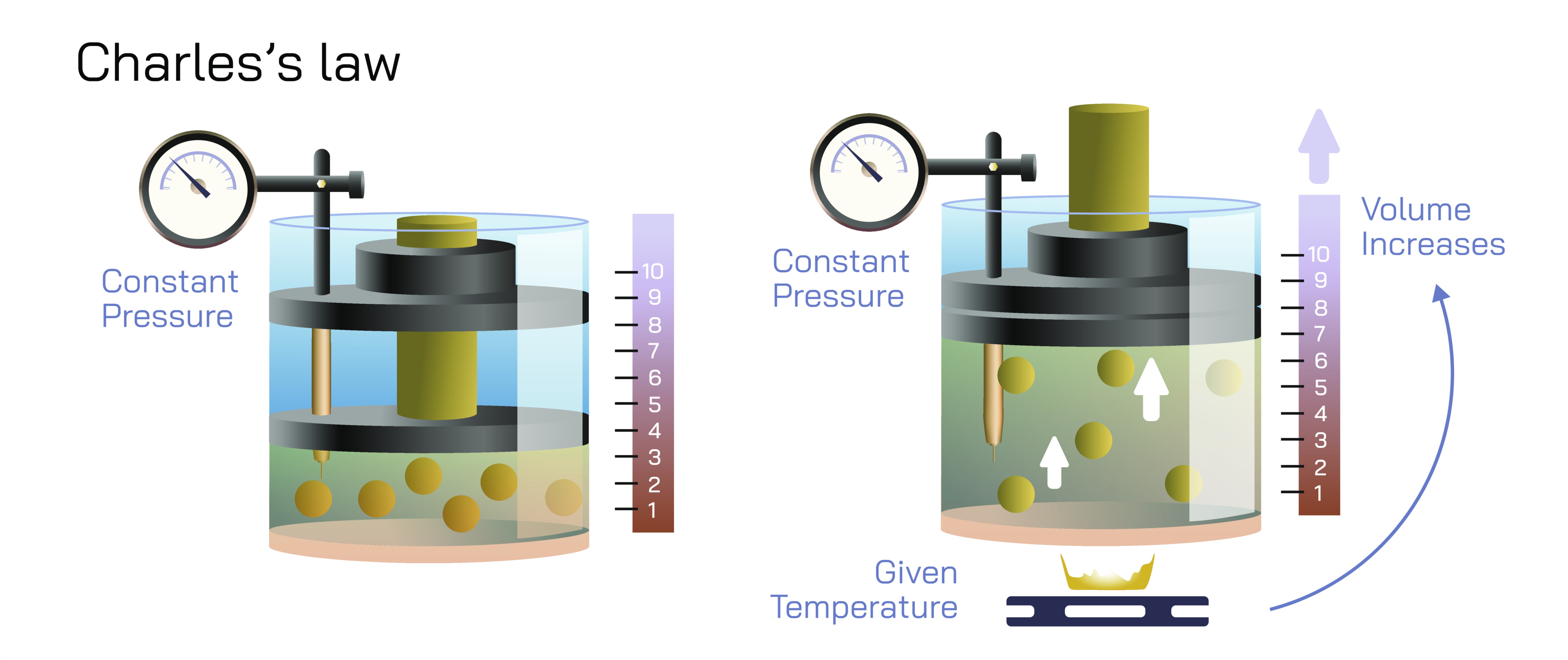
Charles’s Law — Gas Volume and Temperature Relationship
Charles’s Law stands as one of the most foundational principles in the study of gases, offering a clear window into how matter behaves when temperature changes. Even without relying on numerical equations, the conceptual essence of Charles’s Law reveals a profoundly intuitive truth: when a gas is heated, it expands; when it is cooled, it contracts. This law describes the direct relationship between the volume of a gas and its temperature, provided the pressure remains constant. It illustrates how thermal energy influences molecular motion, how the spacing between gas particles changes, and why gases respond so dramatically to variations in temperature. Although simple in concept, the implications of Charles’s Law extend through physics, chemistry, engineering, meteorology, biology, and everyday life. It helps explain phenomena ranging from hot air balloon flight and weather patterns to engine performance, refrigeration, and the behavior of all gases in natural environments.
To appreciate Charles’s Law deeply, one must begin by understanding that gases are composed of rapidly moving particles that are far apart compared to their size. These particles constantly collide with one another and with the walls of their container, and it is these collisions that create pressure. Temperature measures the average energy of motion of these particles. When a gas is heated, its particles move faster, striking the container walls with greater intensity and frequency. If the pressure is kept constant—often by allowing the container to expand—this increased motion forces the volume to grow. When a gas is cooled, particle motion slows, collisions become gentler, internal spacing between particles decreases, and the gas occupies less volume. Charles’s Law thus captures a natural connection between thermal energy and spatial expansion in gases, showing how intimately volume and temperature are linked through molecular behavior.
In the natural world, Charles’s Law plays a major role in atmospheric processes. Air in the atmosphere behaves like a gas mixture that expands when heated and contracts when cooled. Warm air rises because heating causes it to expand, become less dense, and float upward through surrounding cooler layers. This upward movement contributes to convection currents that shape weather systems, wind patterns, and cloud formation. When sunlight heats the ground during the day, the air just above it warms, expands, and rises, influencing temperature gradients and creating the gentle breezes or strong updrafts that birds and gliders rely upon. At night, when the ground cools, the air contracts, becomes denser, and sinks, causing temperature inversions or changes in nighttime wind behavior. Storms, monsoons, sea breezes, and thermal columns used by migrating birds are all guided by the principles embedded in Charles’s Law. Through this relationship between temperature and volume, the law describes the breathing-like rhythms of Earth’s atmosphere.
In technology and engineering, Charles’s Law underpins the functioning of countless devices that rely on predictable gas behavior. Hot air balloons operate entirely on this principle: when the air inside the balloon is heated, it expands, becoming less dense than the surrounding cooler air. This difference in density produces lift, allowing the balloon to rise gracefully into the sky. Lowering the flame cools the air inside, causing contraction and allowing the balloon to descend smoothly. Internal combustion engines also demonstrate the law in action. A mixture of air and fuel enters the engine cylinder; when combustion occurs, temperature rises rapidly, causing the gas mixture to expand and push the piston downward with force. Refrigeration systems rely on cycles of expansion and compression in which gases change volume with temperature, allowing heat to be transferred and removed. Even everyday items such as spray cans or inflatable objects rely on predictable thermal expansion of gases to operate safely and effectively.
Human physiology reflects principles akin to Charles’s Law during respiration. When air enters the lungs, it warms to body temperature, expanding slightly. This expansion allows air to fill the alveolar spaces more efficiently, aiding gas exchange. Deep breath training, athletic endurance, and voice projection all involve subtle interactions between expanding air volume and the body’s ability to regulate pressure within the respiratory system. Mountain climbers experience noticeable effects of volume-temperature relationships as air temperature decreases with altitude; gases in equipment respond differently in cold mountain environments, influencing the performance of oxygen tanks, inflatable gear, and pressure-regulated devices.
In the field of chemistry, Charles’s Law informs experiments involving gas collection, thermal manipulation, and reaction observation. Chemists rely on predictable changes in volume when heating gases during laboratory procedures. Industrial processes such as gas purification, distillation, drying, and reaction control require precise understanding of how gases expand or contract at varying temperatures. Storage tanks, pipelines, and pressure regulators must accommodate thermal expansion of gases to prevent hazards or equipment damage. Even something as simple as a sealed container left in sunlight demonstrates Charles’s Law when warming air inside causes expansion that distorts the container’s shape.
In everyday life, the effects of Charles’s Law are seen everywhere. A basketball left out on a cold night deflates slightly because the air inside contracts. Car tires lose pressure in winter because cooler temperatures reduce air volume. A plastic bottle crushed at high altitude re-expands when brought to lower altitude or warmer temperatures, showing how temperature and pressure combine to change gas volume. Bread rises during baking because heated air and vapor inside the dough expand, creating lift and increasing volume. Popcorn kernels explode open because internal moisture turns into superheated vapor that expands rapidly with increased temperature. Each of these examples illustrates how directly temperature influences the behavior of gases and how volume shifts occur with even modest thermal changes.
Charles’s Law also helps explain why gases are more compressible than liquids or solids. Because gas particles are far apart, heating or cooling them produces large volume changes relative to the energy added or removed. This remarkable responsiveness allows gases to serve as shock absorbers, insulators, and energy-transfer mediums. It also means that temperature control is essential in systems where gas volume must remain stable. Scientists developing airships, environmental control systems, ventilation networks, climate simulations, or aerodynamic models must all consider the implications of Charles’s Law to predict how air or gas mixtures behave under varying conditions.
In astronomy and space science, Charles’s Law affects spacecraft operation, pressurized cabins, and gas storage during mission environments. The gases used in air tanks, environmental suits, propulsion systems, and scientific instruments must be carefully managed to prevent excessive expansion in heat or contraction in cold vacuum environments. Planetary atmospheres also follow principles consistent with Charles’s Law: gas layers expand as planets warm and contract when cooling, influencing atmospheric thickness, pressure distribution, and climate evolution over time.
Charles’s Law, though seemingly simple, reveals a universal connection between heat and expansion, between the kinetic energy of particles and the space they occupy, and between the invisible world of molecular motion and the visible changes we observe in nature. It represents a powerful example of how scientific laws translate microscopic behavior into macroscopic effects. By understanding Charles’s Law, we gain insight into weather systems, daily temperature effects, industrial operations, safety protocols, and biological processes. The law invites appreciation for how temperature shapes the physical world, how energy influences matter, and how the behavior of gases influences nearly every aspect of life—from the air we breathe to the technologies that carry us across land, sea, and sky.