Detailed Overview of the Standard Hydrogen Electrode and Its Electrochemical Role
The standard hydrogen electrode is one of the foundational systems in electrochemistry. It serves as the universal reference for measuring electrode potential, offering a consistent scale that allows comparison between different cells and reactions. Its setup uses controlled conditions to maintain a stable response, and this stability is the reason it has been adopted as the primary reference point in both research and instructional study.
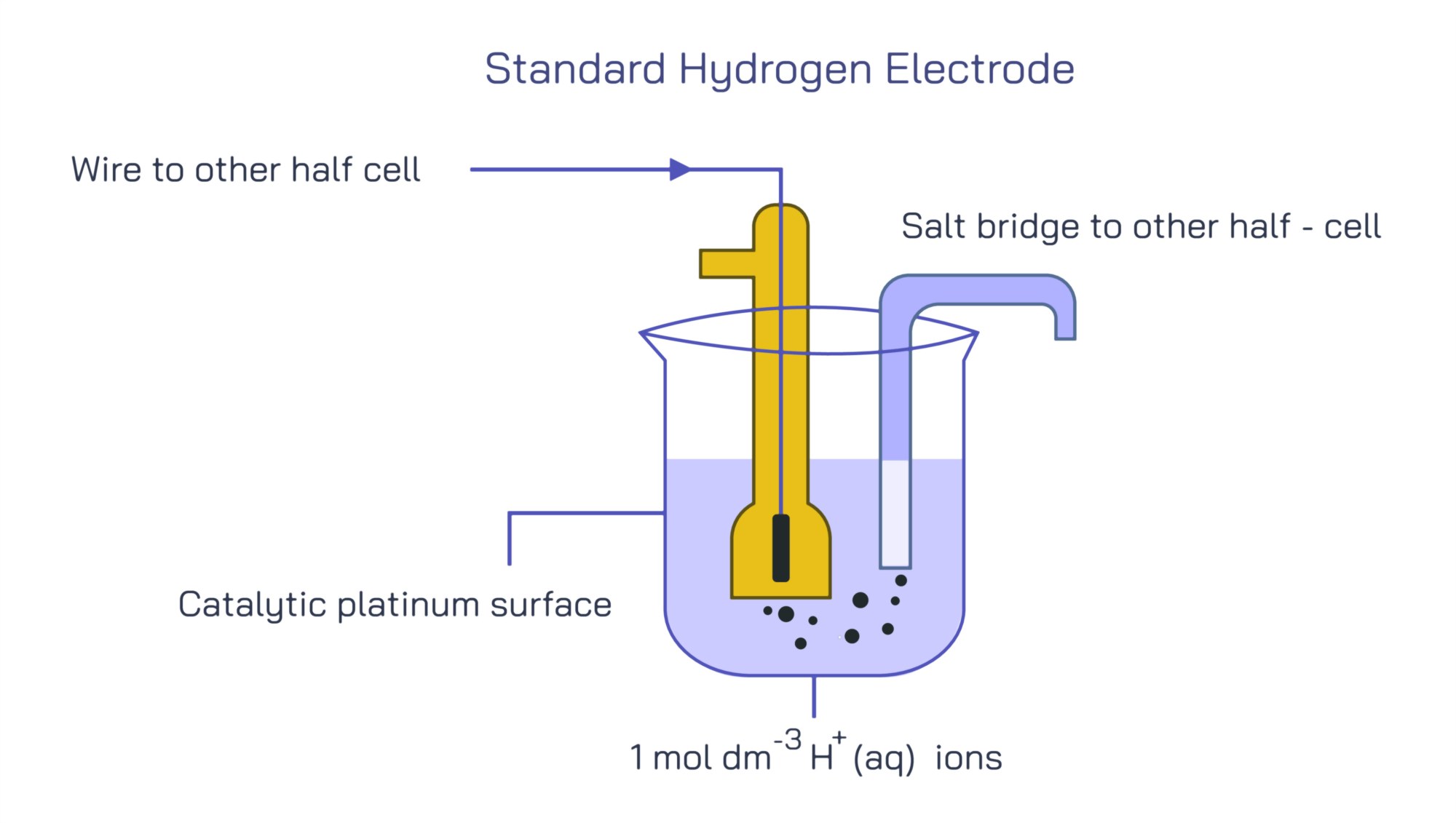
The system begins with a chamber containing a strong acid that provides a steady concentration of hydrogen ions. This liquid phase supports ion activity and creates the environment needed for surface reactions. Into this region, a specially prepared platinum surface is placed. Platinum is chosen because it remains inert while providing a conductive area where ions and gas can interact. The surface is often coated with a fine layer that improves activity, helping the system maintain reliable behavior during use.
Hydrogen gas enters the setup at a regulated rate. This gas flows through a narrow tube and reaches the platinum area as small rising bubbles. When the gas contacts the metal surface, a balance forms between dissolved ions in the liquid and hydrogen from the gas. This balance creates a stable interface, allowing the system to act as an effective reference for potential measurement. The gas pressure is held at a specific value so that the overall behavior remains predictable and consistent.
The electrode becomes useful when connected to another electrochemical cell. It provides a zero point on the potential scale, meaning other electrodes are compared against this constant reference. When linked in a circuit, differences in potential drive electron movement. By examining this difference, researchers determine how strongly a particular electrode attracts or releases electrons. Every potential measurement in the system depends on the constant behavior of the hydrogen reference, which remains unchanged under its standard conditions.
The structure of the system ensures that reactions occur only at the surface. Hydrogen ions can accept electrons to form gas, while hydrogen gas can release electrons to form ions. This dual behavior helps the electrode maintain an exact balance. Because the platinum surface does not chemically change during the process, the system preserves its reliability through repeated use. The balance between gas and ion activity ensures that the potential remains fixed at the reference value.
Understanding the standard hydrogen electrode also helps clarify broader electrochemical concepts. The system illustrates how surfaces interact with ions, how potentials arise from charge movement, and how reference systems guide measurement. It demonstrates the importance of controlled conditions, showing how gas pressure, ion strength, and surface structure combine to produce a stable response. These principles apply to many laboratory systems and industrial designs, highlighting the value of this reference setup.
Through careful control of ion concentration, gas flow, and surface behavior, the standard hydrogen electrode becomes a precise tool for determining potential across various electrochemical systems. Its consistent performance makes it essential in analysis, instruction, and research, providing the foundation for understanding how cells operate and how reactions develop across different materials.