Protoplanetary Disks: Birthplaces of Planets Around Young Stars Explained
A protoplanetary disk is the swirling, flattened disk of gas and dust that surrounds a young star during its earliest stages of formation, and it represents the environment in which planets, moons, asteroids, and comets take shape. Although these disks appear in telescopes as delicate, glowing rings of material, they are the engines of planetary creation — structures where microscopic dust grains evolve over millions of years into worlds capable of hosting oceans, atmospheres, and potentially life. To understand how planets arise, it is essential to explore the physics, chemistry, and dynamic processes inside protoplanetary disks. These disks are not static; they are constantly evolving, influenced by gravity, temperature changes, collisions between particles, and the radiation and magnetic activity of the young star they encircle. Through this process of growth and transformation, the chaotic interior of a disk eventually becomes an ordered planetary system.
A protoplanetary disk forms as a natural consequence of star birth. Stars originate within gigantic clouds of interstellar gas and dust called molecular clouds. When such a cloud fragment collapses under its own gravity, conservation of angular momentum causes the collapsing material to spin faster and flatten into a rotating disk. Most of the mass falls inward to form the central protostar — the infant version of a star — while the remaining material spreads out around it in the form of a disk that may be hundreds of astronomical units across. At this early stage, the disk contains primarily hydrogen and helium gas, along with traces of heavier elements and solid dust grains composed of silicates, carbon-rich materials, and ice. Although the mass of the disk is only a small fraction of the mass of the star, the disk holds enough raw material to build an entire planetary system.
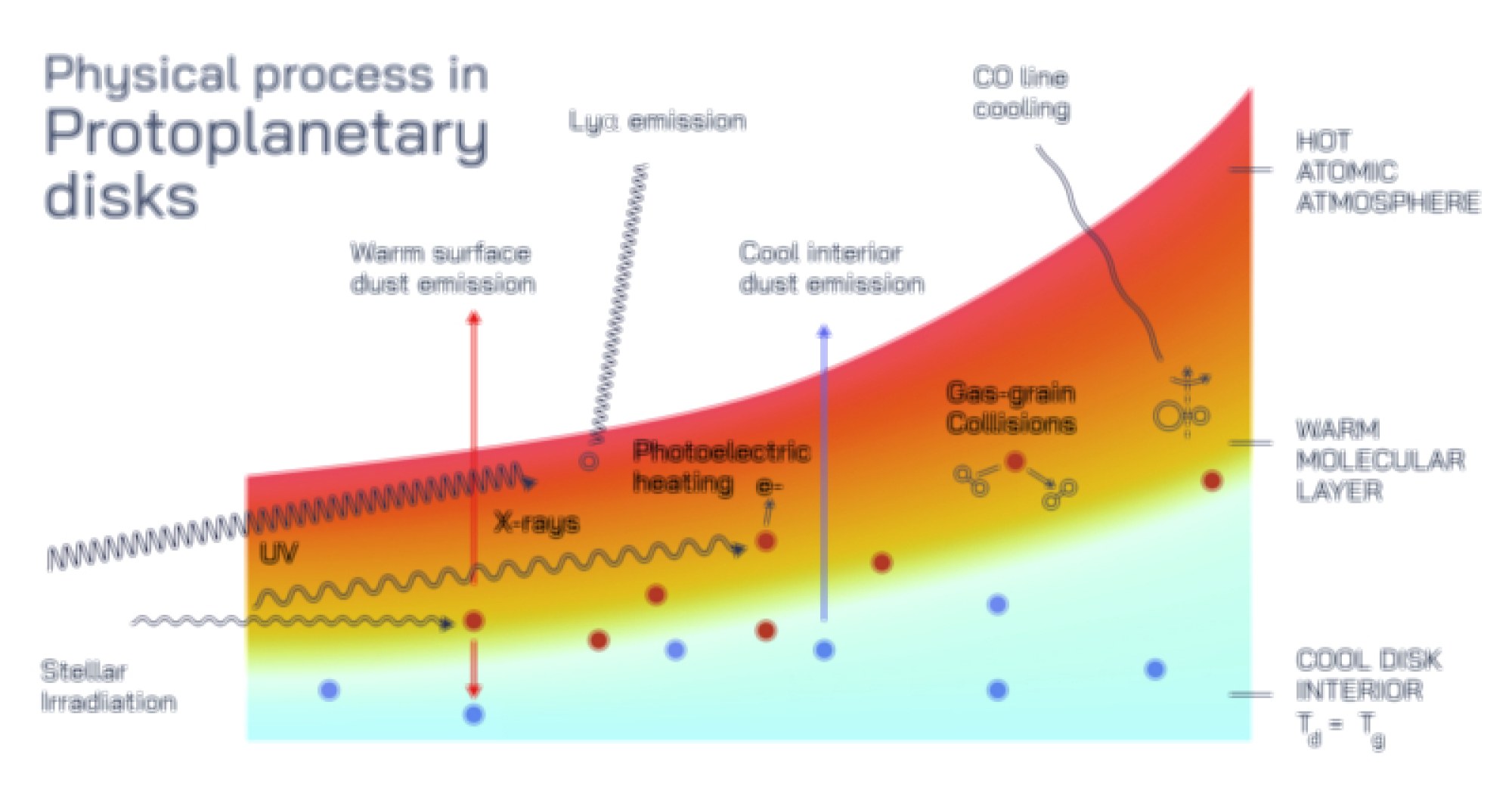
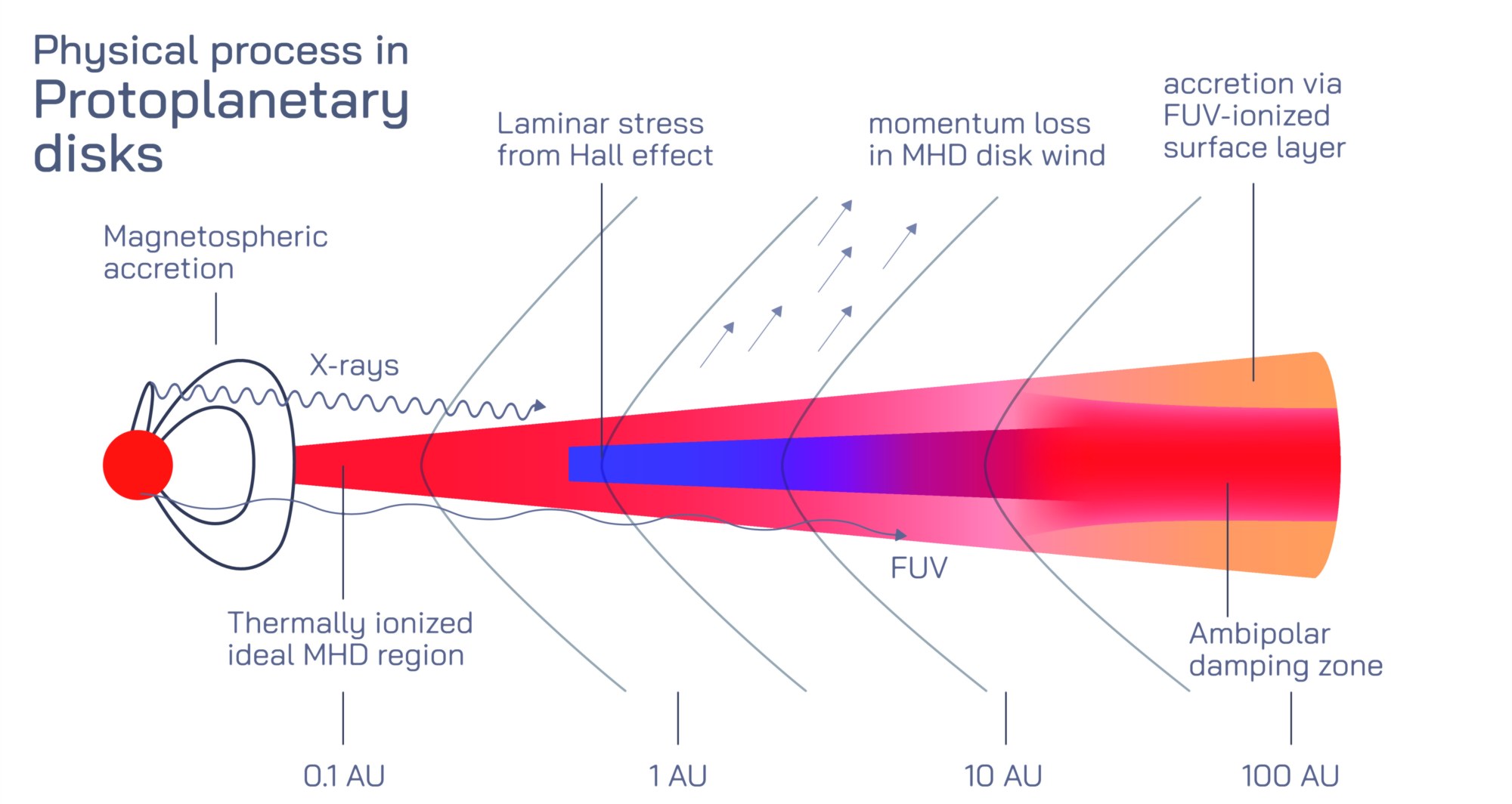
Inside the disk, physical conditions vary dramatically with distance from the star. The inner regions are extremely hot due to intense radiation and gravitational energy released by the growing star. Temperatures there can reach thousands of degrees, vaporizing most ice and many rock-forming minerals. As a result, the inner disk can support the formation of rocky planets like Earth and Mars but not gas giants. Farther out, the disk cools, allowing ices and volatile compounds such as water, methane, and ammonia to condense. This cooler zone creates a fertile environment for the formation of large solid cores that later attract vast envelopes of gas, giving rise to planets like Jupiter and Saturn. Even farther out in the icy outskirts, temperatures drop low enough for the formation of comets and distant dwarf planets. This temperature-dependent distribution of materials explains why different kinds of planets form in different regions of a planetary system, a pattern reflected in our own Solar System.
The growth of planets begins with something almost unimaginably small: dust particles less than a micrometer in size. These particles collide gently and stick to one another through electrostatic forces, gradually forming larger grains. As growth continues, clusters of particles expand into pebbles, rocks, and kilometer-scale bodies known as planetesimals. Gravity becomes dominant once objects reach this scale, causing collisions to become more forceful and increasing the rate of growth. Eventually, these planetesimals merge into planetary embryos — moon- to Mars-sized bodies — through repeated collisions and accretion. The most massive of these embryos become the cores of future planets. In the outer regions of the disk, where icy material remains abundant and the building blocks are larger, solid cores can grow rapidly enough to capture gas from the disk before it dissipates, forming gas giants. In the inner regions, where solids are fewer and gas escapes early, rocky planets take shape instead.
During the process of planet formation, the young star plays a dual role. On one hand, its gravity stabilizes the rotation of the disk. On the other hand, its radiation and magnetic activity constantly push gas and dust outward and distort the structure of the disk. Energetic winds from the growing star gradually erode the disk from the inside out, and ultraviolet radiation heats the upper layers of the disk, causing gas to escape into space. This gradual clearing of material creates gaps and rings in the disk — features that astronomers frequently observe in high-resolution images from telescopes such as ALMA and the James Webb Space Telescope. These rings were once mysterious, but they are now widely interpreted as signatures of planets forming within the disk. A newly formed planet carves a path through the disk as it orbits the star, sweeping up dust and gas and sculpting the disk into visible patterns. In this way, a planet does not simply emerge from the disk — it also reshapes the very environment from which it was born.
As planets grow and migrate, the disk continues to thin. Gas disperses into space, dust is swept up or incorporated into larger bodies, and collisions gradually become rarer. The timeline of disk evolution varies, but most protoplanetary disks last only a few million years — a brief moment on cosmic timescales. When the disk has fully cleared, the planetary system is left behind: rocky planets close to the star, gas or ice giants farther out, and debris belts of leftover material orbiting at the edges. Asteroids, comets, Kuiper Belt objects, and planetary rings are residual reminders of this early phase of formation, marking the remnants of ancient building blocks that were never assembled into planets.
The chemistry of protoplanetary disks plays a major role in shaping the potential habitability of planetary systems. Dust grains inside the disk can act as tiny chemical reactors, accumulating water ice and complex organic molecules — the same kinds of compounds linked to the origin of life. Meteorites that reach Earth contain these materials, suggesting that our planet was seeded with prebiotic chemistry during its formation. In other planetary systems, the distribution and availability of water and organics in the early disk could determine whether terrestrial planets later develop oceans and atmospheres. This connection between disk chemistry and planetary destiny has transformed the study of protoplanetary disks into a cornerstone of astrobiology.
Today, direct observation of protoplanetary disks has confirmed that planet formation is not a rare outcome but a common stage in the life cycle of stars. Nearly every young star is surrounded by a disk, and many show signs of ongoing planetary formation. Each disk has its own combination of mass, temperature distribution, and elemental composition, which leads to extraordinary diversity in planetary systems. Some disks form planets close to the star, while others distribute mass farther out. Some produce super-Earths and mini-Neptunes, while others build giant planets or none at all. The incredible variety of exoplanetary systems discovered across the galaxy reflects the diversity of the disks from which they formed.
Ultimately, protoplanetary disks are the cosmic cradles of planetary systems — arenas where dust becomes worlds. They transform raw interstellar material into intricate architectures of planets, moons, asteroids, and comets, shaping everything from climate and geology to the possibility of life. Every planet, including Earth, began as microscopic dust drifting inside one of these disks, orbiting a young Sun billions of years ago. By examining protoplanetary disks today, scientists look back in time to witness the process that gave rise to our Solar System and countless others, revealing not only how planets form but also how the universe perpetually constructs new opportunities for life to emerge.