Solar Eclipse: Alignment of Sun, Moon, and Earth Explained with Types and Phases
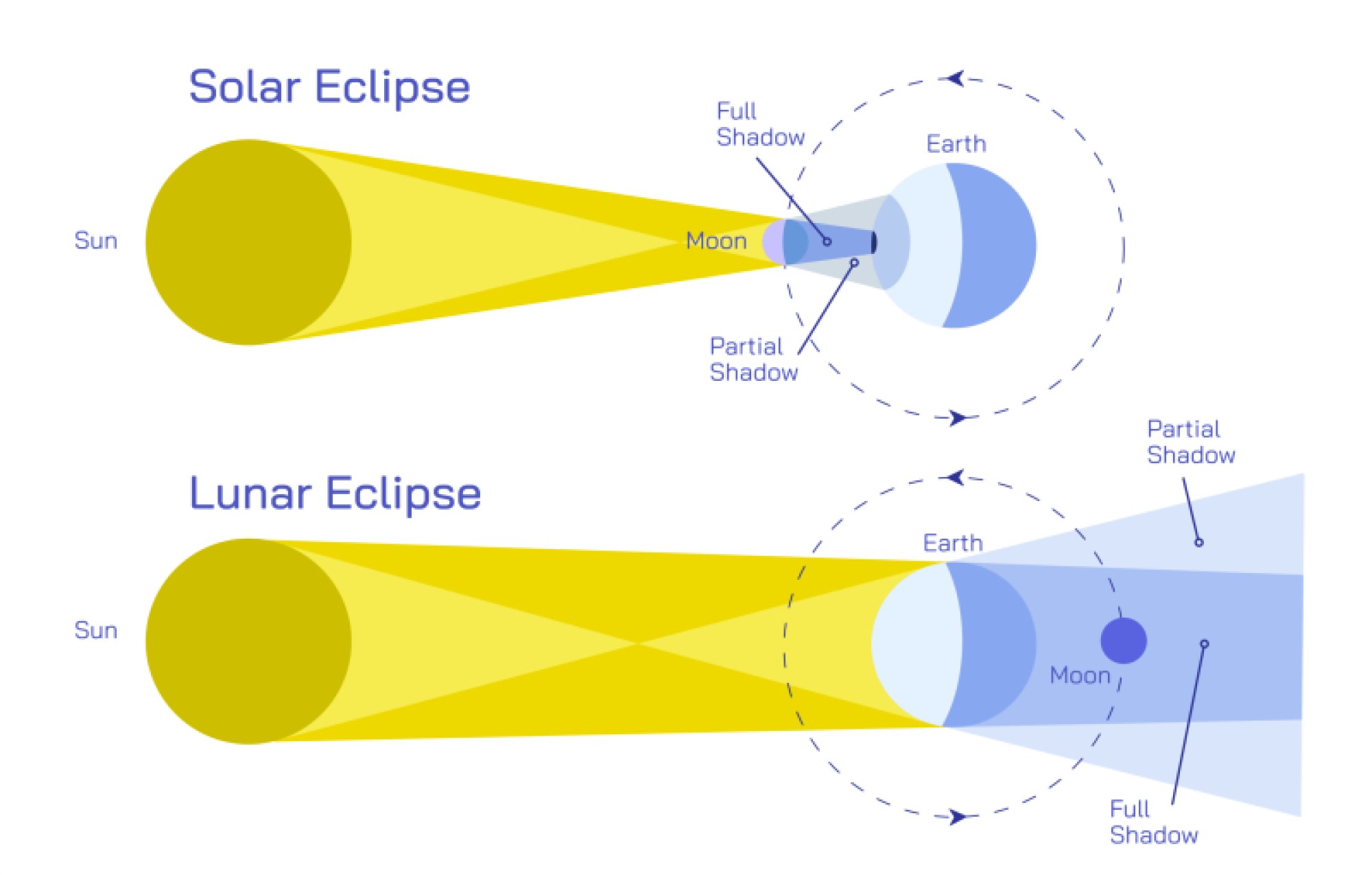
A solar eclipse is one of the most dramatic astronomical events visible from Earth, a moment when the Moon passes precisely between the Sun and the Earth, casting a shadow on the planet and temporarily blocking sunlight in the regions along its path. Although eclipses have historically inspired awe, fear, mythology, and scientific curiosity, their cause lies in the geometry of the Sun–Moon–Earth system. A solar eclipse occurs only during the new moon phase, when the Moon is positioned between the Earth and the Sun. However, eclipses do not happen every month because the Moon’s orbital plane is tilted about five degrees relative to Earth’s orbit around the Sun. Only when the Sun, Moon, and Earth align closely in three-dimensional space — a condition known as syzygy — does the Moon’s shadow fall on the Earth, creating an eclipse. This alignment produces a breathtaking spectacle of celestial order, revealing both the size of cosmic bodies and the precision of their motions.
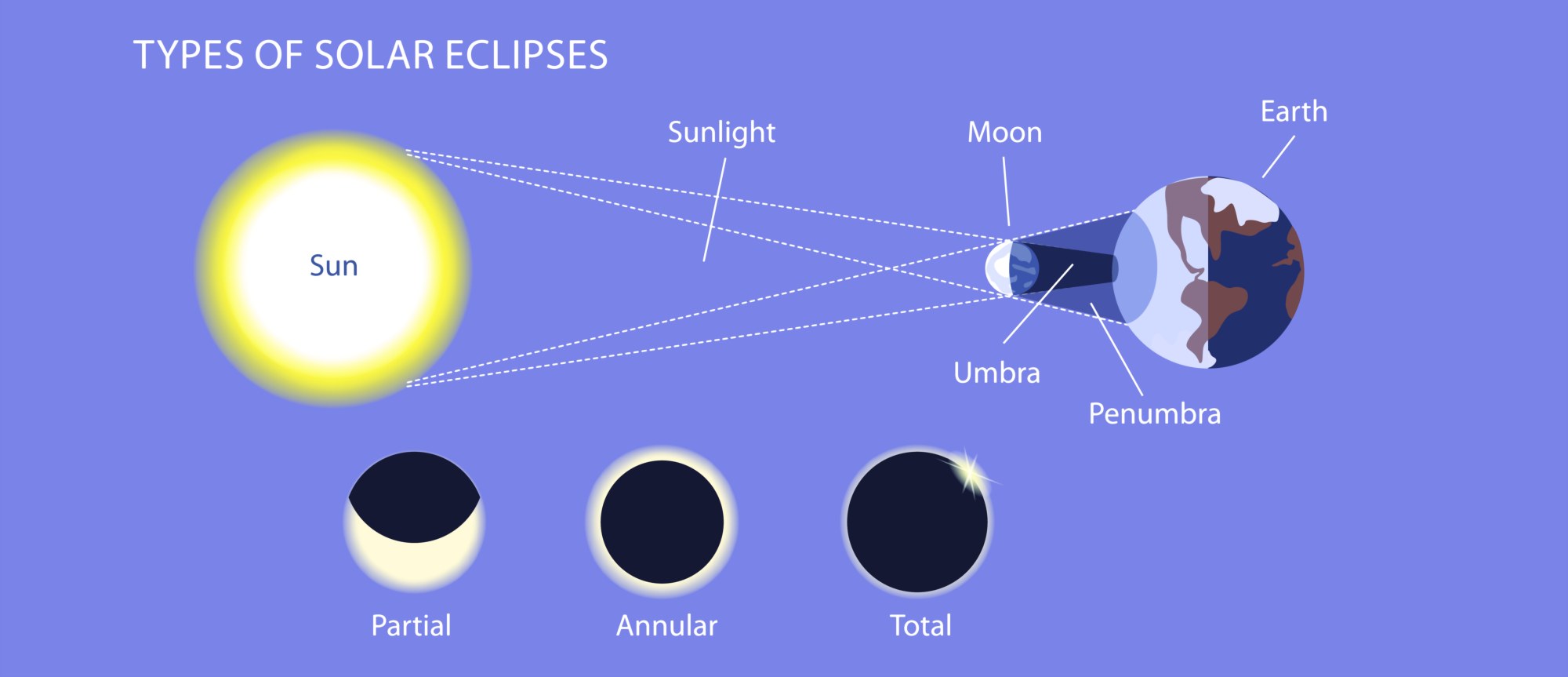
The physical basis of a solar eclipse depends on the Moon casting two types of shadows: the umbra and the penumbra. The umbra is the darkest inner part of the shadow, where the Moon completely blocks the Sun’s disk. An observer standing in the umbra experiences the most dramatic form of eclipse — totality — when daylight suddenly fades and the Sun becomes completely hidden, allowing the sky to darken and revealing bright planets and stars. Surrounding the umbra is the penumbra, a lighter shadow where the Moon blocks only part of the Sun. Observers standing within the penumbra experience a partial eclipse in which the Sun appears crescent-shaped, but daylight does not disappear entirely. The umbrella-like shape of the Moon's shadow stretches across Earth’s surface as the Moon and Earth continue their motions, creating a moving eclipse path that is narrow for totality and much wider for partial visibility.
Solar eclipses occur in several distinct types, depending on the relative distances of the Sun, Moon, and Earth:
• Total Solar Eclipse — When the Moon is close enough to Earth to appear large enough to completely cover the Sun’s disk, observers along the narrow path of the Moon’s umbra experience total darkness during the peak of the eclipse. Temperatures drop, birds quiet, and the Sun’s corona — its outer atmosphere — becomes visible as a white halo.
• Partial Solar Eclipse — When observers are in the penumbra rather than the umbra, only part of the Sun is obscured. Many regions outside the path of totality see a partial eclipse even when totality occurs elsewhere.
• Annular Solar Eclipse — When the Moon is farther from Earth in its elliptical orbit, it appears slightly smaller than the Sun and cannot fully cover it. At maximum coverage, a ring of sunlight remains visible around the Moon, creating the famous “ring of fire” effect.
• Hybrid Solar Eclipse — A rare event in which the curvature of Earth causes different parts of the eclipse path to experience totality or annularity. Some observers see a total eclipse, while others see an annular one along different portions of the path.
Each type of eclipse presents different visual effects and safety considerations, but all of them arise from the same underlying geometry — the interplay of distances, shadow size, and orbital motions.
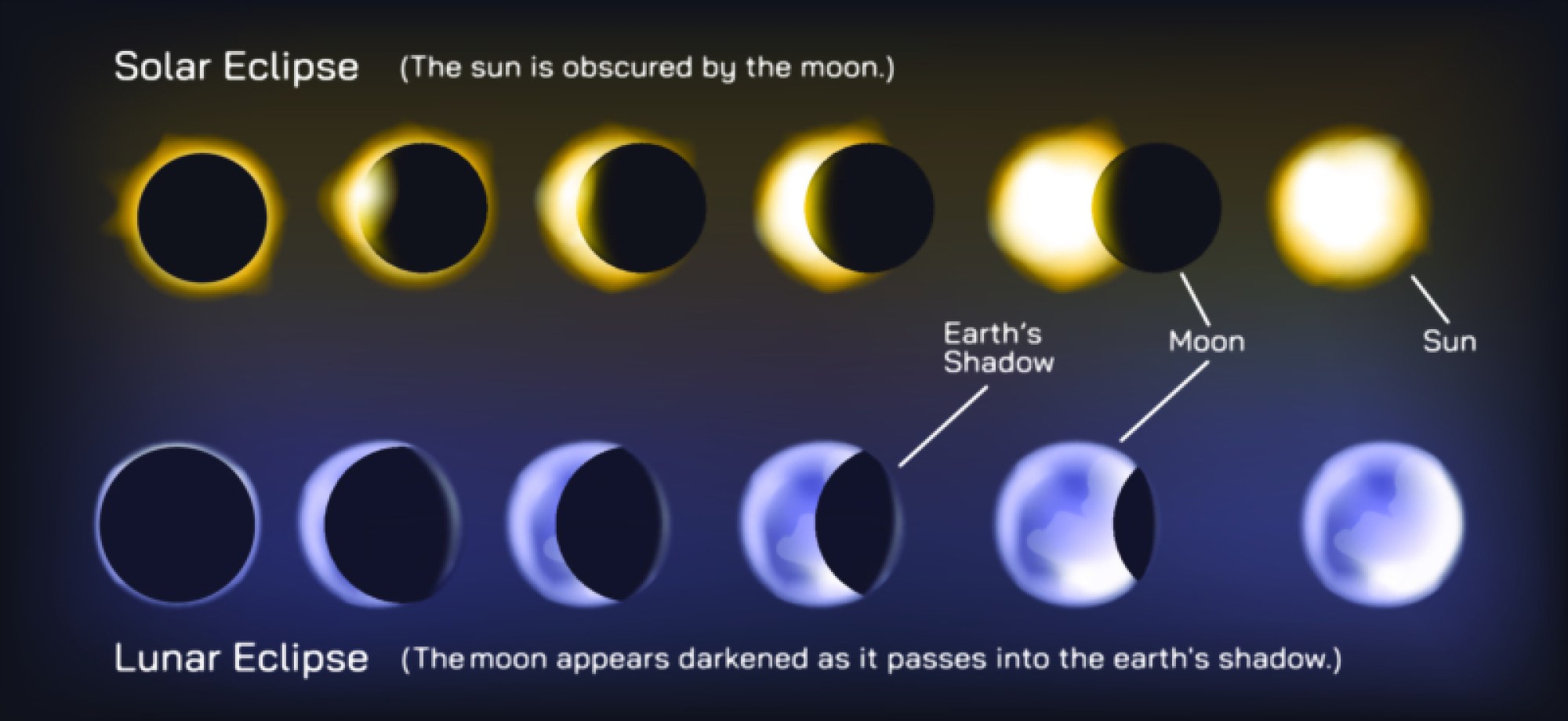
The experience of a solar eclipse unfolds through a sequence of phases that reveal how the Moon gradually covers and uncovers the Sun. The first phase begins when the edge of the Moon makes its first “bite” into the Sun’s disk, causing the crescent Sun to shrink slowly over time. As the Moon covers more of the Sun, daylight dims and shadows grow sharper. Shortly before totality in a total eclipse, unique visual phenomena occur: shadow bands ripple across surfaces, and Baily’s beads — bright beads of sunlight shining through valleys on the Moon’s edge — sparkle just before total coverage. In the final instant before totality, a brilliant flash known as the diamond ring effect appears, formed by a single bead of sunlight shining through one deep lunar valley while the corona glows all around. During totality, the temperature drops, winds may shift, and animals behave as if night has arrived. When the Moon begins to uncover the Sun again, the phases reverse, creating another diamond ring, another display of Baily’s beads, and a gradual return of daylight as the Moon moves away from the Sun’s disk.
A solar eclipse reaches far beyond its dramatic visual effect — it provides scientists with opportunities to study the Sun and Earth in ways not possible under normal daylight. Historically, total eclipses allowed astronomers to observe the Sun’s corona, long before space telescopes existed. A famous eclipse in 1919 provided experimental confirmation of Einstein’s general theory of relativity by showing the bending of starlight by the Sun’s gravity. Today, eclipses are used to study solar wind patterns, atmospheric temperature changes, ionospheric effects on radio communication, and animal behavior. Modern spacecraft can now image the corona, but solar eclipses remain valuable because they reveal the Sun’s upper atmosphere directly to ground-based observers.
Safety also plays a critical role in eclipse education. Except during the brief moments of totality in a total solar eclipse, looking directly at the Sun without proper protection can permanently damage the eyes because sunlight remains intense even when partially blocked. Safe observation requires certified eclipse glasses, pinhole projection, telescopes with solar filters, or indirect viewing techniques. Annular and partial eclipses must never be viewed with the naked eye at any stage because the Sun’s exposed surface remains dangerously bright. Totality is the only moment when the Sun becomes safe to view directly — and only between the diamond ring effects that mark the beginning and end of total coverage.
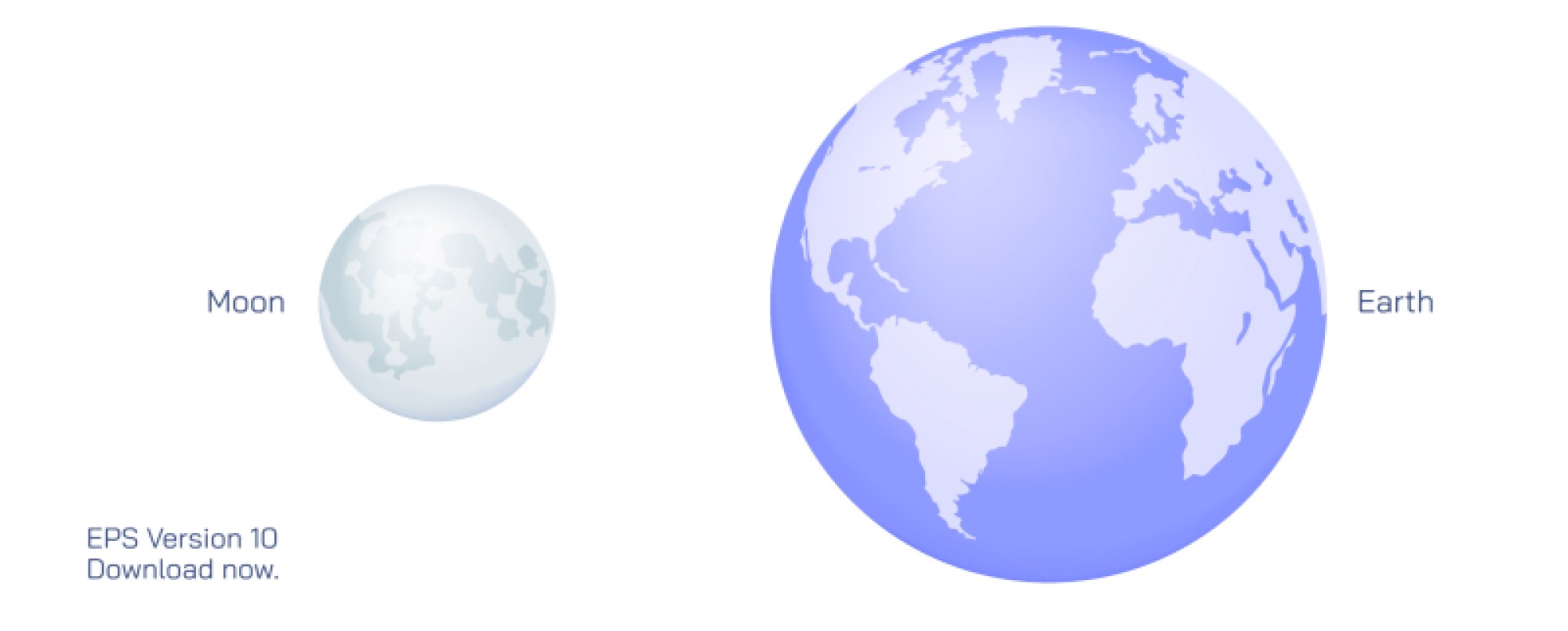
Ultimately, a solar eclipse is the result of precise cosmic synchrony: the Sun is about 400 times farther from Earth than the Moon, yet it is about 400 times larger in diameter — a coincidence that makes both bodies appear nearly the same size in the sky, allowing one to hide the other. This rare proportional relationship allows humans to witness an event unlike anything else in the natural world. The alignment of Sun, Moon, and Earth transforms day into twilight, reveals structures unseen in ordinary sunlight, and underscores the beauty of celestial mechanics. Whether experienced scientifically or emotionally, a solar eclipse is a reminder that the movements of distant celestial bodies can momentarily alter the environment on Earth, connecting us to the vast and dynamic rhythms of the universe.