Kepler’s Second Law of Planetary Motion — Equal Areas in Equal Times and the Changing Orbital Speed of Planets
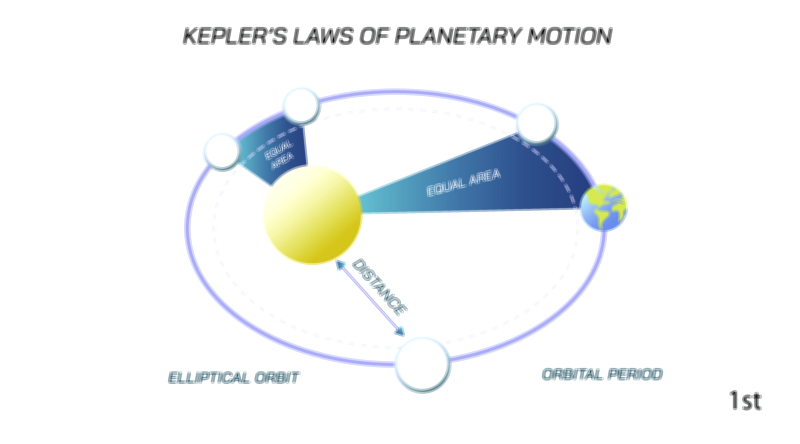
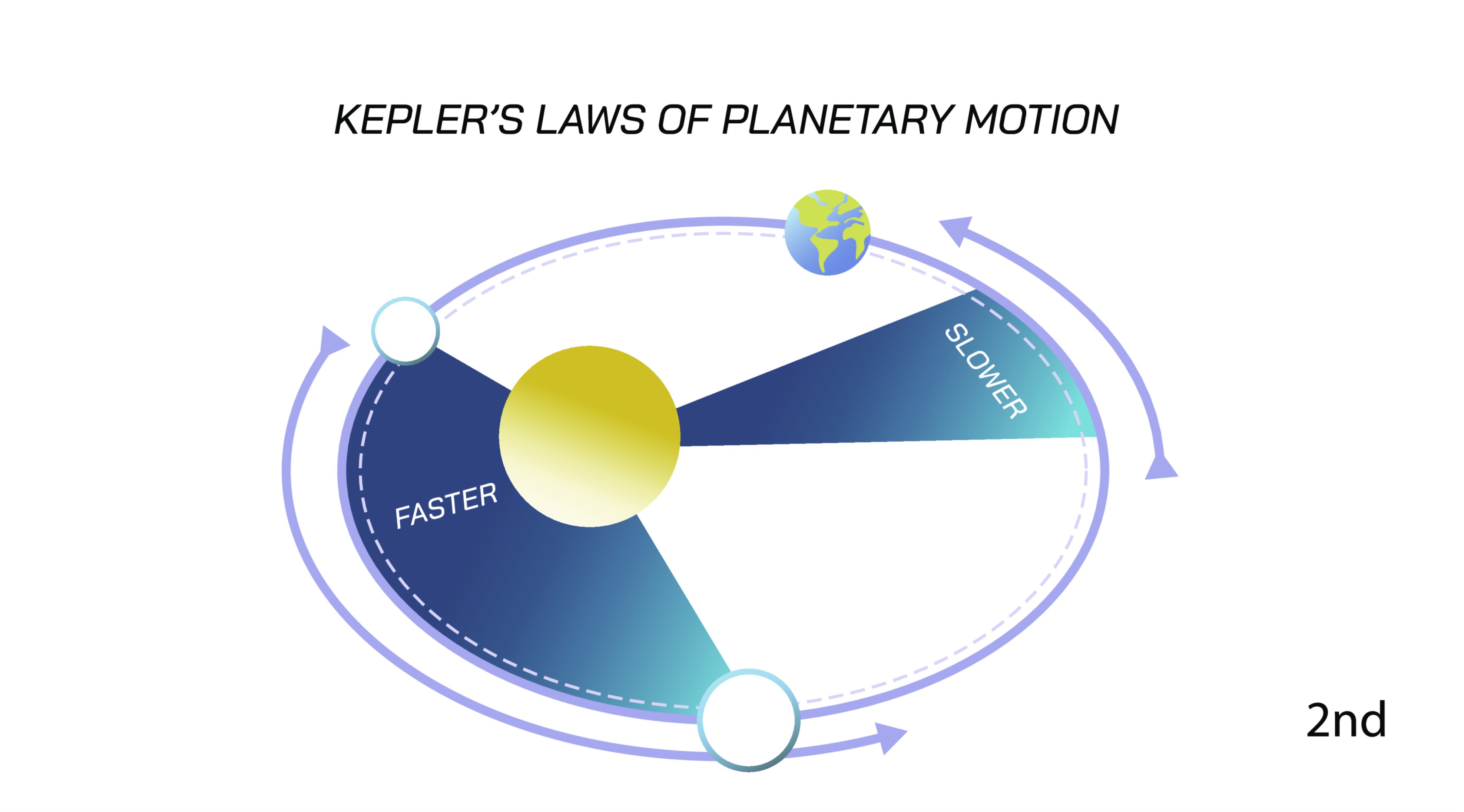
Kepler’s second law of planetary motion describes one of the most elegant and insightful truths about how planets move around the Sun, and it stays visually memorable because of the way it links motion to geometry. The law states that a line joining a planet and the Sun sweeps out equal areas in equal intervals of time, which immediately implies that planets do not travel at a constant speed during their orbits. Instead, they move faster when they are closer to the Sun and slower when they are farther away. A vector illustration of this law usually shows the Sun at one focus of an elliptical orbit with shaded triangular areas representing different time segments, demonstrating that even though the triangles have different shapes, they cover identical areas. This visual model communicates the heart of the law without complex mathematics: orbital motion is dynamic, and distance from the Sun determines orbital speed.
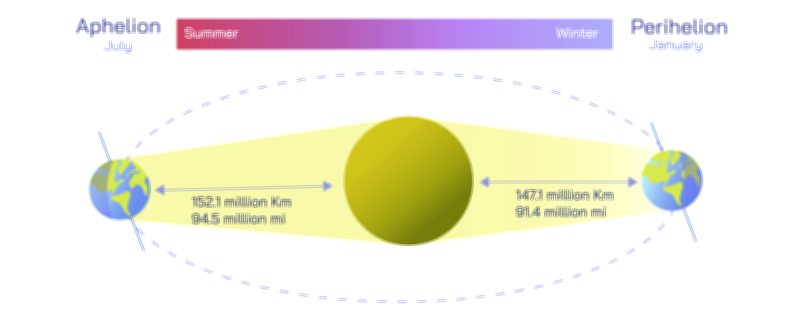
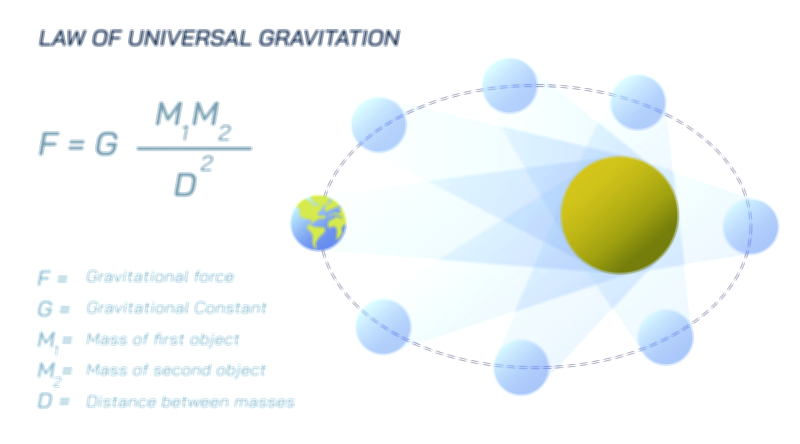
In the context of the solar system, Kepler’s second law explains why Earth moves more rapidly around the Sun in January, when it is at perihelion — the closest point to the Sun — and more slowly in July, when it is at aphelion — the farthest point. The pull of gravity is stronger when a planet is closer to the Sun and weaker when the planet is farther away. This changing gravitational influence translates directly into changing speed, and the equal-area rule captures this relationship geometrically. When the planet is nearer the Sun, it must travel a longer arc of its orbit in the same time interval in order to sweep out the same area that it will sweep when it is farther away. This creates a deep intuitive connection between motion and distance: nearer means faster, farther means slower, yet time symmetry remains preserved across the entire orbit.
In classroom demonstrations and scientific diagrams, the power of Kepler’s rule becomes even clearer when the shaded regions are compared. A 30-day interval near perihelion will cover a long curved section of the orbit but form a triangle with a short radius because the planet is close to the Sun. Another 30-day interval near aphelion will cover a shorter curved path but form a triangle with a long radius because the planet is farther away. Despite these differing arc lengths and shapes, the areas of both triangular regions are equal. A student observing such a vector illustration sees the equal-area principle not as a mathematical statement but as a geometric truth unfolding around the Sun. The illustration transforms abstract orbital physics into a visible pattern based on balance, symmetry, and motion.
Kepler’s law also provides a profound insight into angular momentum conservation without requiring learners to study advanced physics. As the planet approaches the Sun, it gains speed; as it moves away, it loses speed. The sweeping-area rule reflects this conservation-like behavior: the angular momentum remains constant when no external torque acts on the system. The geometric nature of the law is what makes it universal. It applies not only to planets in the solar system but to comets, asteroids, moons orbiting planets, exoplanets orbiting distant stars, and even spacecraft following elliptical paths under a central gravitational field. When a spacecraft takes a slingshot trajectory around a planet, it accelerates in a manner fully consistent with the equal-area law, even though the situation is engineered rather than natural. The vector illustration of equal area sectors becomes a window into both natural and human-designed orbital mechanics.
This law also explains why planets linger for long periods in the outer parts of their orbits. Even though the elliptical orbit returns them to the same cosmic location each year, a planet spends more time farther from the Sun because the weaker gravitational influence reduces its speed. This is why seasons on planets with highly elongated orbits vary dramatically in duration — the planet does not sweep through its orbit uniformly. Kepler recognized this pattern centuries before modern gravity theory existed, and his insight pointed future scientists toward the deeper universal principles later formalized by Newton and Einstein. In this sense, Kepler’s law stands as a historical milestone: it demonstrated that the heavens are governed by predictable natural laws rather than divine loops or perfect circles.
In educational animation and illustration, Kepler’s second law is often shown with a time clock marking equal time intervals as the planet moves around the Sun, studying the changing orbital speeds. The representation directly links the visual geometry with perception of time, making the principle intuitive. When students see equal areas highlighted, they realize that the orbit is not uniform but balanced. It is not the shape of the orbit alone that matters, but the distribution of motion around it. Kepler’s elegant geometric description captures how celestial mechanics work without requiring equations or calculus; it reveals the deep structure of movement written in the sky.
Kepler’s second law also has practical significance beyond astronomy education. Scientists use it to calculate orbital periods, predict the position of planets in the sky, and determine spacecraft trajectories. Space agencies rely on it to time interplanetary missions, launch windows, and gravitational assists. Astrophysicists apply the law to analyze exoplanet systems by interpreting variations in orbital velocity from starlight data. Planetary climate predictions depend on this law to understand seasonal lengths and solar energy distribution as planets move closer to and farther from their parent stars. Even the search for potentially habitable worlds uses Kepler’s rules to understand how long exoplanets spend at optimal temperatures relative to their stars.
What makes Kepler’s second law so richly insightful is that it combines the elegance of geometry with the power of physical prediction. It allows the position of planets to be calculated centuries in advance, yet it is simple enough to be demonstrated with a paper diagram or a vector illustration. It links motion, time, distance, and force without naming any of them outright — the geometric equal-area rule becomes a story of nature’s balance. For students and scientists alike, this law becomes a reminder that the universe is not chaotic but governed by enduring principles that reveal themselves when patterns are observed carefully. A planet sweeping triangles of equal area around a star is more than a diagram — it is the visual signature of celestial order, of the deep harmony connecting space, motion, and time.