Rayleigh and Raman Scattering — Fundamental Principles of Light–Matter Interaction and Spectral Interpretation
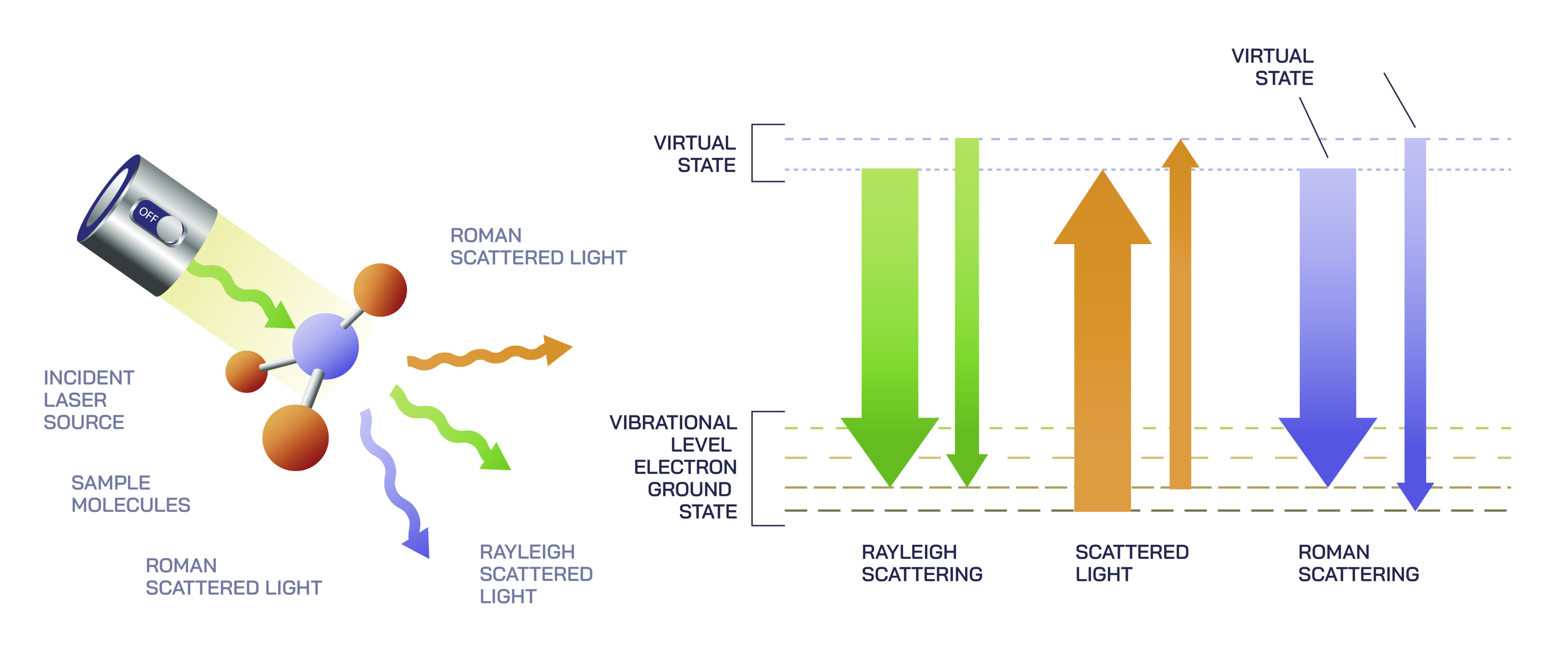
The fundamental principles of Rayleigh and Raman scattering explain how light interacts with matter in ways that reveal the structural and molecular properties of substances, and a diagram illustrating these phenomena typically shows a beam of monochromatic light striking a particle or molecule and emerging as scattered light along different pathways that correspond to different energy exchanges. Even though both effects originate from the same basic process of photons striking molecules, the outcomes are categorically different because Rayleigh scattering produces scattered light of the same frequency as the incoming beam, while Raman scattering produces scattered light of different frequencies due to an energy transfer between photons and molecular vibrational states. In the diagram, the Rayleigh line appears centered at the same wavelength as the incident light because no net energy change occurs, whereas the Raman lines appear shifted in either direction from the Rayleigh peak depending on whether the molecular vibration gained or lost energy in the interaction. These shifts, often marked as Stokes and Anti-Stokes components, visually demonstrate that Raman scattering contains spectroscopic information linked to vibrational energy levels, whereas Rayleigh scattering reflects only the elastic scattering of light without encoding vibrational details.
Understanding the physical foundation of Rayleigh scattering becomes easier when considering that it is an elastic process — the molecules temporarily polarize under the influence of the incoming electromagnetic field but return to their original state without any internal energy change, meaning the outgoing photons retain the same energy and wavelength as those that entered. This explains why Rayleigh-scattered light has the same color as the light source and why its intensity depends on the fourth power of wavelength, resulting in shorter wavelengths such as blue being scattered much more strongly than longer wavelengths like red. This wavelength dependence is the reason the sky appears blue during the day, because sunlight interacting with atmospheric molecules preferentially scatters the blue part of the spectrum toward observers. In a diagram, this property is often shown by a dominant central peak representing the overwhelming proportion of Rayleigh scattering relative to Raman scattering, since only a very small fraction of photons undergo the inelastic interactions that give rise to Raman signals. While Rayleigh scattering provides important insight into particle size, atmospheric optics, and light propagation properties, it does not allow the identification of molecular structure because the scattered light frequency does not encode vibrational or chemical information.
Raman scattering, in contrast, is an inelastic process that shifts the energy of scattered photons in accordance with the vibrational modes of the molecule involved, meaning that during the interaction, the photon briefly couples with the molecule and either excites it to a higher vibrational level or returns energy to a molecule already in an excited vibrational state. When the photon loses energy to the molecule, the scattered light appears at a lower frequency than the original — the Stokes line. When the photon gains energy from a vibrationally excited molecule, the scattered light appears at a higher frequency — the Anti-Stokes line. In a diagram, these appear symmetrically around the central Rayleigh peak, though the Stokes line is usually more intense because most molecules at room temperature reside in the lowest vibrational state, making downward-energy scattering more probable than upward-energy scattering. What makes Raman scattering so scientifically powerful is that the frequency shifts correspond directly to discrete vibrational transitions unique to each molecular structure, transforming Raman spectra into a molecular fingerprinting method capable of identifying compounds, studying chemical bonds, analyzing crystallinity, and exploring biological samples without destructive processing.
The distinction between Rayleigh and Raman scattering in an illustrative diagram conveys a profound conceptual message: although both phenomena arise from the interaction of light with matter, only Raman scattering carries encoded information about molecular vibrational structure. This visual separation of light signals captures the heart of vibrational spectroscopy — chemical identity emerges only when energy is exchanged. The central elastic peak, representing Rayleigh scattering, shows the dominance of elastic light in overall scattering intensity, which is why special optical filters and instrumentation are needed to detect the relatively weak Raman signal against the much stronger Rayleigh background. The presence of shifted lines on either side conveys that vibrational energy levels are quantized and that light–matter interactions are governed not by continuous variations but by discrete energy exchanges tied to molecular structure.
A diagram that highlights these principles also helps explain the practical applications that arise from them, because once it becomes clear that Raman scattering is directly linked to vibrational energy levels, the technique can be understood as a non-invasive analytical method capable of probing the inner nature of materials. Fields such as chemistry, pharmaceuticals, materials science, forensics, art conservation, mineralogy, nanotechnology, and biomedical diagnostics rely on Raman scattering because it enables molecular analysis without cutting, staining, or damaging the sample. The diagram, even without accompanying text, implicitly invites this interpretation: the branching of the original beam into new wavelengths shows that scattered light contains new information not present in the original beam, and it is this new information that scientific instruments decode. Rayleigh scattering continues to play a vital role as well, particularly in atmospheric science and optical communication research, because the intensity of elastic scattering determines how light propagates through gases, liquids, and colloids and influences everything from sky coloration and sunset hues to haze, optical fiber attenuation, and imaging depth in biological tissue.
The significance of the diagram deepens when the directional aspect is considered, because the representation of scattered light emerging in all directions reinforces that both Rayleigh and Raman scattering are omnidirectional rather than mirror reflections or refractions. This means light is redistributed rather than redirected along predictable geometric paths, which is why scattering affects imaging contrast, sensor readings, remote-sensing measurements, and optical channel clarity. The diagram’s representation of molecule-light interaction also illustrates how light polarizes molecules during the scattering process, emphasizing that the temporary charge separation is what enables frequency re-radiation. Even without including mathematical expressions, the visual arrangement of arrows, energy markers, and scattered beams communicates the full sequence of events at the atomic scale: a photon approaches, interacts with a molecule, induces a temporary dipole moment, and exits with either unchanged or modified energy. The simplicity of the image contrasts with the depth of the phenomena it summarizes — a bridge between intuitive understanding and advanced spectroscopy.
Ultimately, the value of a diagram illustrating Rayleigh and Raman scattering lies not just in showing two different types of scattered light but in conveying the deeper conceptual division between motion without change and motion with transformation. Rayleigh scattering is motion without change because the light is redistributed but not altered in wavelength, resulting in insight into light propagation but not molecular identity. Raman scattering is motion with transformation because the exchange of energy produces a modified wavelength that reveals the vibrational dynamics of the molecule. The combination of both in a single illustration captures the complexity of light–matter interaction in a single moment: structure, identity, and material composition surface only when energy shifts occur, while the overwhelming majority of scattering simply redistributes the original light. Such a diagram does not merely show paths but conveys meaning, turning abstract interactions into graspable knowledge and shaping how students, scientists, and observers perceive the hidden molecular world illuminated by light.