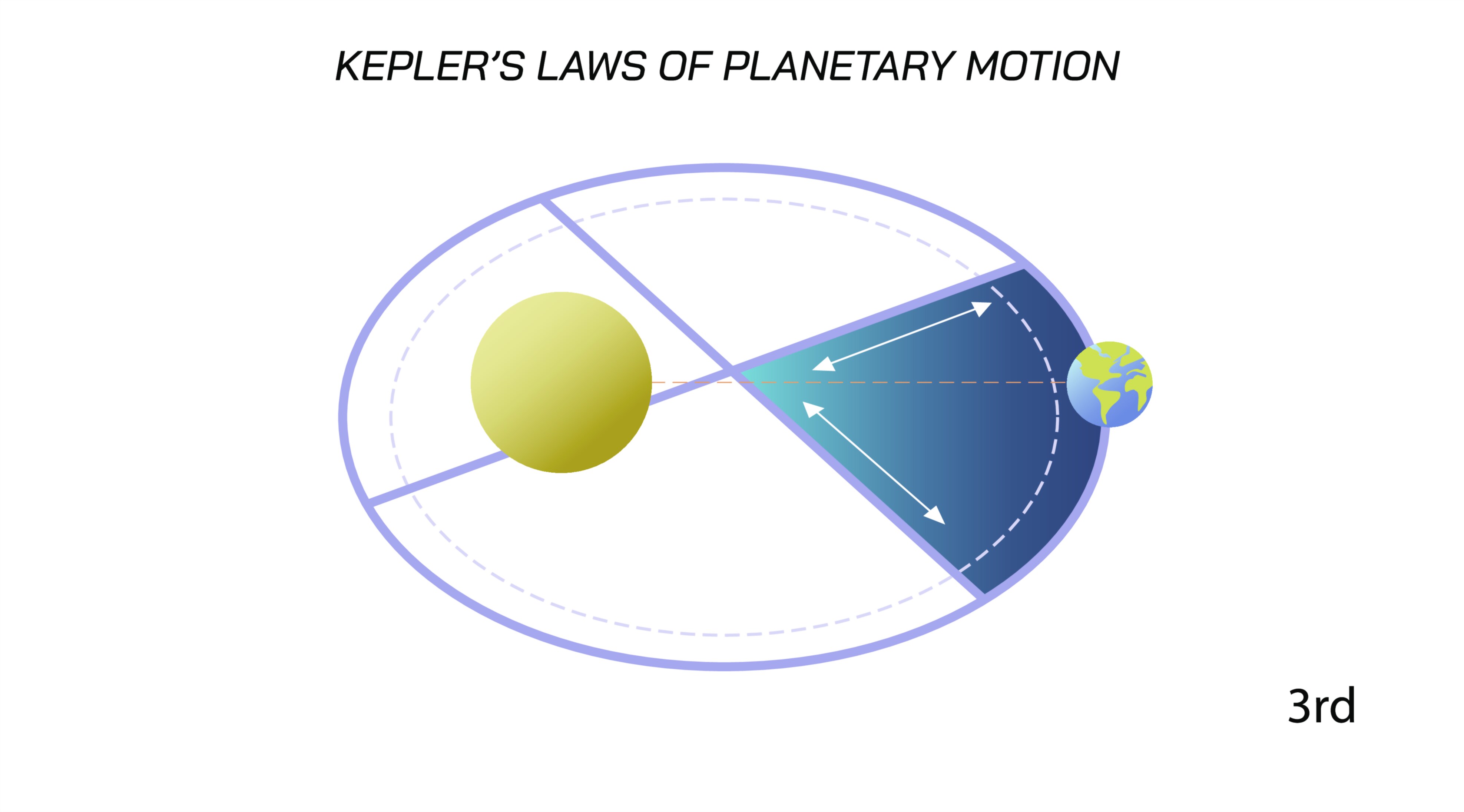
Kepler’s Third Law of Planetary Motion — Mathematical Harmony Between Orbital Period and Distance from the Sun
Kepler’s third law of planetary motion reveals a profound and elegant connection between the time a planet takes to complete one full orbit around the Sun and its average distance from the Sun, offering one of the most powerful insights into the structure and balance of the solar system. The law states that the square of a planet’s orbital period is proportional to the cube of its average orbital radius. Without using formulas, the meaning is simple: planets that are farther from the Sun take much longer to complete their orbits than those that are closer. This is not a linear relationship but a geometric one, meaning that the increase in orbital time is much larger than the increase in distance. When represented through a vector illustration, the law becomes visually intuitive, because planets can be shown at different average distances from the Sun with their respective orbital paths and time clocks, highlighting how orbital duration expands dramatically as distance grows.
Kepler’s third law transformed astronomy by providing a dependable mathematical structure that applied to every planet in the solar system, not just Earth. Before this law was discovered, astronomers believed that planetary motion followed patterns specific to each planet rather than a single universal rule. Kepler demonstrated that all planets — from the fast-moving Mercury to the distant and slow-moving Saturn — obey the same proportional relationship between time and distance. The farther a planet moves away from the Sun, the weaker the gravitational pull acting on it and the slower it travels along its orbit. As a result, a planet in an outer orbit requires far more time to sweep across the full ellipse than one circling closer to the Sun. This shift in speed and orbital time builds a cosmic rhythm in which planets appear arranged not randomly, but in a mathematically coordinated gravitational system.
In educational diagrams, Kepler’s third law is typically visualized by showing planets orbiting the Sun at increasing distances along with their orbital durations. A vector illustration might show the inner planets tracing small, rapidly completed orbits, while outer planets trace broad loops with time indicators showing significantly longer orbital periods. These images help learners understand scale not only in space but in time. Mercury takes only about three Earth months to orbit the Sun, while Neptune takes more than 165 Earth years. The huge difference in orbital length is not because Neptune’s orbit is only a little larger, but because increasing distance from the Sun dramatically decreases orbital speed. By emphasizing this connection visually, the third law becomes accessible even without technical equations.
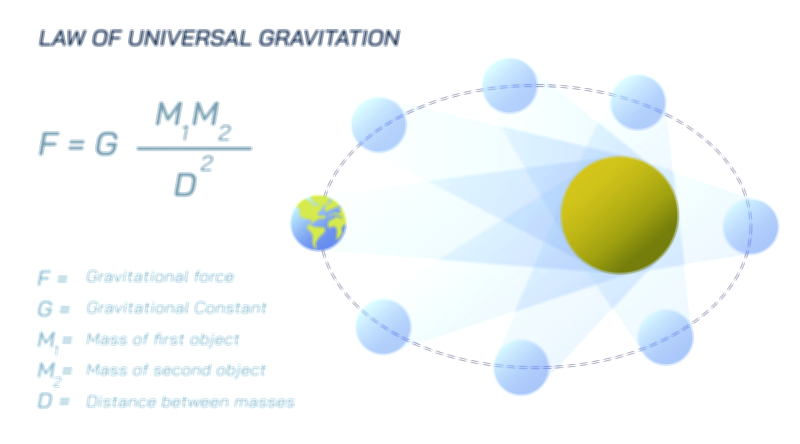
The law also introduced the idea that the solar system behaves as a unified physical mechanism rather than a set of independent celestial paths. Kepler’s proportional relationship laid the groundwork for later understanding of gravitational dynamics. It inspired Isaac Newton to search for a force capable of explaining why planets slow down with increasing distance, which ultimately led to his formulation of the law of universal gravitation. Without Kepler’s third law, Newton might not have recognized that gravitational attraction follows predictable rules based on distance and mass. Because of this, Kepler’s law is not only an astronomical discovery; it is one of the stepping-stones that shaped modern physics.
The third law has another crucial educational value: it introduces scale in astronomy. Orbit sizes and orbital times increase so dramatically that they help demonstrate how vast the outer solar system really is. Although Jupiter’s orbit lies just beyond the asteroid belt, it takes nearly 12 years to travel around the Sun, while Saturn takes nearly 30 years. These differences become far more dramatic in vector graphics, where orbital paths can be sized proportionally and time icons or labels illustrate how slowly the outer planets progress. Students who compare Earth’s one-year cycle with Uranus’s 84-year cycle or Neptune’s century-plus period gain a deeper understanding of the immensity of space.
Kepler’s third law applies far beyond our Sun. It holds true for moons orbiting planets, planets orbiting other stars, and even artificial satellites orbiting Earth—although adjustments are needed for non-circular or heavily perturbed orbits. This universality is a defining reason the law is so important in astronomy and aerospace engineering. Space agencies rely on the same principle that governs planetary periods when placing satellites in low-Earth or geostationary orbit. A satellite close to Earth circles rapidly, while one placed farther away takes much longer. If the time period must match Earth’s rotation so the satellite stays fixed over one region of the globe, engineers simply select the exact orbital distance that satisfies Kepler’s proportional rule. The law governs not only the natural dance of planets but the designed motion of machines that humanity places into space.
At a deeper intellectual level, Kepler’s third law communicates that the universe favors patterns over chaos. Motion in the solar system does not unfold randomly but follows a rhythm shaped by gravitational balance. The planets move at different speeds, but their differences are not arbitrary — they are the natural consequence of distance from the Sun. The farther a planet is, the more space it must travel and the weaker the Sun’s pull becomes, meaning time stretches in proportion to distance. A vector illustration showing the orbits as measured loops around the Sun visually expresses this balance, making the static notion of distance transform into a dynamic narrative of motion across time.
This law also reveals that astronomical understanding does not require direct observation across centuries. Kepler derived his insights without watching multiple planets complete full orbits, but by analyzing precise positional records and looking for hidden relationships. His third law stands as a reminder that science is not only about seeing—it is about noticing patterns within what is seen. It represents the bridge between the geometry of planetary paths and the physics of gravity that governs them.
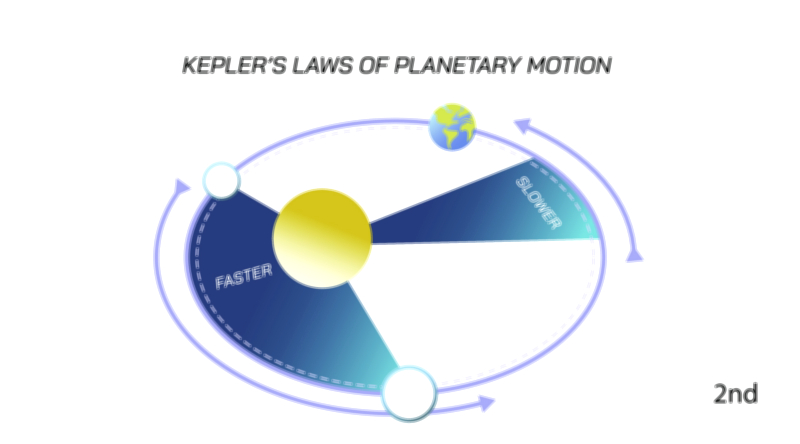
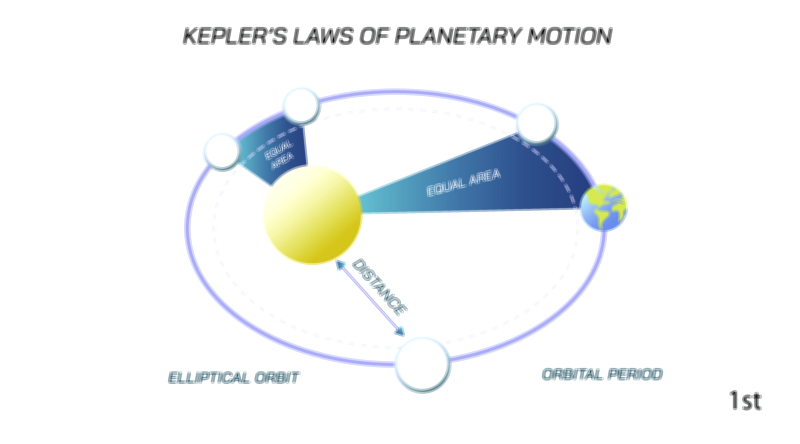
In astronomy education, Kepler’s third law becomes the final piece in understanding orbital behavior. His first law showed that planetary orbits are ellipses, not perfect circles. His second law showed that orbital speed changes depending on distance from the Sun. His third law binds the system together by demonstrating that distance determines how long the full orbit takes. The combination of all three laws reveals not only how planets move, but why their movement expresses order, symmetry, and mathematical beauty on a cosmic scale.
Thus, the vector illustration of Kepler’s third law is not simply a diagram of circles or ellipses labeled with numbers — it is a visual expression of the harmony of the solar system. It shows that space is not vast emptiness but a structured arena in which celestial bodies follow ancient and predictable rhythms. Kepler’s discovery teaches that the architecture of the universe can be understood through observation, reasoning, and geometry, proving that the motions of worlds — once thought mysterious — follow natural laws that can be revealed to the human mind.