Solar and Lunar Eclipse Illustration Showing Sun, Earth, and Moon Alignment
A solar and lunar eclipse illustration is one of the most effective ways to understand how the Sun, Earth, and Moon move in relation to each other and how their alignment causes dramatic visual events in the sky. Although both eclipses involve shadows and alignment, they arise from opposite configurations of the three celestial bodies. The illustrated diagrams nearly always highlight the positions of the Sun as the radiant light source, the Earth as the central participant, and the Moon as the orbiting body whose position determines which type of eclipse occurs. When these bodies form a straight or nearly straight line, sunlight is either blocked by the Moon or intercepted by the Earth, creating a temporary interruption in the light that normally reaches the observer. The value of an eclipse illustration is not simply in depicting this alignment but in showing the geometry of shadows—umbra and penumbra—and how the observer’s location influences what kind of eclipse they experience.
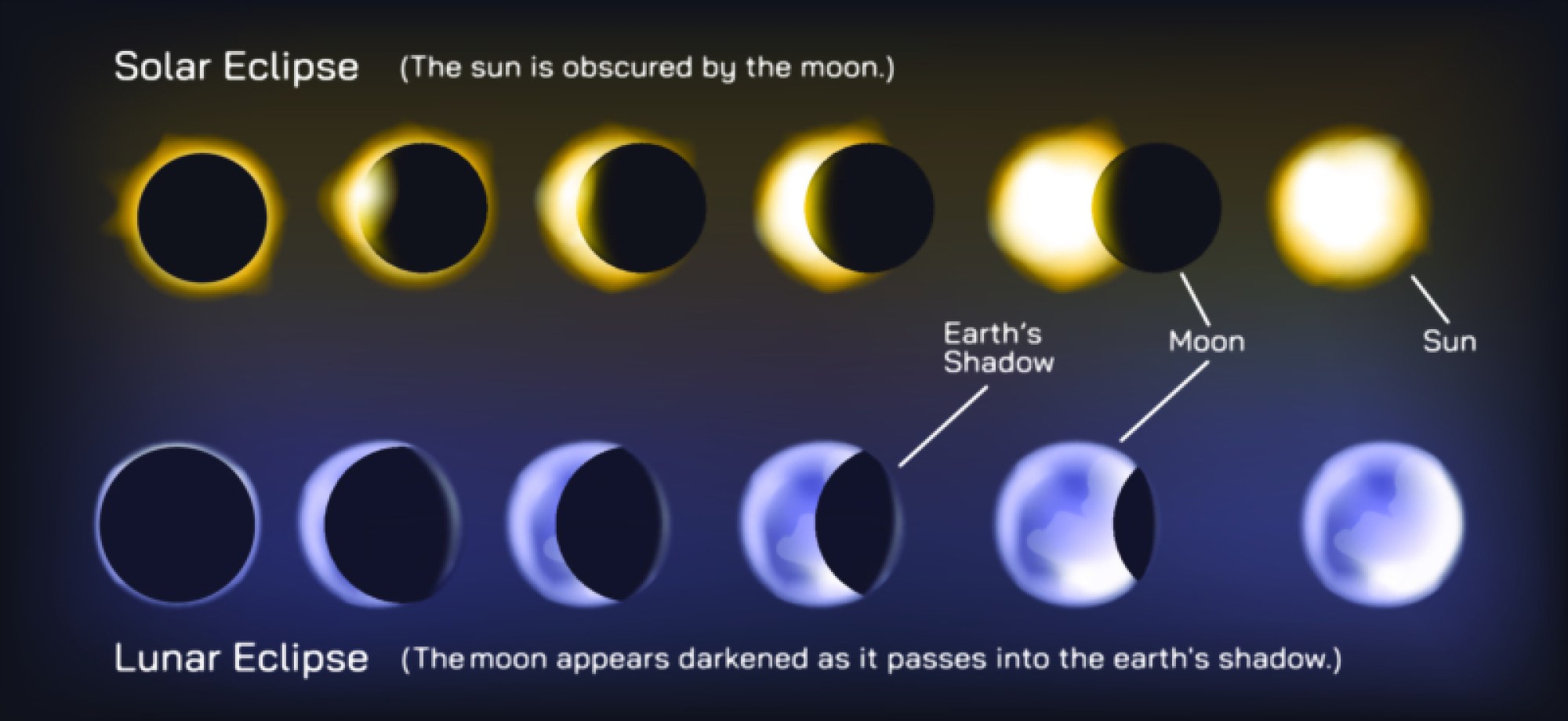
A solar eclipse occurs when the Moon passes directly between the Earth and the Sun, blocking sunlight and casting a shadow on the Earth. In a diagram, the Sun appears at one end emitting broad beams of light that travel toward the Earth. The Moon, positioned between the Sun and Earth, intercepts that light. The shadow it casts is shown narrowing as it reaches the Earth’s surface. The darkest inner shadow, known as the umbra, produces a total solar eclipse for observers located within it, meaning the Sun becomes fully hidden behind the Moon. Surrounding the umbra is a lighter shadow called the penumbra, where observers see a partial solar eclipse because only part of the Sun’s disk is covered. When the Moon is farther away in its orbit and appears slightly smaller in the sky, the umbra may not reach the Earth’s surface, resulting in an annular eclipse, illustrated by a “ring of fire” where the Sun’s outer edges remain visible. All solar eclipse diagrams feature a ground-level viewing perspective on Earth to show why only certain regions experience totality while others experience partial coverage. This emphasizes that solar eclipses are alignment-dependent and location-specific.
A lunar eclipse, by contrast, occurs when the Earth positions itself between the Sun and the Moon, causing the Moon to pass through Earth’s shadow. In an illustration, the Sun again sits at one end producing straight rays of light, but this time the Earth blocks those rays from reaching the Moon. The Earth’s umbra forms a wide cone-shaped shadow extending into space; when the Moon enters this deep shadow, a total lunar eclipse occurs. During this phase, instead of going dark, the Moon often turns a coppery or reddish tone because some sunlight bends through Earth’s atmosphere and scatters toward the lunar surface. The atmospheric filtering of blue and green wavelengths leaves behind red and orange hues, giving rise to the so-called “blood moon.” If the Moon enters only the lighter penumbral region of the Earth’s shadow, a penumbral eclipse occurs, appearing as a subtle shading rather than a dramatic transformation. A partial lunar eclipse occurs when only part of the Moon passes through the umbra. Lunar eclipse diagrams make it clear that—unlike solar eclipses—anyone on the night side of Earth can potentially witness the event, making lunar eclipses far more accessible globally.
When solar and lunar eclipse illustrations are placed side by side, they create an intuitive comparison between two cosmic alignments. The solar eclipse diagram shows the order:
Sun → Moon → Earth
while the lunar eclipse diagram shows the order:
Sun → Earth → Moon
This reversal forms the essence of the difference. Illustrations highlighting these alignments often draw parallel arrows showing how sunlight travels and how the body in the middle determines where the shadow falls. The Moon casts a tapered shadow onto Earth during a solar eclipse, but the much larger Earth casts a wide shadow that envelops the Moon during a lunar eclipse. Thus, while solar eclipses affect a small area on Earth and last only minutes in totality, lunar eclipses can be seen by half of the planet and unfold over several hours.
An effective eclipse illustration also emphasizes the role of orbital tilt. Even though the Moon orbits the Earth every 27 days, eclipses do not occur monthly because the Moon’s orbit is tilted about 5 degrees relative to Earth’s orbital plane around the Sun (the ecliptic). Most of the time, the Moon passes slightly above or below the direct line of sunlight. Only when the Sun, Earth, and Moon align closely enough—during what is known as syzygy—does an eclipse take place. Some diagrams include a side view of the orbital tilt to clarify that alignments enabling eclipses are special events, not regular monthly occurrences. This detail helps explain the rarity and predictability of eclipses, which have fascinated civilizations for millennia.
Illustrations of solar and lunar eclipses are not just academic diagrams but visual frameworks that unlock understanding of celestial motion. They transform astronomical interactions into clear mental images by demonstrating who blocks light from whom, how shadows shape what observers see, and why the Earth’s position relative to the Sun and Moon determines visibility. For students of astronomy, these graphics become stepping-stones toward deeper concepts such as phases of the Moon, orbital mechanics, angular diameter, and atmospheric light scattering. For enthusiasts and the general public, they provide context that heightens appreciation for witnessing an eclipse—not as a random spectacle but as a predictable outcome of orbital geometry, gravitational motion, and the physics of light.
In their simplest form, solar and lunar eclipse illustrations communicate the profound idea that the universe is governed by patterns. By showing the three bodies in dynamic alignment, diagrams convert abstract astronomical concepts into a visual relationship that anyone can understand at a glance. They remind us that eclipses are not accidents of nature but moments when celestial motion reveals itself with striking clarity—when light and shadow, distance and alignment, all come together to change what we see in the sky and invite us to reflect on our position within the cosmic architecture.