Plant Grafting Types: Budding, Approach, Splice, and Cleft Grafting Techniques Explained
Grafting is one of the most impactful techniques in plant propagation, allowing horticulturists to combine the desirable traits of two different plants into a single, unified organism. While seeds reproduce genetic variation and cuttings clone identical stems, grafting achieves a biological partnership: the root system of one plant, known as the rootstock, becomes the foundation for the shoot of another plant, known as the scion. When the graft union heals successfully, the two tissues grow together and form a single vascular system, enabling nutrients, water, and and hormones to flow unhindered between them. This makes it possible to merge the disease resistance, soil adaptation, or size control of one plant with the fruit quality, flowering variety, or ornamental appearance of another. Among the many grafting methods practiced in agriculture, budding, approach grafting, splice grafting, and cleft grafting are four of the most widely used, each tailored to specific plant materials and propagation goals.
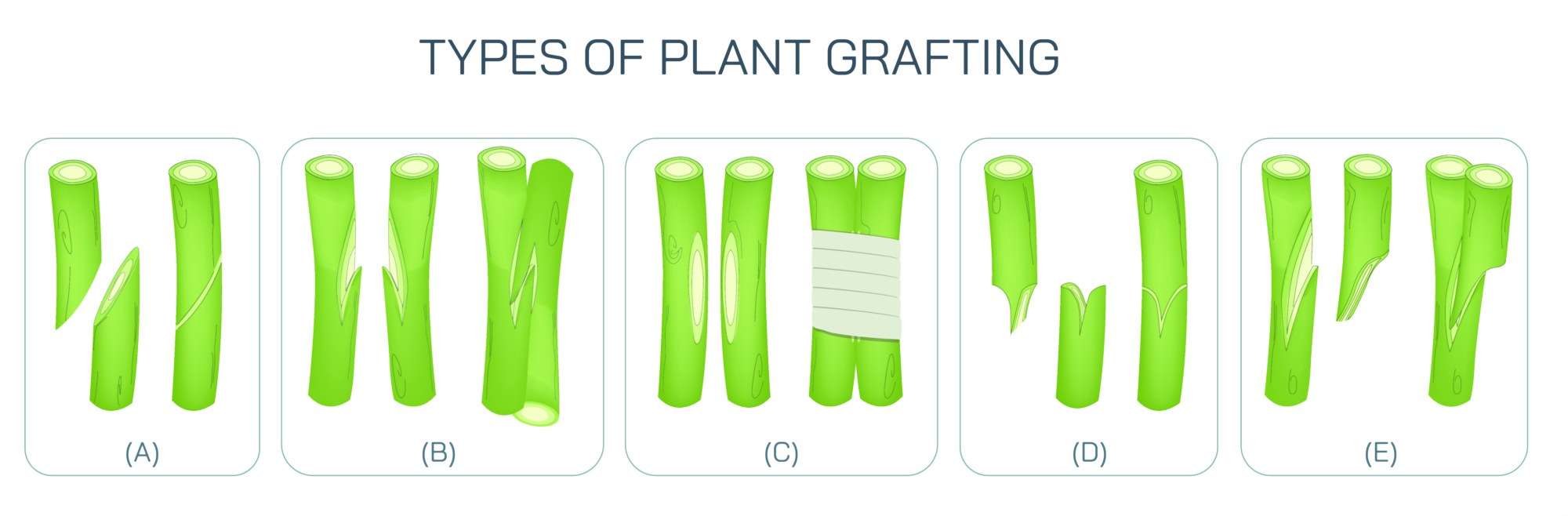
Budding grafting represents one of the most refined forms of grafting because it requires uniting only a single bud from the scion rather than a full stem piece. In this technique, a healthy bud from the desired plant is removed along with a thin sliver of bark and cambium tissue. The rootstock is then prepared by making an incision—often in the shape of a “T” or a chip cut—where the bud shield is inserted so that the cambium of the bud aligns closely with the cambium of the rootstock. Once held in place with tape or grafting wrap, the tissues begin to fuse, and if the union is successful, the bud eventually sprouts to form a new shoot. Budding is highly efficient and widely used in fruit trees and roses because it enables rapid production of uniform plants using very little scion material. By inserting a single bud per plant, budding allows growers to propagate thousands of grafted trees from limited budwood.
Approach grafting differs from most other methods because both the rootstock and the scion remain attached to their original root systems during the healing period. Instead of cutting either plant completely, each is wounded on the contact side by removing a strip of bark and cambium to expose the inner tissue. The two exposed surfaces are then matched and tied together so that the cambium layers make contact. Over time, the tissues naturally fuse while both plants continue to live independently. Once the graft union becomes strong and functional, the scion is severed from its original root system and the rootstock is pruned to transfer full support to the grafted branch. Approach grafting is commonly used when working with plants that are difficult to graft by standard methods or when environmental conditions make graft failure risky. Because both plants remain fully nourished during the healing process, the technique offers a high success rate, particularly for ornamentals and rare or slow-growing species.
Splice grafting is a technique used when the rootstock and scion have similar diameters and can be joined by matching smooth, slanted cuts. Both pieces are cut with a long diagonal slice to create flat surfaces, and when the scion is placed onto the rootstock, the angles allow the cambium layers to align over a large contact area. The graft is then tightly wrapped to prevent drying and to maintain close contact between the tissues. Because splice grafting provides a clean and expansive interface for vascular connection, it is frequently used for young plants, softwood material, and situations in which rapid bonding is essential. It is common for grapes, flowering shrubs, and many fruit trees, especially where precision and clean surfaces increase the chance of successful union. The simplicity of the method makes it widely accessible, but success still depends on matching diameters and maintaining moisture to prevent desiccation.
Cleft grafting, by contrast, is a powerful technique designed for situations in which the rootstock is significantly thicker than the scion. It is especially valuable when topworking established trees — replacing their canopy with new fruiting varieties without uprooting the mature root system. To perform cleft grafting, the rootstock branch or trunk is cut horizontally and split through the center to create a cleft. One or two scions, each shaped into a wedge at the base, are inserted into the slit so that their cambium layers align with the inner edges of the rootstock. Once secured by sealing compounds or binding material, the scions begin to heal alongside the cambium of the rootstock, eventually initiating new growth that overtakes the original upper canopy. Cleft grafting allows orchard growers to switch varieties rapidly, boosting productivity or adapting to market demands without waiting years for new trees to mature.
Despite their structural differences, all grafting types rely on one biological principle: for a graft to succeed, the cambium tissues of the rootstock and scion must contact one another closely. This cambium is the zone of actively dividing cells responsible for forming new vascular tissue. When grafting wounds are aligned, the cut surfaces generate callus tissue that bridges the gap between the two plant segments. Over time, this callus differentiates into xylem and phloem, creating a functional vascular network shared by both partners. When performed incorrectly — with misaligned cambium or poorly sealed cuts — dehydration, infection, or incompatibility prevents the union from forming. When performed correctly, grafting can produce long-lived, healthy plants that behave as a single organism.
The choice among budding, approach grafting, splice grafting, and cleft grafting depends on the growing conditions, the age and thickness of plant materials, the time of year, and the ultimate purpose of propagation. Budding maximizes efficiency and produces uniform commercial fruit trees. Approach grafting provides high success for difficult or delicate species. Splice grafting ensures quick fusion when working with young stems of equal size. Cleft grafting enables the transformation of mature trees without starting from scratch. Taken together, these techniques have allowed humanity to shape orchards, vineyards, forests, and landscapes in ways that maximize survival, produce higher yields, preserve heirloom varieties, and create cultivars that would never exist through natural reproduction alone.
Ultimately, grafting demonstrates both the resilience and adaptability of plants. It shows that plant tissues, when placed in optimal alignment, can merge and share life even if they originated from different genetic lineages. The principles behind budding, approach, splice, and cleft grafting reveal not only horticultural skill but also botanical biology: plants do not depend solely on seeds for continuity. Through grafting, humans and plants work together to combine strengths, overcome weaknesses, and generate new forms of growth shaped by both nature and cultivation.