Plant Branching Showing Types of Branches, Apical Growth, Lateral Growth, and Node Arrangement
Plant branching is one of the most fascinating expressions of growth in the natural world, demonstrating how a plant expands its reach toward sunlight while balancing structural strength, resource distribution, and reproductive strategy. A vector illustration that highlights plant branching typically showcases the different forms of branches, the biological processes governing apical and lateral growth, and the way nodes and internodes determine the spatial arrangement of new shoots. Even though branching may seem like a simple spreading of stems, it is actually a highly regulated developmental mechanism influenced by hormones, genetics, environmental conditions, and photosynthetic demand. Visualizing these processes shows how plants shape themselves in response to light, gravity, water, nutrients, and seasonal rhythms, creating structures as intricate as any engineered design yet guided entirely by biological rules.
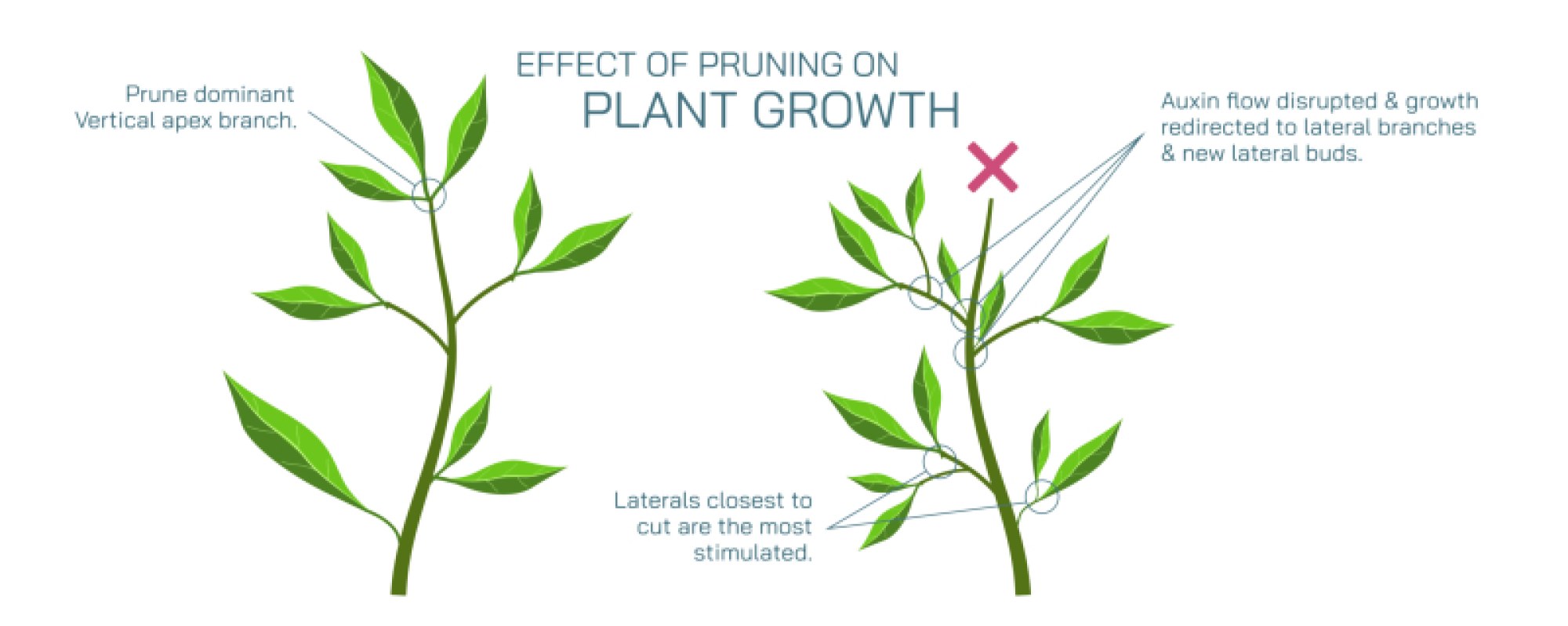
At the top of the plant resides the apical bud, sometimes known as the terminal bud, which drives the apical growth that elongates the main stem upward. This primary growing point contains a cluster of rapidly dividing meristematic cells, and in vector illustrations it is often depicted at the tip of the central stem. Apical growth allows the plant to grow toward sunlight and maintain vertical dominance within its environment. The phenomenon of apical dominance — controlled mainly by the hormone auxin — suppresses the activation of lateral buds below the main shoot. As long as the apical bud remains intact, auxin flows downward through the stem, signaling the plant that upward growth is the priority. This ensures that seedlings and young plants concentrate their energy on reaching an optimal position for light exposure before investing resources in outward branching.
However, plants must also expand sideways to form leaves, flowers, fruits, and structural support, and this is made possible by lateral growth. Lateral branches arise from axillary buds located along the stem at each node — the small junction where a leaf attaches. In illustrations, these axillary buds are shown nestled between the main stem and the leaf petiole, ready to grow when environmental and hormonal conditions permit. When the apical bud is pruned, damaged, or naturally loses dominance with maturity, auxin levels decrease and cytokinin levels rise, triggering these axillary buds to grow into new branches. As a result, the plant transitions from a single upward direction to a broader, more complex branching pattern that increases leaf area, expands photosynthetic surface, and improves reproductive opportunities.
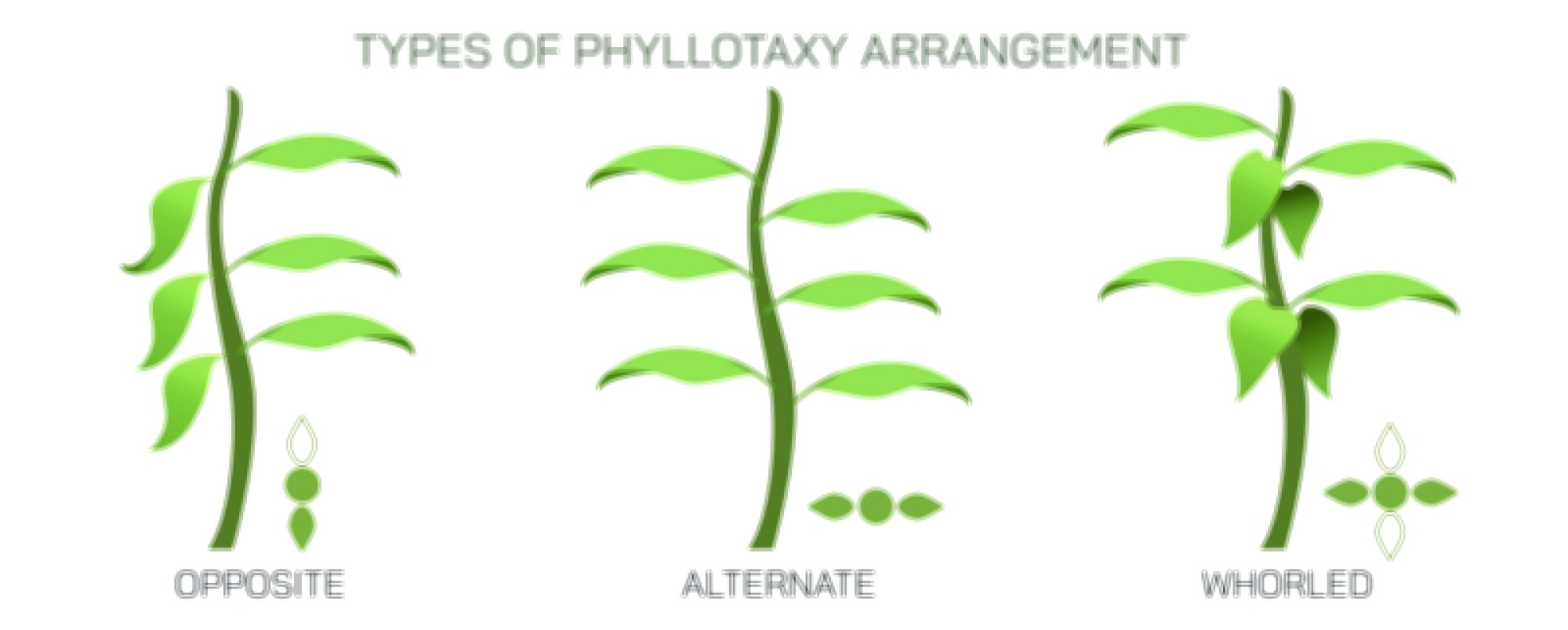
The pattern of branching across the plant depends heavily on node arrangement, which dictates the geometric spacing of leaves along the stem. In a vector model, nodes appear as repeated growth points and the internodes — the stem segments between nodes — determine the distance between branches. Plants display several node arrangements that lead to distinctive branching architectures. In alternate phyllotaxy, one node emerges per position on the stem, each slightly offset from the previous, creating a spiral or staggered arrangement that maximizes light capture. In opposite phyllotaxy, pairs of leaves and buds emerge directly across from each other, often leading to symmetrical branching. In whorled phyllotaxy, three or more leaves and buds form at a single node, producing dense circular growth points around the stem. These arrangements are not simply aesthetic variations — they determine how efficiently the plant can intercept light while minimizing self-shading and allowing airflow to reduce moisture buildup that could invite disease.
Different plants and environments favor different branching types, which are often distinguished in illustrations by their structural patterns. Monopodial branching occurs when the main apical shoot remains dominant throughout the plant’s life, adding lateral branches but preserving the central trunk as the longest axis. Pine trees, palms, and many hardwoods follow this scheme, resulting in a clear upward-leading form. Sympodial branching, on the other hand, occurs when the apical shoot ceases growth — due to flowering, dormancy, or internal timing — and one of the lateral buds takes over as the new leader. Repetition of this process creates zig-zag or forked branching patterns common in shrubs, tomatoes, and certain ornamental plants. Another contrast appears in dichotomous branching, in which the growing tip splits evenly into two branches repeatedly, forming a highly symmetrical and forked growth system seen in cycads and some ferns.
In addition to branching type and node arrangement, the direction of branch growth carries adaptive meaning. Branches that grow orthotropically (upright) help compete for vertical light and structural height, while plagiotropic branches (angled or horizontal) contribute to canopy spread and reproductive positioning. Many trees display both — upward branches form the main architecture of the canopy while horizontal branches support leaves and flowers that require maximum sun exposure. What might look like spontaneous growth is actually a coordinated strategy to stabilize the trunk, distribute mechanical load evenly, capture optimal sunlight, and protect vital tissues from wind stress. These structural decisions are influenced by hormone gradients, mechanical feedback from wind, the angle of sunlight, and even gravity-sensitive cells called statocytes that guide branch bending to maintain optimal orientation.
Plant branching also reflects life cycle strategy. Fast-growing annuals prioritize quick lateral expansion to maximize photosynthetic gain within a single season, while long-lived trees invest in sturdy monopodial trunks first and build complex secondary branching networks over decades. In forest ecology, branching style influences the entire community — narrow conifers let snow fall through efficiently while broad deciduous canopies create deep shade below. In agriculture and horticulture, humans manipulate branching on purpose: pruning reduces apical dominance to stimulate lateral shoots, increasing flowering and fruit yield. The science of shaping branching patterns is fundamental to bonsai artistry, vineyard cultivation, orchard management, forestry, and landscape architecture.
The biomechanics of branching add another layer of sophistication. The angles of branches influence how weight and force travel through the plant's structure. A narrow angle may create a strong joint resistant to wind stress but may limit sunlight penetration, while a wider angle increases photosynthetic exposure but may be weaker under heavy loads. The distribution of branches from lower to upper portions affects stability; trees that retain only upper branches can become top heavy and prone to uprooting in storms, while those that retain structured lower support can distribute weight more safely. These mechanical decisions emerge biologically from growth regulators, not conscious planning, yet the results are evolutionarily refined.
A vector illustration showing branching types, apical and lateral growth, and node arrangement often labels the main stem, apical bud, axillary buds, nodes, internodes, and different branch patterns. Arrows may highlight hormone movement, growth direction, or light interception. The intent is not only to depict the shape of a plant but to communicate the invisible rules that produce that shape — how dominance shifts from tip to sides, how nodes determine geometry, and how branching forms adapt to environment and function.
When viewed from a distance, a plant’s branching pattern appears simply natural; when viewed biologically, it becomes a high-level problem-solving process. Apical growth ensures height and competition for light. Lateral growth expands photosynthetic surface, reproductive potential, and canopy size. Node arrangement directs geometric efficiency. Branching architecture reflects long-term adaptation to climate, wind, soil, and light. This is why different plants — even when genetically unrelated — develop similar branching styles in similar ecological environments; branching is a universal solution to a universal challenge: capturing sunlight while maintaining structure.
In summary, the concept illustrated by branching diagrams is both botanical and architectural. Through branches, apical tips, lateral nodes, and phyllotactic spacing, a plant builds the structure it needs to survive. Growth may appear slow and silent, yet it follows precise biological algorithms that optimize sunlight, support, reproduction, and longevity. What begins as a single meristem becomes a complex three-dimensional system — not by mechanical blueprint but through living developmental cues. Thus, plant branching is more than a pattern; it is a record of the plant’s decisions, adaptations, and resilience over time, written in every fork, angle, and node along its stems.