Alternate and Whorled Phyllotaxy Showing Leaf Arrangement Patterns and Botanical Structure on the Stem
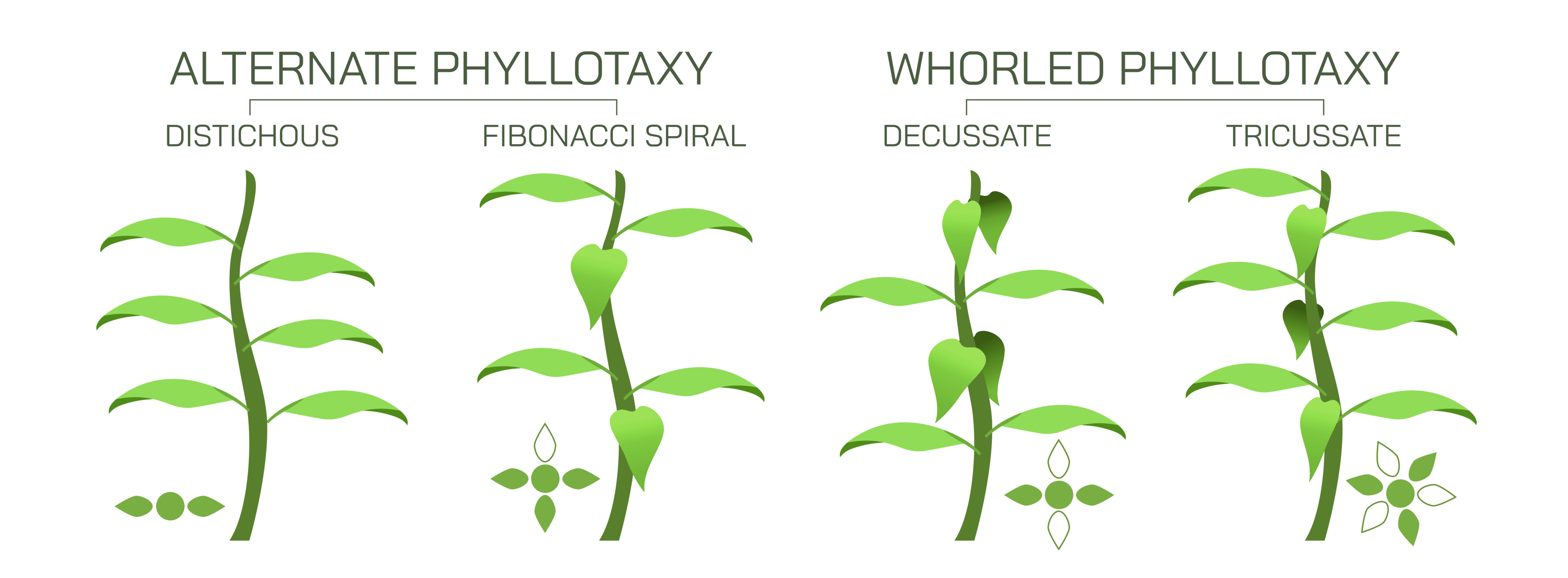
Phyllotaxy refers to the specific pattern in which leaves are arranged along the stem of a plant, and it plays a central role in determining how effectively a plant captures sunlight, balances internal growth forces, and interacts physically with its surroundings. Although leaves may seem to appear randomly on branches at first glance, their arrangement follows highly controlled developmental programs that evolved to maximize photosynthetic efficiency, minimize self-shading, distribute weight, and ensure structural stability. Among the most widely studied arrangements in the botanical world are alternate phyllotaxy and whorled phyllotaxy, each displaying distinct geometric organization and deeply rooted evolutionary significance. A vector illustration showing these arrangements typically depicts the stem as a vertical axis and the leaves attached in repeating positions around it, allowing viewers to visualize how plants distribute foliage to optimize both light exposure and physical balance.
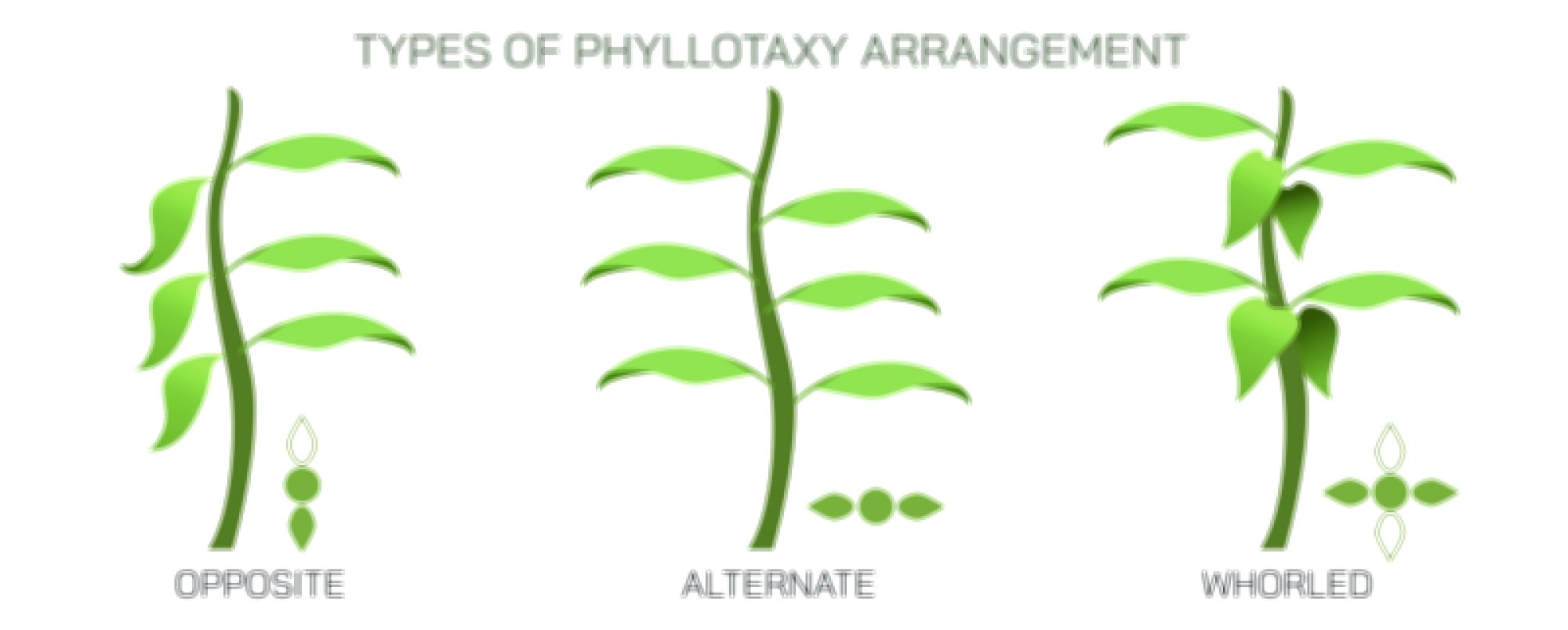
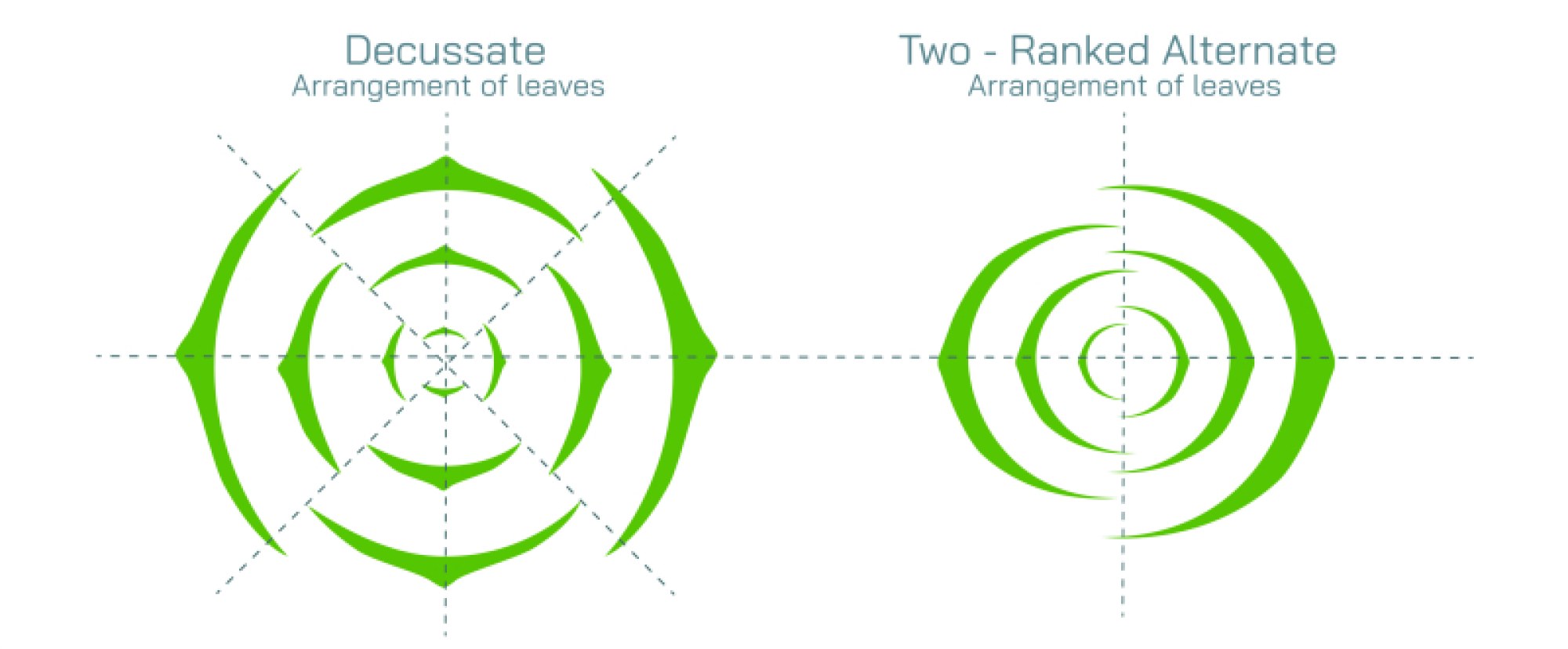
Alternate phyllotaxy is characterized by a pattern in which only one leaf arises from each node on the stem, and consecutive leaves appear on alternating sides rather than directly above each other. This arrangement produces a natural spiral or staggered structure along the stem. In classical visual representations, the leaves are shown offset at consistent angular intervals, creating a graceful, helical pattern up the stem. The spacing prevents any single leaf from being directly shaded by the leaf above it, which is essential for maximizing sunlight interception in competitive environments such as dense forests and undergrowth ecosystems. Alternate phyllotaxy is one of the most common structural patterns in flowering plants, appearing in species such as sunflowers, oaks, elms, apples, hibiscus, and roses. Even within this arrangement, variation exists: the angles separating successive leaves can vary widely among species, but they almost always produce an efficient distribution of leaf blades in three-dimensional space.
The biological mechanics behind alternate phyllotaxy involve complex hormonal interactions at the shoot apical meristem. Leaves are initiated in zones where concentrations of plant growth hormones — particularly auxin — form local peaks. Once a new leaf primordium forms, it alters hormone flow around it, preventing another leaf from emerging too close and guiding the next primordium to an open zone. This self-organizing distribution leads to a predictable alternating pattern, even without a rigid blueprint encoded in DNA. The elegance of alternate phyllotaxy lies in this effortless emergence of spiraling symmetry through chemistry and growth rather than strict architectural instructions. In diagrams, this biological sophistication becomes visible simply as a sequence of leaves positioned singly and alternating along the axis of the stem.
Whorled phyllotaxy, by contrast, displays a configuration in which three or more leaves arise from the same node, encircling the stem like spokes of a wheel. In visual form, several leaves radiate symmetrically around one point, creating a structured ring before the next whorl appears farther up the stem. This pattern is less common than alternate phyllotaxy but provides remarkable advantages in specific ecological contexts. Plants with whorled phyllotaxy typically excel in environments where strong vertical competition for light exists, such as wetland edges, tropical understory habitats, or riverbanks. The whorl creates a broad horizontal plane of leaves that captures sunlight uniformly from multiple directions. Species exhibiting this pattern include Nerium (oleander), Alstonia, Galium, and many aquatic or marsh-adapted herbaceous plants.
The geometry of whorled phyllotaxy produces layers of leaf clusters arranged at regular intervals along the stem, often resembling a series of leafy tiers. Each whorl must be spaced far enough apart vertically to avoid excessive shading of the whorl below it. Plants achieve this spacing naturally by allowing internode length — the distance between two successive nodes — to stretch until enough light penetrates to support another whorl. The number of leaves per whorl can vary: some plants consistently produce groups of three, while others may generate four, five, or more leaves at each node. Botanical diagrams commonly highlight these multiples, clearly contrasting whorled phyllotaxy with the single-leaf nodes of alternate arrangement.
From a functional standpoint, alternate and whorled phyllotaxy reflect two contrasting adaptive strategies. Alternate phyllotaxy favors gradual, continuous distribution of leaves along the stem, reducing wind resistance and minimizing excessive shading among leaves. It suits trees and shrubs that must compete over long lifetimes, where optimal spacing over many years matters more than rapid short-term leaf expansion. Whorled phyllotaxy, on the other hand, supports fast, broad leaf deployment within a short vertical interval, enabling young or fast-growing plants to quickly capture light and photosynthesize intensively. This is especially advantageous for plants with rapid seasonal growth, soft stems, or habitats where competing vegetation grows aggressively and light becomes limited quickly.
Despite their differences, both phyllotactic patterns embody mathematical efficiency, a hallmark of plant evolution. Alternate phyllotaxy often approximates a spiral arrangement related to the Fibonacci sequence and the golden angle — a spacing of approximately 137.5 degrees between successive leaves that minimizes overlap. While whorled arrangements follow radial rather than spiral geometry, the angular positions within a whorl also minimize leaf overlap and maximize surface exposure. The visual simplicity emphasized in a vector illustration — leaves placed around a central stem — masks the deep mathematical and developmental precision guiding the pattern.
The arrangement of leaves affects not only photosynthetic output but also structural mechanics. In alternate phyllotaxy, leaves distribute mass evenly around the stem, stabilizing the plant against wind by preventing uneven lateral torque. Whorled phyllotaxy supports upright stems by distributing weight symmetrically in all directions. In addition, each arrangement influences water runoff and gas exchange. The alternating pattern of leaves often improves airflow and reduces moisture retention, which limits fungal growth — a valuable trait in forest species. Whorled leaves, on the other hand, form natural troughs that may funnel water down the stem or toward the root zone, advantageous in areas with intermittent rainfall.
A complete vector illustration representing alternate and whorled phyllotaxy typically includes:
• A central vertical stem drawn clearly as the reference axis
• Leaves placed one per node and alternating along the stem for alternate phyllotaxy
• Leaves placed three or more per node in a ring for whorled phyllotaxy
• Slight shading or spacing to emphasize three-dimensional orientation
• Labels identifying nodes, internodes, and leaf orientation
• Optional top-down views showing radial positioning around the stem
Even without botanical terminology, the viewer can immediately see how leaf distribution differs between the two arrangements and how each influences light exposure and plant structure. Alternate phyllotaxy evokes a spiraling ascent of leaves, while whorled phyllotaxy evokes circular tiers that wrap around the stem.
Ultimately, phyllotaxy captures an essential truth about plant design: survival depends on how efficiently leaves interface with light, air, and space. Alternate and whorled arrangements represent two successful evolutionary strategies for distributing leaves, each with strengths that suit particular growth habits and environments. Through a single illustration, viewers witness not only how leaves appear on the stem but how plants translate geometric arrangement into biological advantage — transforming pattern into function, structure into adaptation, and simple leaf placement into a blueprint for thriving in the natural world.