Phyllotaxy Leaf Arrangement Types: Alternate, Opposite, Whorled, and Spiral Patterns Explained
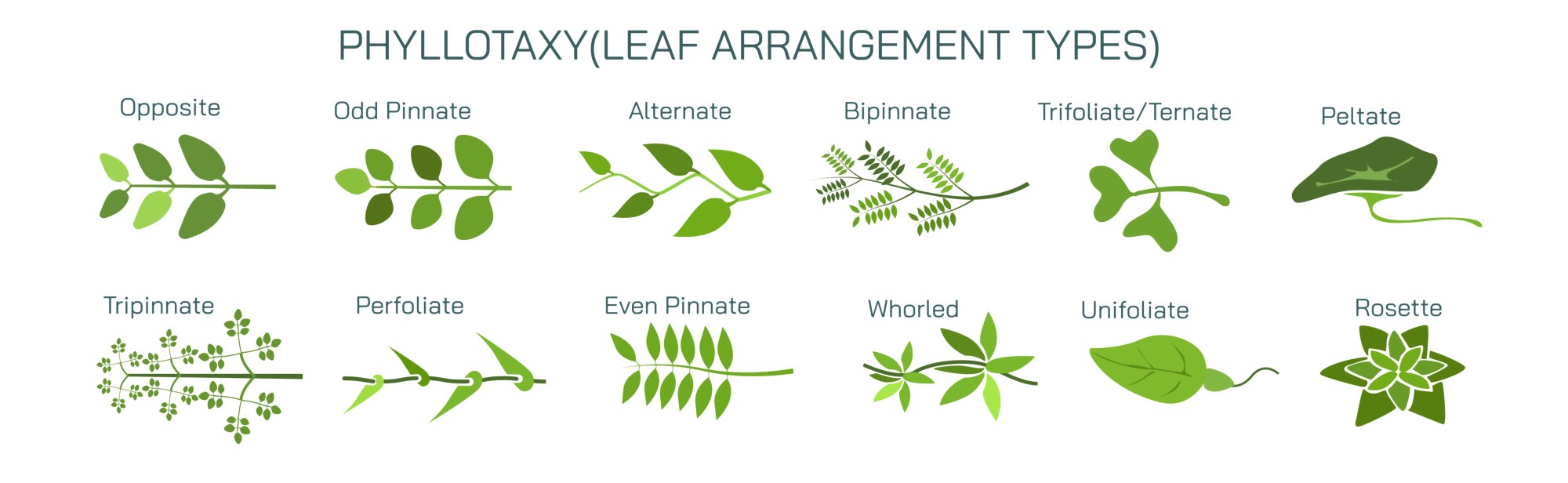
Phyllotaxy refers to the arrangement of leaves on a plant stem, and although it might seem like a botanical detail visible only to trained observers, it actually plays a crucial role in maximizing light absorption, air circulation, and photosynthetic efficiency. Plants cannot reposition themselves to chase sunlight, so their growth patterns must compensate by distributing leaves in ways that minimize shading and optimize exposure. These patterns are not random; they reflect highly evolved developmental programs shaped by genetics, hormonal signals, and geometric constraints within the growing shoot. When we study phyllotaxy closely, especially through diagrams that show leaves spaced along a stem, the orderliness of their placement becomes clear. The most widely recognized patterns are alternate, opposite, whorled, and spiral, each representing a specific strategy for arranging leaves over time as the plant continues to grow.
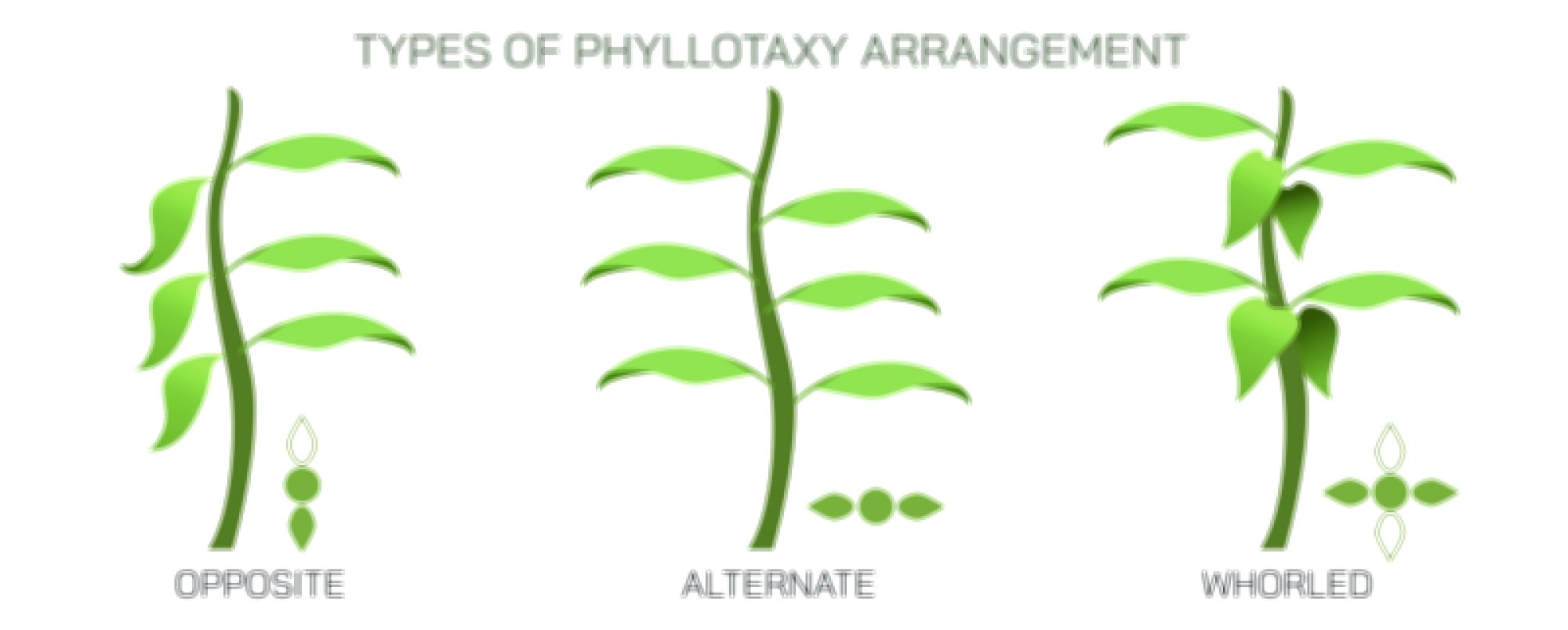
In alternate phyllotaxy, one leaf emerges at each node, and successive leaves arise on alternating sides of the stem. Viewed from above, the positions of the leaves shift around the stem rather than lining up in a vertical row. This configuration prevents upper leaves from sitting directly above lower ones and blocking sunlight. Because alternate placement rotates gradually around the stem, it creates a helical progression with only one leaf per node. Many plants such as sunflowers, apples, and oak trees exhibit alternate leaf arrangements. In alternating phyllotaxy, the distance and angular shift between successive leaves may vary depending on species, resulting in a general but flexible pattern that favors light distribution without requiring symmetry.
In opposite phyllotaxy, two leaves originate at the same node on opposite sides of the stem, forming a pair. Each pair is separated from the pair above and below by an angular rotation, typically 90 degrees, so that the pairs alternate direction as the plant grows taller. This arrangement produces a clear cross-like visual pattern when viewed along the stem. Opposite leaf arrangement is common in plants like mint, basil, maple, and jasmine. Because each node bears a matched pair of leaves, opposite phyllotaxy creates greater symmetry than alternate phyllotaxy but still avoids excessive shading because the next pair emerges at a new orientation.
In whorled phyllotaxy, three or more leaves develop from the same node, encircling the stem like spokes around a wheel. This arrangement maximizes exposure because many leaves radiate outward at the same height, eliminating overlap at that level. Plants such as Nerium, Galium, and Alstonia display whorled phyllotaxy, and the number of leaves per whorl remains consistent within a species. Whorled arrangements are particularly efficient for capturing light in open, bright habitats, but they require precise developmental timing because several leaves must form simultaneously at a node instead of one or two at a time. The even radial distribution also enhances mechanical balance around the stem.
Although alternate, opposite, and whorled describe recognizable structural patterns, spiral phyllotaxy demonstrates the deeper mathematical logic driving leaf arrangement. Spiral phyllotaxy is actually a specific form of alternate arrangement in which the angular displacement between successive leaves follows a regular ratio known as the golden angle — approximately 137.5 degrees. This angle ensures that leaves rarely overlap and instead fill the available space in an optimal packing pattern. When viewed from above, spiral phyllotaxy creates a stunning sequence of leaf positions that form logarithmic spirals reminiscent of patterns seen in pinecones, pineapples, and many seed heads. The distribution is so efficient that it maximizes light capture even as plants grow in crowded environments. The mechanical explanation lies in the shoot apical meristem, where leaf primordia compete for space and chemical gradients that cause new leaves to form where inhibitory zones do not overlap. This competition results naturally in the golden-angle spacing that produces spiral patterns.
What unites all four phyllotaxy types is the goal of minimizing self-shading and maximizing light capture. The way leaves are positioned influences how much sunlight reaches lower leaves, how air circulates through the plant canopy, and how easily raindrops and pests are shed from the plant surface. Even small geometrical differences can significantly affect photosynthetic efficiency. In addition, phyllotaxy contributes to the mechanical stability of the stem because the distribution of leaf weight affects bending and torsion forces. Plants have evolved these arrangements not through conscious strategy but through generations of selection that favor those growth patterns that maximize survival and reproduction in particular environments.
Modern biology shows that phyllotaxy is regulated by genetic programming and the plant hormone auxin. Auxin accumulates at specific points in the shoot tip and triggers leaf formation at positions where its concentration reaches a maximum. However, each newly forming leaf also creates an inhibitory zone that prevents another leaf primordium from forming too close. The interplay of auxin peaks and inhibitory fields shapes the spatial pattern in which leaves emerge. Depending on species-specific rules that govern how auxin is transported and redistributed, the plant develops alternate, opposite, whorled, or spiral phyllotaxy. The mathematical regularity seen in spiral patterns, the paired symmetry of opposite phyllotaxy, the radial uniformity of whorls, and the staggered efficiency of alternation all arise through variations of the same hormonal and developmental mechanism.
Studying phyllotaxy reveals that the arrangement of leaves is far more than a visual trait — it is a structural adaptation tied to function, energy capture, and ecological survival. Every leaf represents both an investment of resources and a miniature solar panel designed to support the plant’s metabolism. How these panels are spaced determines the overall productivity of the organism. The patterns, once recognized, are not only scientifically meaningful but also aesthetically striking, reflecting deep connections between biology and geometry. Whether a plant displays alternate staggering, opposite pairing, whorled symmetry, or spiral golden-angle spacing, its phyllotaxy represents a finely tuned solution to the challenge of maximizing sunlight while minimizing internal competition. Through these arrangements, plants translate biological growth into mathematical architecture, building structures that support their survival using only the principles of development, physics, and evolution.