Phyllotaxy Arrangement Types Explained: Alternate, Opposite, and Whorled Leaf Patterns
Phyllotaxy, the pattern in which leaves are arranged on the stem of a plant, holds remarkable significance in understanding the structural and physiological principles of plant growth. Every plant must optimize its exposure to sunlight for effective photosynthesis, and the orientation of leaves plays a silent yet powerful role in ensuring that no leaf excessively shades the other. This arrangement is not random but follows highly organized patterns that have evolved over millions of years, shaping diversity in the plant kingdom. Alternate, opposite, and whorled phyllotaxy represent the three major patterns by which the placement of foliage along the stem helps balance light capture, airflow, water distribution, and structural stability. These arrangements are far more than aesthetic botanical traits; they reflect adaptation strategies and survival mechanisms that different plants employ in their unique habitats.
Alternate phyllotaxy and its structural advantage in plant evolution
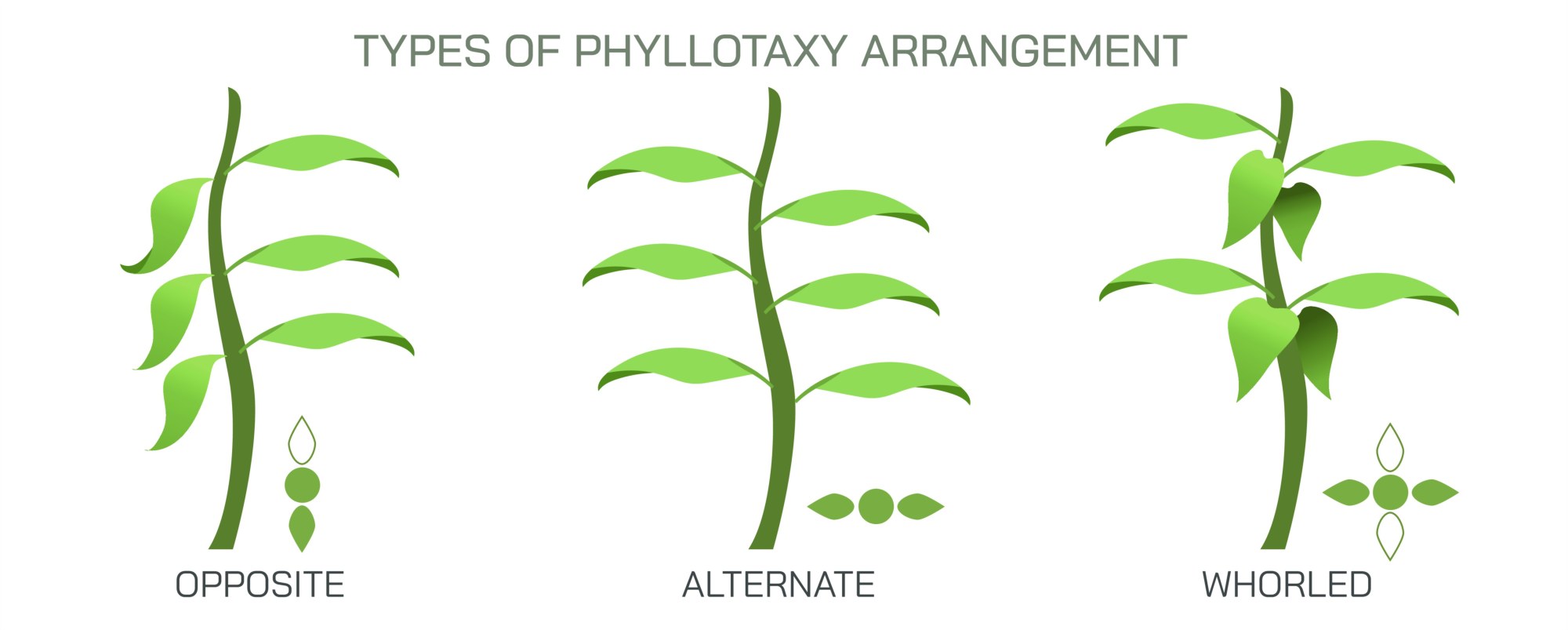
The alternate leaf arrangement is one of the most widely observed phyllotactic patterns in nature. In this configuration, each node on a stem bears a single leaf, and the leaves are positioned in an alternating order rather than directly across from each other. This staggering minimizes overlap between adjacent leaves, reducing self-shading and enabling the plant to maximize sunlight interception even when growing densely among other vegetation. The spacing often follows spiral patterns that are mathematically harmonious, increasing the plant’s ability to distribute leaves efficiently around the stem axis. Many trees and herbaceous plants, including sunflowers, hibiscus, and mangoes, display alternate phyllotaxy, showcasing how adaptable and advantageous it has proven in diverse ecological niches. When observed closely, alternate arrangements give the stem a dynamic zig-zag architecture, supporting not only efficient lighting but also improved tolerance to wind by distributing the force more evenly across the foliage.
Opposite phyllotaxy and its symmetrical design for improved balance and compact leaf growth
Opposite leaf arrangement is characterized by the presence of two leaves growing at each node, positioned directly across from one another on the stem. This symmetrical positioning creates a balanced silhouette that gives the plant a compact and neatly organized crown. Opposite phyllotaxy can be extremely beneficial in habitats where growing space is limited, allowing a plant to create dense leaf coverage with fewer internodes. Examples of opposite leaf arrangement can be seen in maple, jasmine, and guava, where the uniformity of leaf orientation enhances structural harmony. Interestingly, some plants exhibiting opposite phyllotaxy enhance light absorption by orienting each successive pair perpendicular to the pair below, creating a cross-like orientation that minimizes shading despite the paired arrangement. This adjustment helps avoid the trapping of moisture and improves ventilation around the foliage, reducing risks associated with fungal growth.
Whorled phyllotaxy and its adaptive leaf clusters for maximizing surface area exposure
Whorled phyllotaxy is far less common compared to alternate and opposite arrangements but demonstrates remarkable structural specialization. In this configuration, three or more leaves emerge from the same node, forming a circular cluster around the stem. This arrangement yields a dramatic increase in photosynthetic surface area within a linear region of the stem, enabling plants to thrive in environments where rapid vertical growth is required to compete for sunlight. Whorled arrangements are often found in aquatic plants, herbaceous climbers, and species growing in shaded forests where maximizing the exposure of leaves at certain height intervals becomes vital. Plants like Nerium oleander and Alstonia scholaris present whorled leaf patterns that give them an instantly recognizable morphological identity. The circular arrangement of leaves can also offer mechanical stability by balancing weight distribution around the stem, supporting vertical elongation even during rapid growth spurts.
Structural diversity of the three arrangements and their ecological implications
While alternate, opposite, and whorled phyllotaxy differ visibly, they share a common purpose of optimizing sunlight capture while regulating moisture levels and gas exchange. The level of spacing between consecutive leaves affects the microenvironment around the plant, influencing heat dissipation, ventilation, and tolerance to environmental stress. Alternate phyllotaxy gives plants a broad distribution of leaves across different orientations, making them more resistant to wind and competition for light in mixed vegetation environments. Opposite phyllotaxy allows for controlled and uniform canopy formation that supports species that thrive in more organized, compact growth habits. Whorled phyllotaxy offers peak leaf density per node, often becoming an advantage in zones where sunlight is unpredictable or where other plants compete vertically for photosynthetic advantage. The uniqueness of each pattern reflects fine-tuned morphological strategies, revealing how plants adjust to environmental stressors through structural evolution rather than through movement.
Plants do not readily switch among these phyllotactic patterns, as the arrangement is deeply encoded in their biology. The genetic control determining how many leaves arise at each node and how they orient around the stem plays an essential role in the identity and predictability of every species. However, variations can sometimes occur under stress, damage, or hormonal imbalance, creating abnormalities that offer insight to botanists studying developmental biology. Phyllotaxy, therefore, is not simply an observational curiosity but a vital clue to understanding how internal cellular processes and external environmental pressures interact in shaping plant form.
The biological efficiency supported by phyllotactic organization across species
Alternate, opposite, and whorled phyllotaxy patterns demonstrate how plants capitalize on structure to sustain survival and growth without locomotion. Each leaf becomes part of an intricate arrangement that enhances sun capture, reduces shading, improves respiration, and protects the plant from external pressures. From towering hardwood trees to delicate aquatic herbs, the arrangement of leaves stands as a fundamental biological design that determines how a plant experiences the world around it. The study of phyllotaxy continues to illuminate how plants integrate mathematics, cellular biology, and environmental adaptation into a single seamless and often artistic architecture. Understanding these arrangements not only deepens appreciation of plant morphology but also supports fields such as agriculture, forestry, ecology, and biomimetic design, where nature’s patterns inspire innovations in technology and sustainable systems.
Through these carefully evolved arrangements, phyllotaxy reveals the elegance of nature’s engineering in plant life, demonstrating how even the position of a leaf speaks volumes about survival, balance, and adaptation in the living world.