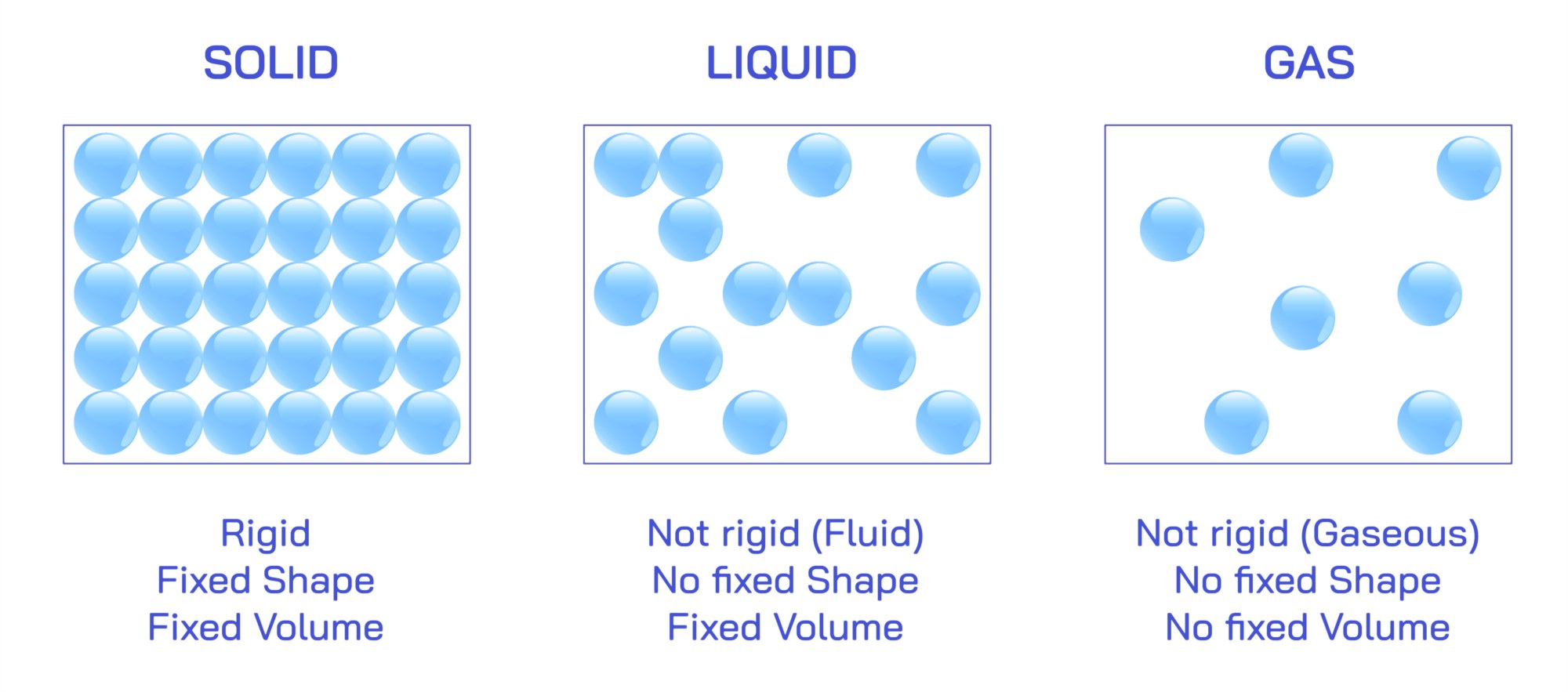
Solid, Liquid, and Gas Properties and Appearance Illustrated for States of Matter Comparison
A comparison of solids, liquids, and gases becomes most meaningful when it is visualized as a transition across increasing molecular freedom, yet even without a drawing the description of their appearance and behavior can take form as a vivid mental illustration. When matter exists as a solid, its particles are packed together in a tightly organized arrangement that gives the material a definite shape and a definite volume. A cross-sectional view of a solid would show particles positioned in an ordered pattern, each one held in place by strong intermolecular forces that allow only vibration rather than free movement. Because there is no empty space between the particles and because their position is fixed, a solid resists compression, maintains its shape even when left unsupported, and responds to force through bending, breaking, or deformation rather than flowing. This stability explains why a metal rod, a block of wood, an ice cube, a crystal, or a stone all hold their structure regardless of the container or space around them. Even though solids do not appear to move on the macroscopic level, the invisible illustration of particles vibrating rapidly within their rigid structure helps convey that solids are not motionless; they simply have motion restricted to microscopic trembling rather than macroscopic rearrangement.
When the image shifts from solid to liquid, the illustration transforms into something more fluid and spacious. The liquid state still carries a definite volume, meaning the amount of space the substance occupies remains constant, but unlike a solid, a liquid does not maintain a fixed shape. In a visual depiction, liquid particles appear close together but not arranged in a fixed or repeating pattern. They slide past one another freely, guided by weaker intermolecular forces than in a solid. This internal flow explains why a liquid can adapt to the shape of any container while maintaining a consistent level surface due to gravity pulling the particles downward. Because particles are still reasonably close to one another, a liquid is only slightly compressible, and its weight settles into whatever vessel holds it, whether a glass, a bottle, or a natural basin like a pond. To convey appearance more fully, the illustration might depict ripples, waves, or smooth surfaces that reflect the liquid’s ability to flow. In this phase, internal motion becomes visible: the constant rearrangement of particles expresses itself as swirling currents, convection patterns, and the ability of the liquid to be poured, stirred, or displaced. Temperature adds further features to the illustration; heating a liquid intensifies particle movement and makes it appear more dynamic, while cooling slows these motions and pushes the liquid closer to turning solid. The dynamic yet contained motion of liquids helps distinguish them clearly from both the rigidity of solids and the free expansion of gases.
When the focus moves to a gas, the illustration changes dramatically, expanding into open space and conveying the greatest degree of molecular independence. In a diagrammatic interpretation, gas particles spread far apart with large empty spaces separating one from another, moving rapidly in straight paths until they collide with other particles or the walls of the container. Because the particles are dispersed and operate under extremely weak intermolecular forces, a gas neither has a definite shape nor a definite volume. Instead, it expands to fill whatever space it occupies. This is why a balloon inflates uniformly, why air fills every pocket of an environment, and why water vapor does not sit at the bottom of a room but disperses evenly through it. Gas particles move so rapidly and unpredictably that they exert pressure on whatever enclosure surrounds them, and this pressure can be increased by raising the temperature, which speeds up particle movement even further. In a visual representation, the unrestricted motion of gas particles would appear almost chaotic, with arrows showing travel in multiple directions and collisions occurring frequently. This dispersed motion contrasts with the ordered lattice in solids and the fluid yet compact motion in liquids, completing the comparative image of the three states of matter.
Side-by-side comparison of solids, liquids, and gases invites deeper understanding of how particle arrangement determines appearance and properties at the human scale. In solids, the particles fill every available space in a fixed geometrical pattern, which gives strength and stability to the material. This explains why a solid object can rest on a surface without changing shape and why it cannot easily be formed to fit a container unless it is melted or physically reshaped with force. In liquids, the internal structure loosens enough to allow movement while preserving cohesion, creating a state that can take on any shape while holding the same amount of matter. This explains why water fills the bottom of a cup uniformly and why it can flow downhill or across surfaces. In gases, the particles separate widely enough that each particle behaves almost independently, and the gas naturally expands to occupy every accessible cubic centimeter of space it reaches. This behavior explains why smells spread through a room, why compressed gas tanks hold great amounts of substance in small volumes, and why gases mix effortlessly without stirring.
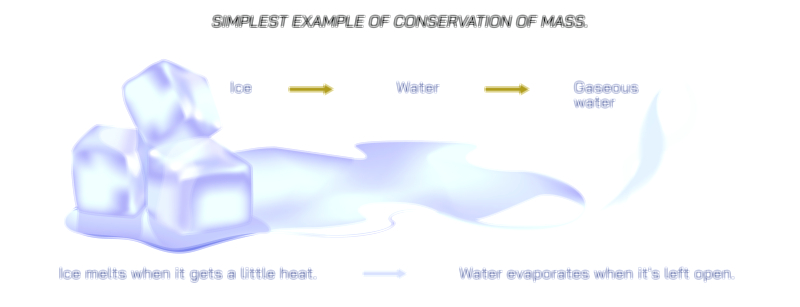
The transitions between these states—melting, freezing, evaporation, condensation, and sublimation—provide further insight into how temperature and energy influence the appearance and behavior of matter. When a solid melts into a liquid, the particles absorb thermal energy and vibrate so intensely that they break free from their fixed positions, allowing flow. When a liquid evaporates into a gas, particles gain even more kinetic energy and separate far enough to escape into open space. When cooling reverses these processes, gases condense back into liquids and liquids freeze into solids, restoring order and reducing particle spacing. A sophisticated mental illustration of these transitions shows energy flowing into or out of the system like an invisible force loosening or tightening the molecular structure. The appearance of matter at each stage is therefore a visual reflection of an internal energy balance that governs how tightly particles remain linked or how freely they travel.
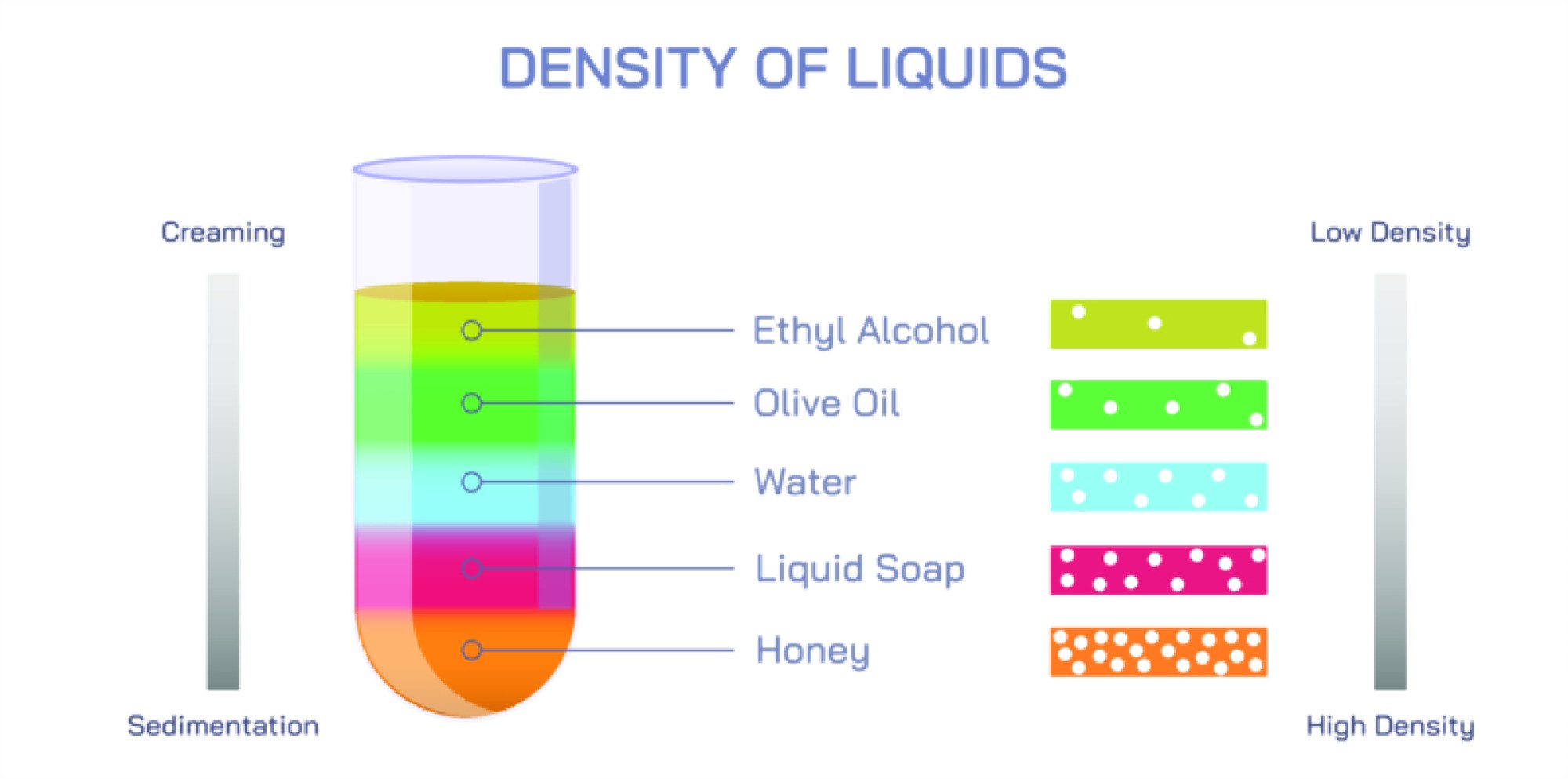
The concept of matter in three states also extends into the understanding of physical properties such as shape, compressibility, density, flow, and thermal response. Solids are most dense because their particles occupy minimum space and resist compression; liquids retain moderate density because the particles remain close but not fixed; gases display least density because particles spread out across large volumes with little interaction. Solids respond to heat by expanding slightly, liquids expand more noticeably, and gases expand dramatically because increases in kinetic energy translate directly into greater spread between particles. Even the appearance of motion reflects this hierarchy: solids appear still, liquids appear fluid, and gases appear invisible but hyperactive. Combining these concepts deepens appreciation of the fact that the three classical states of matter are not arbitrary categories, but predictable expressions of molecular organization and energy levels.
Though diagrams traditionally present each state in observed form—solid blocks, flowing liquids, and diffuse clouds of gas—the scientific understanding behind these visual representations lies in the arrangement and behavior of particles. When someone sees steam rising from a boiling pot, ice floating in water, or a balloon inflating, what they are truly witnessing is the movement of matter across various levels of energy. Solids resist change because their particles lack the freedom to rearrange; liquids adapt their form because their particles move with moderate freedom; gases race and disperse because their particles move independently with maximum kinetic energy. These differences—seen, felt, and measured daily—are the foundation of material science, thermodynamics, atmospheric physics, and countless real-world technologies, from refrigeration and steam engines to hydraulic systems and gas-pressure devices.
Ultimately, a comparison of solids, liquids, and gases is not only a visual contrast but a way of describing the continuum of energy that shapes physical existence. The structured certainty of solids dissolves into the graceful fluidity of liquids and eventually transforms into the limitless expansion of gases. When this comparison is viewed as an illustration of particle arrangement and energy transformation rather than a static classification chart, the states of matter become a vibrant narrative about how the building blocks of the universe behave under different conditions. From the ice of polar glaciers to the flowing rivers of Earth, and from the air we breathe to the vapor that forms clouds in the sky, the world demonstrates constantly that matter moves between these states with predictability, elegance, and purpose. The comparison therefore serves not only as a scientific explanation but also as a reminder that the physical world operates through patterns and transitions that reveal the harmony between microscopic behavior and everyday experience.