Animal vs Plant Cell Showing Differences in Organelles, Cell Wall, Vacuole, and Chloroplast Structure
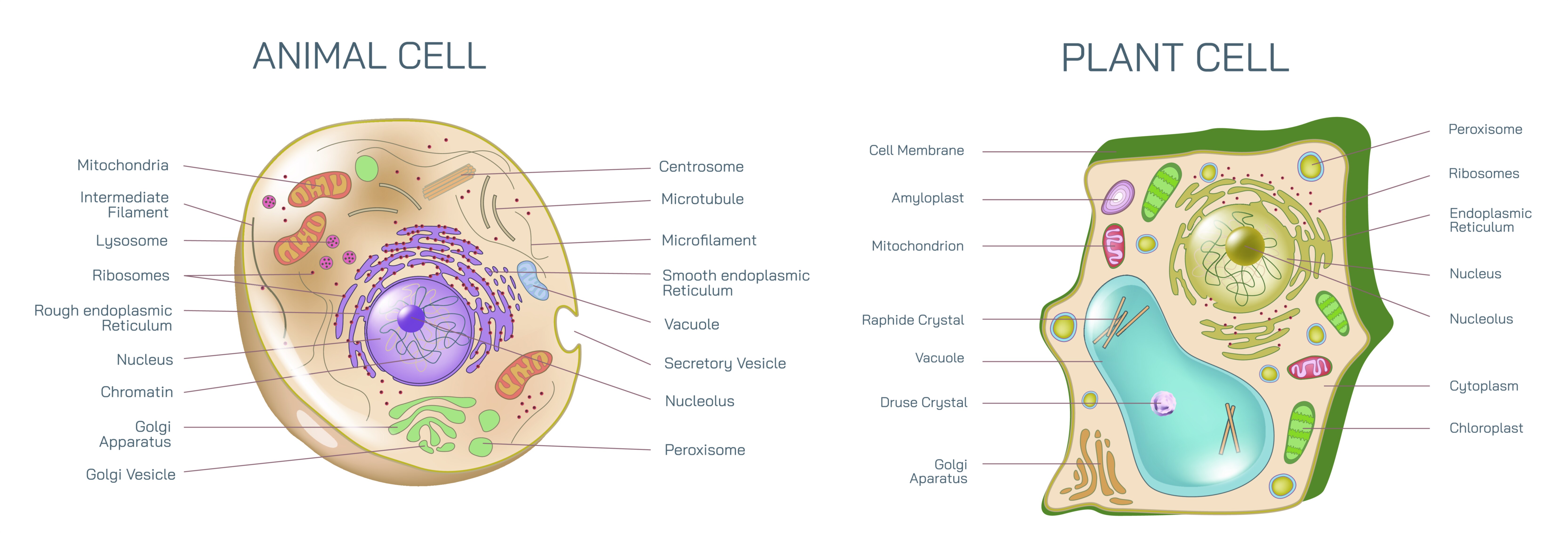
The comparison between animal and plant cells offers one of the clearest examples of how structure reflects biological function. Although both belong to the category of eukaryotic cells and share many of the same fundamental organelles, a detailed examination reveals significant differences in their physical structure, internal components, and specialized functions. A vector illustration comparing animal and plant cells typically places both side by side, shaping the plant cell in a characteristic rectangular or polygonal form and the animal cell in a more rounded or irregular form. By highlighting visible distinctions such as the presence or absence of a cell wall, the size and function of the vacuole, the existence of chloroplasts, and the arrangement of organelles, the illustration visually explains how each cell type has evolved to support the needs of the organism it belongs to. Beneath this visual comparison lies the deeper biological relationship between cellular architecture and survival strategy, demonstrating how plants and animals achieve life functions differently even while relying on the same fundamental cellular blueprint.
One of the most noticeable differences is the presence of a cell wall in plant cells and its absence in animal cells. The cell wall is a rigid outer structure composed primarily of cellulose, giving the plant cell its straight-edged geometric shape. This sturdy outer layer protects the cell, maintains its structural integrity, and allows the plant to withstand internal water pressure, which is especially important since plants cannot move away from environmental forces like wind and gravity. In contrast, animal cells do not possess a cell wall. Instead, they rely on a flexible plasma membrane, which provides mobility and allows animal tissues to bend, move, and form many shapes. This flexibility supports the dynamic functions of animal bodies such as movement, muscle contraction, and cellular migration during development and wound healing. The presence of a cell wall in plant cells therefore underlines the strategy of structural rigidity and passive defense, whereas the absence of one in animal cells supports active locomotion and flexible biological behavior.
Another major distinction is the vacuole, which plays very different roles in plant and animal cells. In plant cells, the vacuole is a large central organelle that can occupy up to 80–90% of the cell’s interior. This massive structure performs multiple duties, including storing water and nutrients, maintaining internal turgor pressure to keep the cell firm, and participating in waste breakdown. In illustrations, it appears as a large dominant space occupying the center of the cell, pushing other organelles toward the edges. Without the vacuole maintaining hydrostatic pressure, plants would lose firmness and wilt. Animal cells also contain vacuoles, but they are small, numerous, and temporary. Instead of maintaining structural stability, animal vacuoles play short-term roles in storage, transport, and digestion. The contrast in vacuole size and function explains how plants rely on water storage and internal pressure for support, while animals depend on muscular and skeletal systems for physical structure.
Perhaps the most defining organelle unique to plant cells is the chloroplast, the green, lens-shaped structure responsible for photosynthesis. Chloroplasts contain chlorophyll, the pigment that captures light energy and transforms it into chemical energy in the form of glucose. They are typically shown as bright green organelles scattered throughout a plant cell illustration. Their presence allows plants to manufacture their own food using sunlight, carbon dioxide, and water — a process that fuels not only plant growth but the energy supply for nearly all life on Earth. Animal cells lack chloroplasts entirely, because they obtain energy by consuming other organisms rather than synthesizing it. Plant cells therefore contain both chloroplasts for food production and mitochondria for energy conversion, while animal cells rely solely on mitochondria to extract usable energy from organic molecules. This contrast highlights the organism-level difference between autotrophic plants and heterotrophic animals.
The shape differences between plant and animal cells in illustrations are not arbitrary; they arise directly from structural components. The plant cell wall creates a fixed rectangular or polygonal shape, while the flexibility of the animal cell membrane allows a more rounded or irregular outline. The cytoskeleton inside animal cells adapts easily to movement and structural variation, while plant cell rigidity restricts such changes. The typical vector diagram, with one cell drawn in precise angles and the other in soft curves, gives visual clarity to these biomechanical differences.
Both cell types contain a nucleus, mitochondria, endoplasmic reticulum (smooth and rough), Golgi apparatus, cytoplasm, ribosomes, and a cell membrane. These shared organelles reflect their common ancestry as eukaryotic cells. However, even shared components can appear differently in illustrations due to spatial organization. In animals, organelles are evenly distributed within the cytoplasm; in plant cells, they are pressed toward the edges by the large central vacuole. This difference reflects how interior compartment positioning is influenced by evolutionary necessities — plants emphasize water retention and structural stabilization, while animals emphasize metabolic flexibility.
Another meaningful difference involves centrioles and the cytoskeletal system. In animal cells, centrioles are crucial for cell division and are commonly shown near the nucleus, assisting in spindle formation during mitosis. Plant cells typically do not have centrioles, relying on alternative mechanisms to organize microtubules for cell division. This difference again reflects contrasting cellular adaptations: plants divide within rigid cell walls, whereas animals divide while changing shape and moving.
The mode of energy use and storage further divides plant and animal cellular strategy. Plant cells store energy largely as starch and produce glucose through photosynthesis. Animal cells store energy primarily as glycogen and rely on food intake to produce ATP through respiration. In a comparative illustration, chloroplasts and starch grains usually mark this plant-specific capability, while animal cells may include more lysosomes to support metabolic digestion and recycling of materials. Lysosomes, often more abundant and prominent in animal cells, play a critical role in breaking down cellular debris and damaged components. Plant cells contain similar enzymes but house them primarily inside the large vacuole instead of using numerous lysosomes.
These internal differences produce external consequences in the living organisms. Plants grow upright because water-filled vacuoles push outward against rigid cell walls, and their energy source comes from sunlight. Animals develop systems of muscles and bones for movement, depend on external food sources, and require flexibility for adaptation and locomotion. The cellular difference between chloroplasts and mitochondria is a biological dividing line between photosynthesis and consumption, and the difference between a cell wall and a flexible membrane defines whether an organism grows by structural rigidity or moves by muscular and neural control.
A complete vector illustration comparing plant and animal cells typically includes:
• A rectangular plant cell showing a thick cell wall, a large central vacuole, chloroplasts, and the nucleus pushed to the side
• A rounder animal cell showing a flexible membrane, smaller vacuoles, centrioles, and evenly distributed organelles
• Shared organelles labeled clearly to show that both cell types are eukaryotic
• Distinct differences highlighted visually so the viewer immediately understands functional biology through structural contrast
The deeper message communicated through this illustration is that microscopic differences create macroscopic diversity in life. Plants and animals evolved from a common ancestor, but their cellular architecture reflects different ecological strategies: one capturing sunlight to build food internally while remaining structurally anchored, the other consuming organic material and relying on movement, specialization, and flexibility. The plant cell emphasizes sustainability, energy production, and structural strength; the animal cell emphasizes mobility, internal digestion, and adaptive change.
By comparing the nail-fine details of each organelle’s presence, shape, and function, the illustration makes an essential lesson clear without the need for equations or biochemical symbols: the structure of a cell is not random — it is a blueprint for how life works. The defining features of the plant cell serve the needs of a stationary, photosynthesizing organism, while the features of the animal cell serve the demands of a mobile, consuming organism. Understanding these contrasts deepens appreciation of how life diversifies through the smallest components, and how tiny structural differences determine the enormous variety of living forms across Earth.