Curie–Weiss Law — Magnetic Susceptibility and Temperature Relationship
The Curie–Weiss Law represents one of the most important conceptual frameworks in magnetism, offering deep insight into how materials respond to changes in temperature and how their internal magnetic structures rearrange themselves as thermal energy competes with magnetic ordering forces. Although the formal expression of the law is mathematical, its true significance can be understood without using equations by focusing on the underlying physical ideas that govern magnetic behavior. At its core, the Curie–Weiss Law describes how the magnetic susceptibility of certain materials—specifically paramagnetic and ferromagnetic substances—varies as temperature changes. Magnetic susceptibility indicates how easily a material becomes magnetized when placed in a magnetic field, and this property shifts dramatically with temperature because heat influences the alignment of tiny magnetic moments within the material. The Curie–Weiss Law offers a conceptual bridge between classical magnetism and the more sophisticated understanding of phase transitions, critical temperatures, and cooperative phenomena in condensed matter physics. Through this law, one gains a clearer picture of why some materials become strongly magnetic below certain temperatures, why magnetism weakens when heated, and how the microscopic interactions among atoms lead to macroscopic magnetic behavior.
In order to understand the Curie–Weiss Law conceptually, it helps to begin with the idea of magnetic moments. Every atom possesses magnetic moments arising from the intrinsic spin of electrons and their orbital motion around the nucleus. In some materials, these magnetic moments act independently; in others, they interact strongly with neighboring moments, aligning in patterns that give rise to collective magnetization. When a material is heated, the atoms vibrate more vigorously, creating thermal agitation that disrupts the alignment of magnetic moments. As temperature rises, thermal motion competes increasingly with the magnetic interactions that try to align the moments. Magnetic susceptibility, which measures how responsive a material is to an external magnetic field, therefore becomes inherently tied to temperature. The Curie–Weiss Law captures this relationship by showing that magnetic susceptibility increases significantly as temperature decreases and approaches a critical point. This critical temperature, often referred to as the Curie temperature, marks a transition between disordered and ordered magnetic states, helping us understand why some materials exhibit strong magnetism only below specific temperature thresholds.
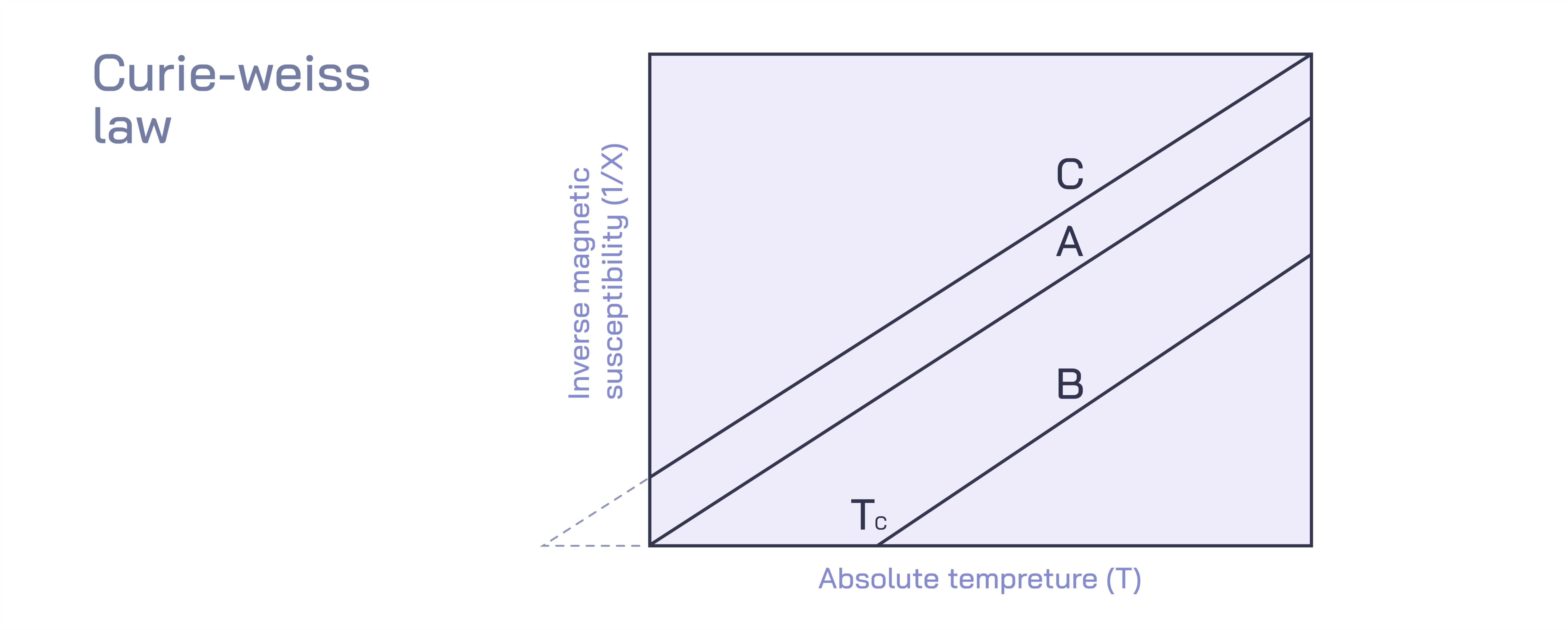
In a paramagnetic material, magnetic moments behave like a collection of tiny, randomly oriented magnets that do not align spontaneously but respond to external magnetic fields by partially aligning in the field’s direction. As the temperature rises, these moments become increasingly disordered because thermal energy agitates them, reducing the influence of the external field. As the temperature decreases, thermal agitation weakens, making it easier for the field to align the moments. The Curie–Weiss Law provides a conceptual framework for this behavior by indicating that susceptibility grows dramatically when temperature is lowered toward a certain point. This means that paramagnetic materials become more magnetically responsive at lower temperatures, a fact that is observed in materials ranging from simple salts to rare-earth metals. As the temperature continues to decrease toward the Curie temperature, susceptibility may diverge, signaling the beginning of cooperative magnetic ordering in which interactions between neighboring magnetic moments become important.
This cooperative behavior becomes most striking in ferromagnetic materials. In these substances, magnetic moments do not act independently. Instead, they interact strongly through exchange forces that encourage neighboring moments to align in the same direction, producing spontaneous magnetization even without an external magnetic field. Such materials include familiar magnets like iron, cobalt, and nickel. However, this spontaneous alignment does not persist at all temperatures. When the material is heated above its Curie temperature, the thermal agitation becomes strong enough to overwhelm the exchange interactions, causing the magnetic moments to lose their collective alignment and behave like a paramagnetic material. The Curie–Weiss Law describes this transition by showing that the susceptibility of the material above the Curie temperature still responds to temperature but does so in a way that reflects the lingering influence of cooperative interactions. Even when the material is no longer ferromagnetic, its susceptibility retains a memory of the strong internal interactions that dominated below the critical temperature.
One of the most profound insights of the Curie–Weiss Law lies in the way it reveals the existence of a characteristic temperature—often called the Weiss constant—that reflects the strength and nature of internal magnetic interactions. If this characteristic temperature is positive, it suggests that the dominant interactions in the material favor alignment, meaning the material can become ferromagnetic below a certain point. If the constant is negative, it indicates that the interactions favor anti-alignment, leading to antiferromagnetic behavior in which neighboring magnetic moments orient oppositely. Although this deeper interpretation requires a microscopic view of magnetic interactions, the conceptual takeaway is simple: magnetic materials carry within them a tendency toward specific magnetic arrangements, and temperature determines whether these tendencies dominate or are overshadowed by thermal noise. The Curie–Weiss Law therefore provides a window into the internal magnetic landscape of matter, helping scientists predict and understand phase transitions between magnetic states.
This relationship between susceptibility and temperature becomes even more interesting when one considers how materials behave near the Curie temperature. Close to this critical point, magnetic susceptibility often grows dramatically because even small changes in temperature can dramatically alter the balance between thermal agitation and magnetic interaction. This region around the critical point is associated with long-range magnetic fluctuations, in which large regions of the material temporarily develop coordinated magnetic orientations before thermal motion disrupts them again. These fluctuations reflect the beginnings of cooperative ordering and are studied extensively in modern physics to understand critical phenomena, phase transitions, and the emergence of complex behavior from simple microscopic rules. Although the Curie–Weiss Law is an approximate description rather than a perfect model, it captures the essential physics of how materials approach the threshold between paramagnetic disorder and ferromagnetic order.
The Curie–Weiss Law also plays a crucial role in understanding magnetic materials used in modern technology. The behavior of magnetic storage media, permanent magnets, transformer cores, memory devices, and magnetic sensors all depends on how materials respond to magnetic fields at different temperatures. Engineers must account for the fact that magnetic susceptibility can change dramatically as a device heats during operation. The design of electric motors, generators, and magnetic shielding systems depends on predictable magnetic behavior that the Curie–Weiss Law helps describe. In applications like cryogenics, spacecraft design, and superconducting systems, understanding how magnetic susceptibility varies with temperature becomes essential for avoiding malfunctions and maintaining stability. Even everyday devices such as hard drives, speakers, and magnetic resonance imaging systems rely on the predictable magnetic responses that stem from the principles embodied in the Curie–Weiss Law.
In the natural world, the law helps explain Earth’s magnetic properties and how minerals behave deep within the planet. Certain iron-bearing minerals undergo transitions from paramagnetic to ordered magnetic states as temperature falls below their Curie points during geological cooling. These transitions help preserve magnetic signatures in volcanic rocks, enabling scientists to reconstruct past changes in Earth’s magnetic field and plate movements. Paleomagnetism—one of the most important tools for understanding Earth’s geologic and tectonic history—depends directly on how minerals acquire magnetization as they cool through temperatures where the Curie–Weiss behavior dominates. The law also applies to planetary magnetism more generally, helping explain how iron-rich materials behave under extreme heat and pressure in planetary interiors.
At the microscopic scale, the Curie–Weiss Law provides insight into the interactions between electron spins, which are responsible for magnetism at the quantum level. It reveals how quantum mechanical exchange interactions give rise to collective magnetic behavior and how thermal agitation competes with these tendencies. These insights form the foundation of modern condensed matter physics, helping scientists understand phenomena such as spin waves, magnetic excitations, quantum criticality, and the emergence of new phases of matter. Even advanced materials such as magnetic semiconductors, spintronic devices, and quantum magnets exhibit behavior influenced by the principles described by the Curie–Weiss Law. Although these materials often display far more complex behavior than classical magnetic materials, the conceptual link between susceptibility and temperature remains fundamental.
Another important conceptual aspect of the Curie–Weiss Law is that it helps distinguish between materials dominated by independent magnetic moments and those dominated by collective interactions. In simple paramagnetic materials, susceptibility decreases steadily with increasing temperature because thermal agitation disrupts moment alignment. But in materials where magnetic moments interact strongly, the Curie–Weiss Law reveals deeper structure. The presence of a characteristic temperature indicates a material’s predisposition toward ordering, even if that order does not fully manifest until the system crosses a threshold. Materials with strong internal interactions behave differently from those with weak or negligible interactions, and the Curie–Weiss Law provides a clear conceptual tool for identifying and understanding these differences.
Ultimately, the Curie–Weiss Law serves as an elegant conceptual bridge between microscopic magnetic interactions and macroscopic magnetic behavior. It shows how temperature influences magnetic susceptibility, how internal forces shape the magnetic properties of materials, and how cooperative phenomena emerge from simple interactions. Through this law, one gains insight into why magnets lose their strength when heated, why certain materials only display magnetism below specific temperatures, and how the delicate balance between thermal motion and magnetic forces governs the behavior of matter. Even without mathematical expressions, the Curie–Weiss Law offers a comprehensive understanding of magnetic susceptibility and its temperature dependence, revealing the intimate connection between heat, disorder, alignment, and the fundamental magnetic nature of materials.