Parts of a Circle – An Educational Summary on Geometry, Structure, Measurement, Spatial Relationships, Real-World Applications, and the Conceptual Understanding of Circular Shapes in Mathematics
A circle is one of the most fundamental and elegant shapes in geometry, instantly recognizable and deeply rooted in both mathematical theory and observable patterns throughout nature and human design. Although a circle may appear simple at first glance, its internal structure is composed of multiple interrelated components that define its geometry, measurement, and practical applications. The detailed understanding of the parts of a circle forms a foundational chapter in mathematics education because it teaches students how shapes are analyzed, how distances and curves are measured, and how mathematical definitions support reasoning, problem-solving, and real-world use. Each part has a unique role, whether it describes distance, position, curvature, boundary, or relationship between points. When learners acquire a complete picture of a circle’s internal architecture, they not only understand geometry more deeply but also develop the ability to interpret circular patterns in engineering, science, physics, architecture, and daily life.
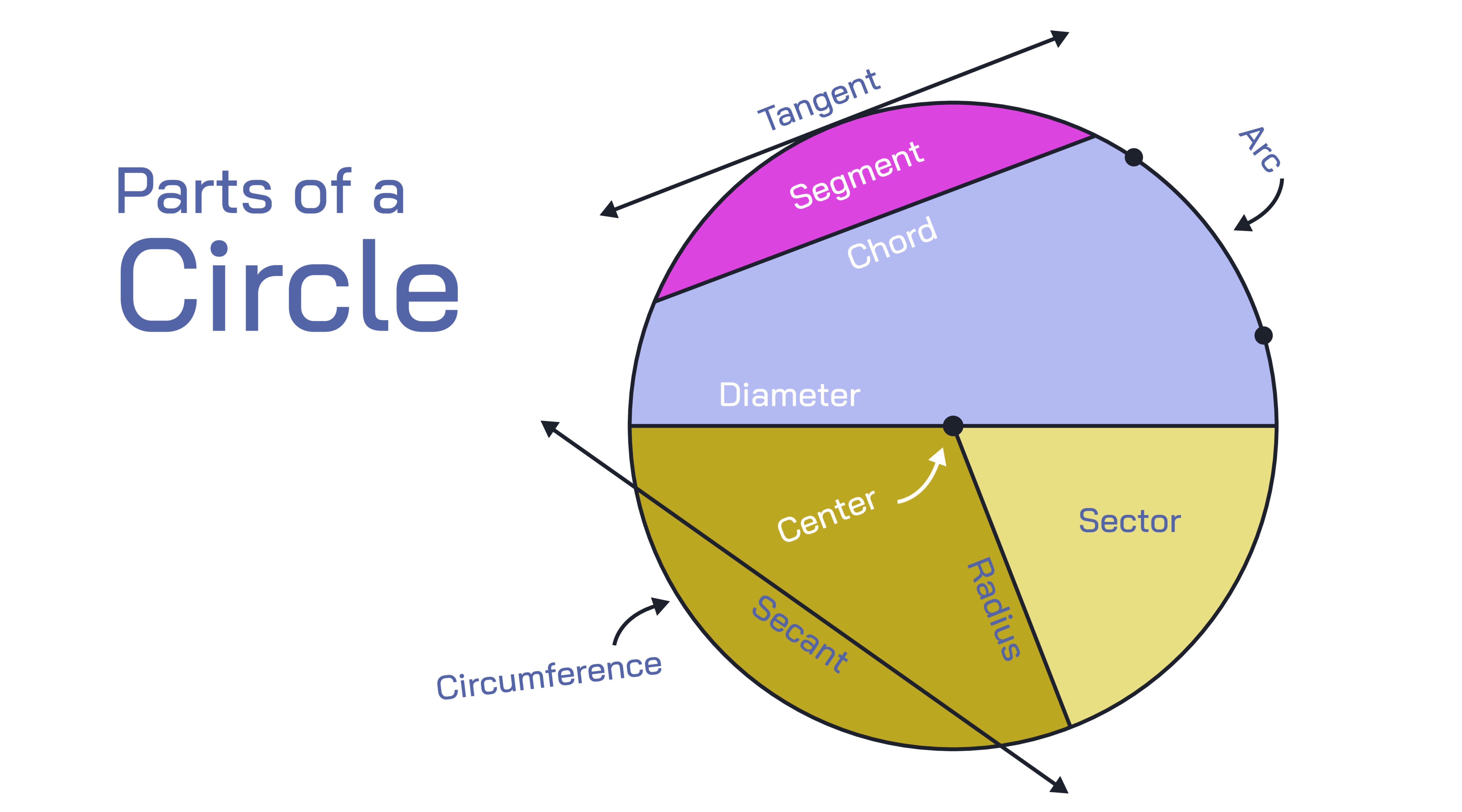
At the core of every circle lies its most defining feature: the centre. The centre is a fixed point from which every point on the boundary of the circle is equidistant. Without the centre, the circle loses its mathematical definition, because equal distance from a common reference point is what distinguishes a circle from any other curved shape. From the centre extends the next fundamental component, the radius, which is the line segment joining the centre to any point on the circumference. The radius is constant throughout the circle, and it acts as the key measurement that determines the size of the circle. A circle with a longer radius has a larger area and a longer boundary, whereas a shorter radius creates a smaller circle. The constancy of the radius across the entire shape is what keeps the circular boundary smooth and perfectly curved.
The diameter builds on the radius by stretching across the entire circle through the centre, connecting two points on the circumference. Since the diameter includes two radii end to end, its length is always twice the radius. In practical measurement, the diameter is often easier to measure physically—such as across a circular table or wheel—while the radius becomes more useful in calculations. Students quickly realize that circles derive many mathematical formulas from the radius, including the calculations for circumference and area, and these formulas are grounded in the relationship between radius, diameter and the constant π.
The boundary of the circle, known as the circumference, marks the entire curved outline of the shape. Unlike the perimeter of polygons, which is composed of straight segments, the circumference is a continuous curved line. It defines the limit or edge of the circle and serves as an essential reference in mathematics, science, and engineering. The measure of the circumference depends directly on the length of the radius or diameter, revealing that even the edge of the circle depends fundamentally on the centre. The continuity of the circumference gives circles an infinite symmetry, with no corners, no sides, and no beginning or endpoint.
Within the circle, special line segments and regions offer more detailed understanding. A chord is any line segment that joins two points on the circumference without necessarily passing through the centre. All diameters are chords, but not all chords are diameters. The longest chord in a circle is always the diameter, and other chords become shorter as they move away from the centre. Chords help define several other circle components. One such connection occurs with the arc, which is the portion of the circumference lying between two endpoints of a chord. When the chord is small, it produces a short arc; when the chord is nearly a diameter, the arc becomes long. Understanding arcs teaches students how curved distances can be measured and compared without flattening the shape.
The chord and arc together form two regions inside the circle. The area enclosed between a chord and the arc above it is called a segment. Detecting segments helps in geometry when shapes are cut, missing, or divided. In contrast, if the region includes one radius or two radii, the enclosed portion becomes a sector. A sector resembles a slice of pizza: its curved outer edge is an arc and its two straight boundaries are radii. Sectors play a major role in angle measurement since they create direct links between central angles and the proportion of the circle they occupy. When the angle at the centre increases, the arc increases, and the sector expands proportionally. Whether learners are studying clocks, wheels, pie charts, or circular motion, the sector becomes an intuitive example of how angles relate to portions of a whole.
Another important part of a circle is the tangent, a straight line that touches the circumference at exactly one unique point. Unlike chords and secants, a tangent never enters the inside of the circle. Its defining property is that it is always perpendicular to the radius at the point of contact. This perpendicular relationship is a strong geometric fact that helps students solve many problems involving angles, distances and right triangle formation. The opposite of a tangent is the secant, a line that cuts through the circle and intersects the circumference at two points. Secants extend the concept of chords into infinite straight lines, giving a wider algebraic and geometric perspective on how straight and curved paths interact.
The interior and exterior regions of a circle are equally important in understanding diagrams and spatial reasoning. Everything inside the circumference is called the interior, forming a region that includes chords, radii, sectors, and segments. The exterior contains all points outside the circle, and this space helps define how tangents and secants behave before they meet the circle. These regions teach students to recognize relationship boundaries in diagrams and classify points as inside, outside or on the circle.
When all of these parts are integrated, a circle becomes not just a shape but a conceptual system. The centre determines the radius, the radius determines the diameter, the diameter determines the circumference, and these relationships unlock measurement formulas. Chords generate arcs, and arcs define sectors and segments. Tangents and secants create right angles and geometric properties that allow precise calculation even on curves. Every part connects to the others, forming a complete and harmonious geometry network.
Outside mathematics, the parts of a circle have practical meaning in countless real-world applications. Engineers rely on radii and diameters when designing gears, tires, pipes, machine tools and rotating components. Architects use circle geometry to construct arches, domes, bridges and circular windows. Physicists analyze circular motion using radius-based measurement of orbits and rotation forces. Art and cultural design incorporate arcs, segments and symmetry in decorative patterns, mandalas, rangoli, pottery and structural motifs. Even simple everyday objects such as clocks, pizzas, coins, tables, lids, traffic roundabouts and wheels represent geometry in action, demonstrating how circles shape the physical world.
From an educational standpoint, learning the parts of a circle nurtures visual understanding, spatial reasoning, logical thinking and quantitative interpretation. It helps students transition from arithmetic and polygons to a world of curves, proportions and constant relationships. It reinforces that mathematical shapes are not flat drawings but interconnected systems of components, each contributing meaning and structure. A circle may appear smooth and seamless from afar, but step by step, the study of its parts reveals a rich geometric universe.
By mastering the centre, radius, diameter, circumference, chord, arc, segment, sector, tangent, secant, and interior–exterior regions, learners gain not only geometric skill but also a deeper appreciation for how mathematics explains the patterns of space and movement that surround us daily. A circle becomes more than a shape—it becomes a foundation for measuring the world, designing structures, analyzing motion, and understanding the silent geometry woven into both nature and human innovation.