Surgical Blades and Their Types – Educational Summary on Design, Function, Anatomy, Materials, Handling, Safety, and Clinical Application
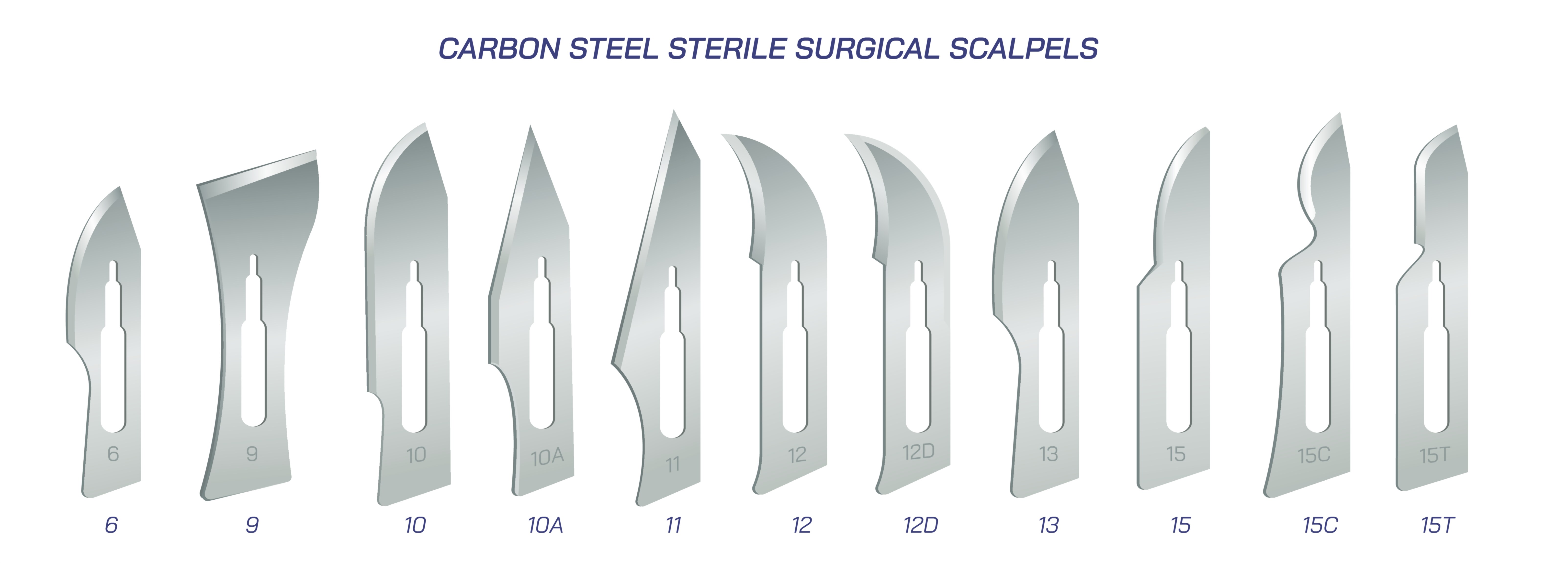
Surgical blades are one of the most fundamental and indispensable tools in modern medicine, and understanding their structure and classification is crucial for anyone learning about surgical practice, medical instrumentation, or operative procedures. Although they appear simple at first glance, surgical blades represent a precisely engineered balance of sharpness, strength, sterility, and safety. Their design is based on the principle that different tissues, procedures, and anatomical locations require different patterns of incision. A single uniform blade would not be sufficient for the wide range of surgeries performed today, and this is why surgical blades are manufactured in multiple shapes, sizes, edges, and bevel angles, each supporting a specific surgical function. In medical education, illustrations of surgical blades help students visualize the variations clearly, showing how the contour of a blade, the orientation of the cutting edge, and the length of the cutting surface change depending on its designated surgical use. This connection between shape and purpose allows learners to appreciate how precision cutting influences operating time, tissue trauma, healing speed, and surgical outcomes.
The anatomy of a surgical blade itself is designed with intention. A typical disposable blade consists of a sharp cutting edge, a spine for strength, a slot for attachment to a compatible scalpel handle, and a point or tip that is shaped according to clinical need. The blade cutting angle determines the efficiency and smoothness of the incision, while the spine provides rigidity so that pressure from the surgeon’s hand results in controlled tissue entry rather than flexing or tearing. Many blades have a single-bevel edge, but some models incorporate double bevels to enhance glide through dense tissue. The tip of the blade defines its most immediate purpose: a sharply pointed blade allows deep puncturing access, whereas a rounded or curved design provides sweeping or layered cuts. All of these structural features can be visually understood through detailed vector illustrations, which highlight the subtle geometry that is difficult to identify with the naked eye during surgery.
In clinical education, much attention is given to the standardized numbering system used for surgical blades because it ensures universal recognition despite the wide range of manufacturers and countries. Each blade number corresponds to a specific shape profile, and these profiles are linked to well-established surgical tasks. For instance, Blade No. 10, one of the most widely used, has a large curved cutting edge that is ideal for making long, smooth incisions through skin and subcutaneous tissue. Blade No. 11 has a sharply pointed triangular tip suited for precision stab incisions, vessel incision, drainage of abscesses, or other procedures that require narrow, controlled entry. Blade No. 12 features a crescent-shaped hook that curves backward and is typically used in ENT and soft tissue surgery for removal of sutures or dissection in confined areas. Blade No. 15 has a small curved edge suited for short, precise incisions in delicate tissue such as pediatrics, plastic surgery, and cardiovascular operations. Larger blades such as Nos. 20, 21, 22, and 23 are similar to No. 10 but are scaled to longer and deeper incisions used in abdominal and orthopedic surgeries. These differences reflect how surgeons match the size of the blade to the incision length, tissue thickness, and visibility within the operative field.
4. The locking mechanism is designed so that the blade slides onto the handle and clicks firmly into place, ensuring that it will not loosen during cutting. Proper handling helps control incision direction and depth, reduces surgeon fatigue during prolonged operations, and prevents accidental slippage that could jeopardize patient safety. Vector illustrations of blades shown fitted onto their respective handles are helpful in conveying this information visually to students who are new to surgical setup.
The materials used to manufacture surgical blades reflect balancing the needs of sharpness, sterility, durability, and biomedical compatibility. Stainless steel has long been the standard material because it combines corrosion resistance, cost efficiency, and high surface polish. High-carbon steel, on the other hand, provides exceptionally sharp cutting ability and edge retention, making it suitable for precise incisions requiring minimal drag. Some modern surgical blades undergo special surface treatments such as Teflon coating or polymer lamination to reduce friction, improve glide, and reduce tissue trauma. The sharper and smoother the blade, the less pressure the surgeon needs to exert, reducing microscopic tearing and consequently improving postoperative healing. Sterilized packaging ensures that each blade is contamination-free until opened in the operating theater, and disposable use prevents cross-contamination between patients.
Handling and safety are integral to surgical blade education. Because surgical blades are extremely sharp, improper attachment, removal, or disposal can lead to accidental cuts and exposure to bloodborne pathogens. Safe practice requires that the blade be attached using an instrument rather than fingers, held firmly with controlled motion during incision, and disposed of immediately in a sharps container after removal from the handle. The risk increases when blades are reused, improperly stored, or placed temporarily on surgical surfaces, which is why adherence to sterile technique and sharps safety protocol forms a crucial part of surgical training. Instructional illustrations that show step-by-step blade attachment and disposal procedures help prevent injuries among trainees and surgical staff.
The selection of the correct blade type is not simply a matter of surgical convenience; it directly influences healing and cosmetic outcomes. A blade with the right curvature and sharpness produces an incision with minimal tissue trauma, reducing inflammatory response and scarring. In reconstructive and plastic surgery, where visual outcome is critical, surgeons rely on smaller precision blades like No. 15 to create delicate incisions aligned with natural skin creases. In emergency trauma surgery, larger and stronger blades are used to open body cavities rapidly for life-saving intervention. In orthopedic surgery, blades must cut through fibrous tissue and fascia without fragmenting underlying structures. These varied clinical contexts show that incision is not merely opening a wound—it is an essential part of surgical art, requiring the blade to be chosen with understanding of anatomy, pathology, and desired recovery.
Surgical blades also play an important role in minimally invasive and modern digital-assisted surgery. Although laparoscopy and robotic interventions reduce incision size, scalpel blades are still required for trocar entry points, specimen extraction, and conversion to open procedure when necessary. Even in technologically advanced operating rooms, surgeons rely on blades because of their mechanical precision and tactile feedback, which cannot always be replicated by electronic cutting tools. This reinforces the fact that surgical blades remain relevant despite advances in energy-based alternatives such as electrocautery and laser surgery.
Ultimately, learning about surgical blades and their types is not simply memorizing numbers and shapes. It is an introduction to how surgical precision begins long before the internal procedure is performed. The correct blade helps establish a clean operative field, minimizes bleeding, respects tissue planes, reduces postoperative pain, and supports optimal healing. Through detailed vector illustrations and educational study of blade geometry, students understand that every feature—from the curvature of the cutting edge to the grip of the handle—has been engineered for clinical impact. Mastery of surgical blades builds confidence, reduces risk, and deepens appreciation for the balance between surgical skill and instrument design that defines modern operative care.