𝐒𝐨𝐝𝐢𝐮𝐦 𝐁𝐫𝐨𝐦𝐢𝐝𝐞 — 𝐀𝐭𝐨𝐦𝐢𝐜 𝐒𝐭𝐫𝐮𝐜𝐭𝐮𝐫𝐞, 𝐈𝐨𝐧𝐢𝐜 𝐁𝐨𝐧𝐝𝐢𝐧𝐠, 𝐂𝐡𝐞𝐦𝐢𝐬𝐭𝐫𝐲 𝐁𝐞𝐡𝐚𝐯𝐢𝐨𝐮𝐫 𝐚𝐧𝐝 𝐄𝐝𝐮𝐜𝐚𝐭𝐢𝐨𝐧𝐚𝐥 𝐒𝐮𝐦𝐦𝐚𝐫𝐲
Sodium bromide, expressed chemically as NaBr, is an ionic inorganic compound formed from the combination of sodium and bromine. At first glance, sodium bromide appears as a simple white crystalline salt that dissolves rapidly in water, resembling the familiar behaviour of table salt (sodium chloride). Yet beneath that simple appearance lies a powerful demonstration of atomic structure, ionic bonding and solution chemistry that makes NaBr an important compound in learning fundamental chemistry. Understanding sodium bromide requires examining how a metallic atom such as sodium behaves when it loses an electron, how a nonmetallic atom such as bromine behaves when it gains an electron, and how the transformation of two neutral atoms into charged ions drives the formation of stable crystalline solids. Every macroscopic property of sodium bromide—its solubility, electrical conductivity in water, melting point, reactivity and biological roles—emerges from the microscopic world of atomic and ionic structure.
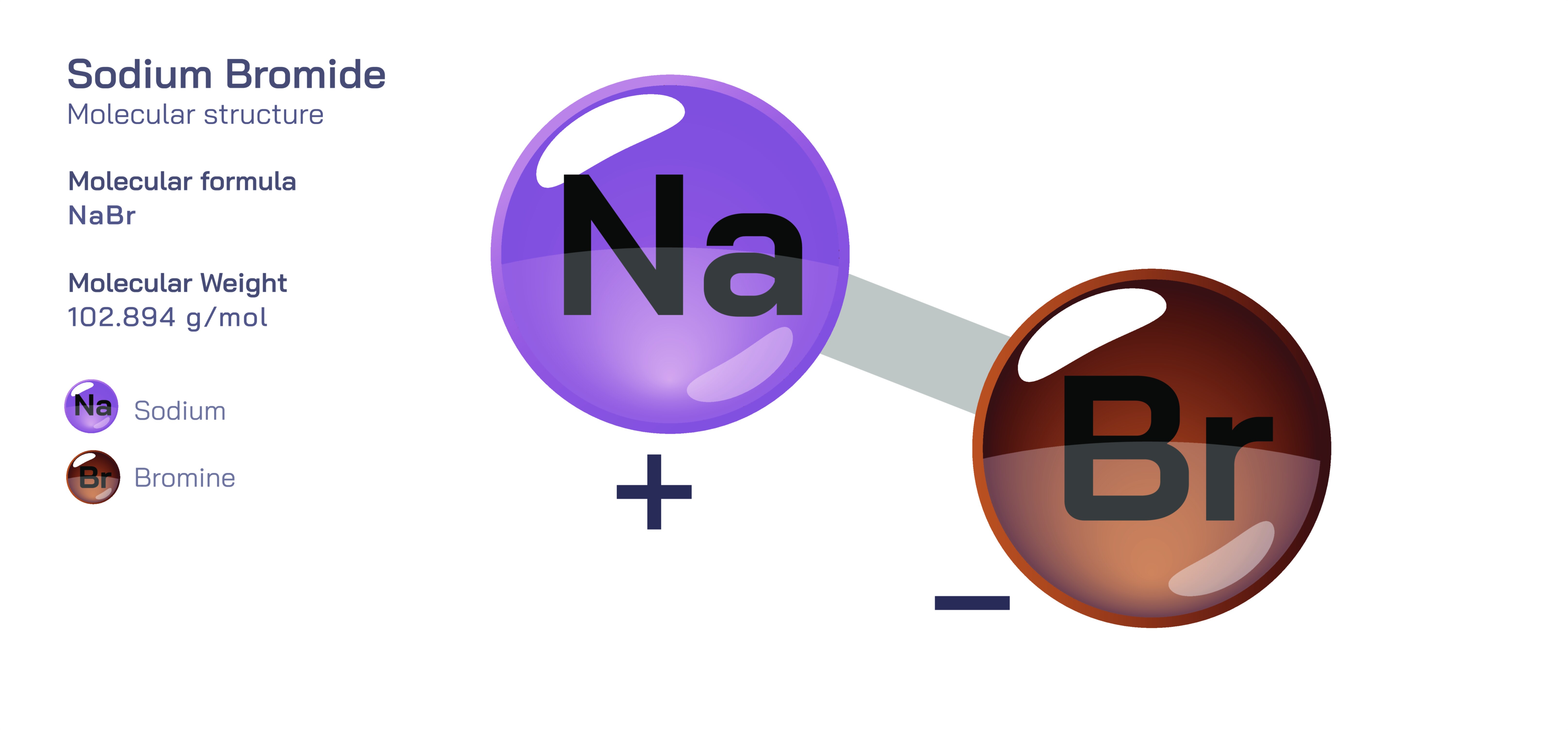
The atomic basis of NaBr begins with sodium, a soft, highly reactive metal located in Group 1 of the periodic table. In its elemental form, a sodium atom contains one valence electron in its outermost shell, making it very eager to lose that electron so that it can achieve the stable electron configuration of neon. Bromine, by contrast, is a halogen in Group 17 that contains seven valence electrons, lacking one electron to complete its outer shell and achieve the configuration of krypton. When sodium and bromine interact, the chemical driving force is clear: sodium loses one electron and becomes a positively charged ion, Na⁺, while bromine gains one electron and becomes the negatively charged bromide ion, Br⁻. This exchange is not a covalent sharing of electrons but a full transfer, and the resulting electrostatic attraction between the oppositely charged ions is so strong that it generates a stable ionic lattice. This electron transfer lies at the heart of ionic bonding and explains why NaBr exists as ions in the solid and dissolved states rather than as neutral molecules.
In the solid state, sodium bromide forms a highly organized three-dimensional crystal lattice in which every sodium ion is surrounded by bromide ions and every bromide ion is surrounded by sodium ions. The structure is typically cubic, similar to that of sodium chloride, and is held together by repeating electrostatic interactions between positive and negative ions. This crystalline packing produces a rigid solid with a relatively high melting point because overcoming the attractions between Na⁺ and Br⁻ requires considerable thermal energy. The solidity and stability of NaBr in its crystalline form therefore arise not from molecular building blocks but from an extended network of alternating ions. This is one of the most important conceptual lessons of ionic chemistry—that ionic compounds are not made of small individual units containing discrete NaBr pairs but instead consist of giant lattices of ions arranged according to electrical forces.
When sodium bromide is placed in water, the ionic lattice undergoes complete dissociation. Water molecules surround each ion through hydration: the slightly negative oxygen end of water coordinates around sodium ions, and the slightly positive hydrogen ends surround bromide ions. This energetic hydration process overcomes the ionic attraction in the solid and pulls the ions apart into solution. As a result, NaBr dissolves readily and produces a solution that strongly conducts electricity due to the free movement of charged particles. This behaviour provides a clear demonstration of electrolytes—compounds that yield ions when dissolved and enable electrical conduction. The stark contrast between solid NaBr, which does not conduct electricity, and aqueous NaBr, which does, reinforces the idea that ionic behaviour depends on the mobility of ions in a given phase.
The ionic nature of sodium bromide plays an important role in acid–base and precipitation reactions. Bromide ions participate in halide chemistry and form highly insoluble silver bromide (AgBr) when solutions containing bromide are treated with silver nitrate. This reaction produces a cream-coloured precipitate that helps identify bromide ions in qualitative analysis. The reaction reflects a hierarchy of ionic stability: bromide forms a stronger lattice with silver than with sodium, driving precipitation. Sodium bromide also demonstrates spectator ion behaviour in many reactions—the sodium ion remains unreactive because its low charge density and high stability make it extremely resistant to redox processes or complex formation. This predictability of sodium ions helps chemistry learners understand the difference between chemically active species, such as halides, and chemically passive ions used for electrical neutrality.
In biological and medical history, sodium bromide once played a major role as a sedative and anticonvulsant because bromide ions can depress neural activity. Although its medical use has largely been replaced by safer alternatives, its historical importance highlights how inorganic ions can interact with neurological systems. Today, bromide ions still appear in some veterinary medicine formulations and in controlled laboratory research, demonstrating ionic effects on tissues. Importantly, this biological interaction emphasizes that sodium bromide’s properties originate from the bromide ion rather than the sodium ion. The sodium ion is physiologically compatible and abundant in biological systems, while the behaviour of bromide in the body depends on concentration, making sodium bromide an example of how dosage determines benefit or risk.
In industrial contexts, sodium bromide is used in photography, water treatment, chemical synthesis, analytical laboratories and oil extraction. In photographic film development, sodium bromide functions as a restrainer by selectively limiting the reduction of silver ions, preventing fogging of images. This application is rooted in the fact that bromide ions interact strongly with silver ions, slowing silver deposition during development. In water treatment, sodium bromide combines with oxidizing agents to produce hypobromous acid, a disinfectant that provides microbial control in cooling systems and hot tubs. This use demonstrates the chemical reactivity of bromide ions under oxidative conditions. In organic synthesis, NaBr serves as a source of bromide ions in substitution reactions, participating in the formation of organobromine compounds. These reactivities again reinforce that the bromide ion—not the sodium ion—governs chemical functionality.
Thermally, sodium bromide behaves as a stable salt that does not decompose under moderate heating, reflecting the strong electrostatic attraction of its ionic lattice. Only at very high temperatures does it begin to dissociate or volatilize. The compound is not oxidizing or reducing in nature under standard conditions, meaning that its thermal stability corresponds directly to its neutral ionic composition. Sodium ions cannot be reduced easily due to their deep energy well, and bromide ions cannot be oxidized without strong oxidizing agents because their valence shell is already nearly complete. This stability helps explain why sodium bromide is safe to store and transport under normal circumstances.
Although NaBr is chemically stable, safe use depends on context. When handled properly, it poses minimal risk because sodium and bromide ions are not strongly corrosive or reactive. However, ingestion of excessive bromide can cause neurological symptoms because bromide competes with chloride ions in biological pathways. Environmentally, bromide is naturally present in seawater and does not accumulate in harmful ways when used responsibly. These factors demonstrate the teaching principle that toxicity arises from concentration and exposure rather than the inherent nature of ions.
Ultimately, the educational value of sodium bromide lies in the way its behaviour illustrates foundational chemistry concepts. The compound demonstrates electron transfer and the formation of ions, the creation of ionic lattices, the dissociation of salts in water, the relationship between structure and solubility, the electrical conductivity of electrolyte solutions, halide precipitation reactions, and the separation between chemically active and chemically passive ions. Sodium provides the cationic stability that anchors the lattice, while bromide provides the anionic chemistry that defines reactivity. Every property—from crystal formation to biological effects—can be traced to the combination of atomic structure and ionic bonding.
Sodium bromide therefore stands as a model compound for chemistry learning because it reveals the deep connection between the atomic world and the macroscopic world. It shows how the transfer of a single electron from one atom to another can transform two hazardous elements—metallic sodium and toxic bromine—into a stable, useful and predictable salt. It makes clear that ionic compounds are not molecules but lattices, that solubility reflects hydration energy overcoming lattice energy, and that ions move freely in water to drive electrical and chemical processes. By examining NaBr, learners see that chemistry is not a list of formulas but a science built on understanding how structure creates function, how atomic behaviour governs material behaviour, and how the invisible realm of electrons shapes the visible properties of matter.