𝐒𝐨𝐝𝐢𝐮𝐦 𝐁𝐨𝐫𝐚𝐭𝐞 — 𝐌𝐨𝐥𝐞𝐜𝐮𝐥𝐚𝐫 𝐂𝐨𝐦𝐩𝐨𝐬𝐢𝐭𝐢𝐨𝐧, 𝐂𝐡𝐞𝐦𝐢𝐬𝐭𝐫𝐲 𝐁𝐞𝐡𝐚𝐯𝐢𝐨𝐮𝐫, 𝐚𝐧𝐝 𝐃𝐞𝐞𝐩 𝐄𝐝𝐮𝐜𝐚𝐭𝐢𝐨𝐧𝐚𝐥 𝐒𝐮𝐦𝐦𝐚𝐫𝐲
Sodium borate, widely recognized in its common form as borax and represented by the chemical formula Na₂B₄O₇·10H₂O for the decahydrate, is a fascinating compound whose molecular architecture reveals a rich combination of ionic and covalent chemistry. While it presents itself as a soft white crystalline powder, the internal structure of sodium borate is remarkably complex because it contains borate units built from boron–oxygen frameworks paired with sodium ions and, in its most familiar form, water molecules that participate in the crystal lattice. To understand sodium borate is to understand how boron behaves in chemical bonding: unlike many elements that form predictable straight-chain or tetrahedral structures, boron atoms form networks of triangular and tetrahedral oxygen coordination that interconnect into polyborate anions. These anions interact electrostatically with sodium ions to create an extended ionic arrangement that dissolves readily in water, yet maintains a distinctive chemical signature. The water molecules embedded within the structure of sodium borate decahydrate are not merely trapped moisture; they surround sodium ions and stabilize the borate ions in geometrically organized hydration spheres that shape the behaviour of the compound once it dissolves. In its anhydrous and hydrated forms, sodium borate demonstrates how the chemistry of glassmaking, detergents, buffering solutions, metallurgy and biochemistry can all arise from fundamental features of molecular composition.
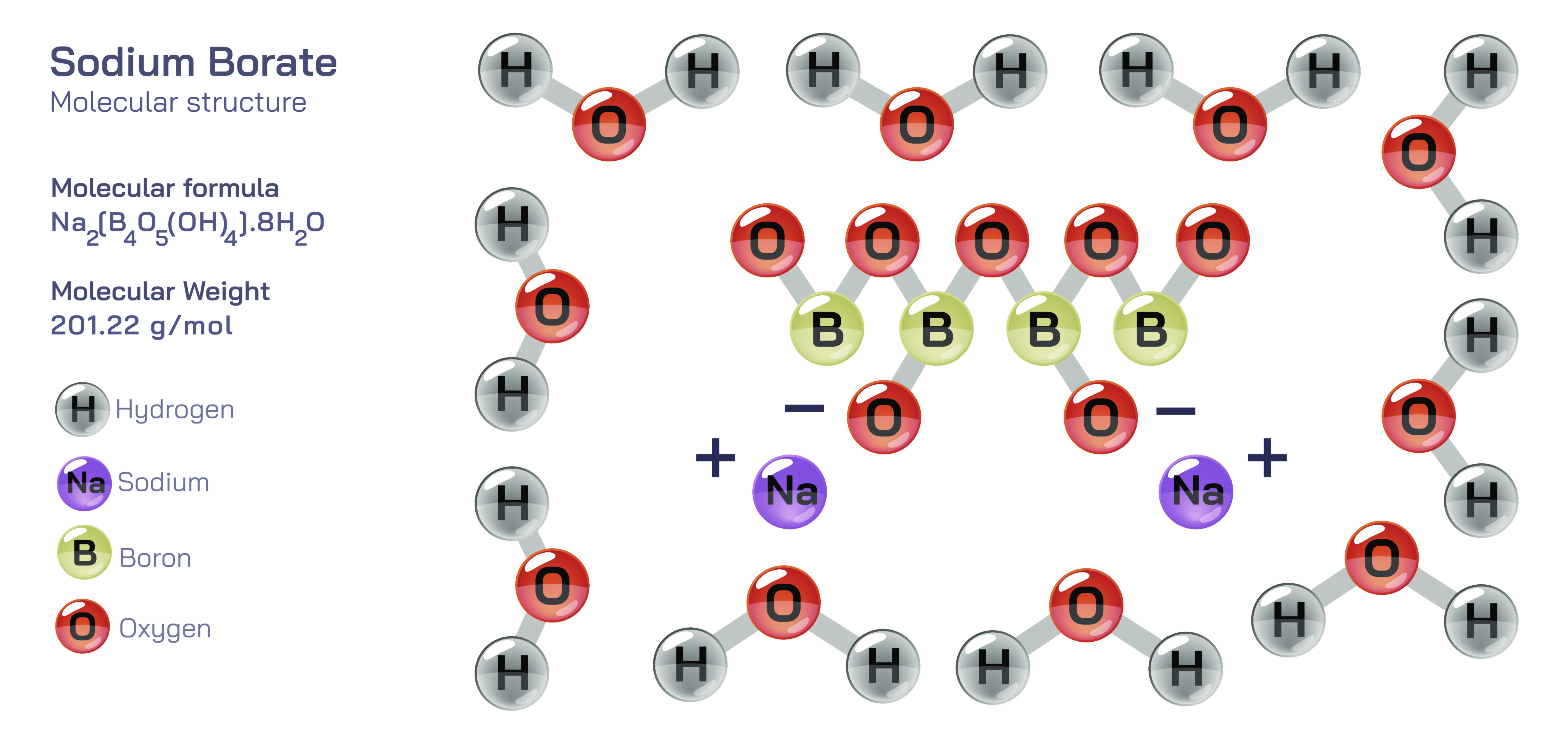
The backbone of sodium borate lies in the borate ion network, typically composed of a mixture of trigonal BO₃ units and tetrahedral BO₄ units. In the decahydrate form, four boron atoms are interconnected through shared oxygen atoms to create the B₄O₅(OH)₄²⁻ anion. The ion contains bridging oxygens linking the boron centers and hydroxyl groups positioned outward from the core of the structure. This mixture of covalent bonding within the anion and ionic interactions between the anion and sodium cations produces a compound that is structurally robust in solid form but highly reactive in aqueous solution. When sodium borate dissolves in water, the borate clusters do not remain fully unchanged. Instead, depending on pH and concentration, they undergo rearrangements that form a range of borate species including monoborate, diborate and tetraborate anions. These transformations help explain the behaviour of sodium borate as a buffering agent in mildly alkaline solutions. Because the borate anion can accept hydrogen ions from weak acids or donate them under strongly basic conditions, sodium borate maintains a relatively stable pH in solution and is therefore used in biological and industrial systems where precise control of alkalinity is necessary. From a teaching perspective, sodium borate illustrates the concept that molecular identity in solution may be dynamic rather than static; ions can reorganize while maintaining stoichiometric balance.
One of the most recognizable chemical behaviours of sodium borate is its ability to interact with polymers such as polyvinyl alcohol (PVA) to form viscoelastic networks, popularly known in education as “slime.” The formation of this gel-like material does not require covalent polymerization; instead, sodium borate promotes crosslinking between polymer chains by interacting with hydroxyl-rich groups and producing temporary bonds that break and reform repeatedly. This network structure gives rise to the unique physical texture of slime—stretchable yet resistant to sudden force—demonstrating the concept of reversible crosslinking. The experiment is a powerful teaching tool because it shows how molecular interactions translate into macroscopic material properties. The borate ions act as connectors among polymer chains, exhibiting how a compound known for glassmaking and cleaning can also play an instructive role in polymer chemistry.
The role of sodium borate in detergents and cleaning products stems from its ability to act as both a pH buffer and a water softener. The borate ion reacts with metal cations such as calcium and magnesium—the minerals responsible for water hardness—forming complexes that prevent these ions from interfering with surfactants. This behaviour increases the efficiency of soaps and detergents by allowing them to foam and dissolve greasy residue more effectively. The compound’s mild alkalinity also aids in stain removal by emulsifying oils and neutralizing acidic contaminants. These properties do not originate from reactive corrosive behaviour but from the subtle structural characteristics of borate species that interact predictably with metal ions and hydroxyl groups. In addition to its detergent role, sodium borate finds application in fire retardants because borate ions help convert combustible organic material into a protective char layer that resists ignition by limiting oxygen access. The behaviour reflects the thermal decomposition pathway of borate compounds, which release water and form heat-resistant boron oxides that coat surfaces in high temperatures. This demonstrates how molecular composition can influence safety in materials exposed to fire risk.
Sodium borate’s relevance in glass and ceramic manufacturing stems from the behaviour of boron–oxygen networks during melting. When added to silicate mixtures, sodium borate lowers the melting point and improves the mechanical strength and thermal resistance of glass by introducing borate units into the silicon–oxygen framework. Borosilicate glass, known for its durability and thermal stability in laboratory glassware and cookware, depends on this structural integration. Borate units modify the rigidity and flexibility of glass by allowing the network to absorb and withstand thermal expansion stress, preventing cracking. This direct connection between microscopic bonding and macroscopic durability highlights how advances in material technology originate from understanding atomic-scale structure.
From a biological and environmental perspective, sodium borate plays nuanced roles. Trace amounts of boron are essential micronutrients for plants, where borate ions help stabilize cell wall structure and support membrane transport processes. In agricultural contexts, sodium borate is used carefully in fertilizers to correct boron deficiencies, but its concentration must be controlled because excess boron becomes toxic to plants. In environmental chemistry, borate ions participate in buffering aquatic systems by moderating alkalinity, although not as dramatically as carbonate and bicarbonate ions. In biochemistry, borate is used in electrophoresis buffers to maintain pH during separation of nucleic acids, once again relying on the buffering behaviour that originates from its structural composition.
Thermal behaviour of sodium borate provides another demonstration of structure–function relationships. Upon heating, hydrated sodium borate gradually releases its water of crystallization in a stepwise manner rather than instantaneously. Each released water molecule represents the loosening of specific hydration layers around sodium cations and borate anions. With continued heating, the compound transforms into anhydrous sodium tetraborate and ultimately into boron oxide (B₂O₃), which plays a key role in glass formation. This progressive change shows that chemical behaviour does not always occur through abrupt decomposition; it can occur through a sequence of structural reorganizations driven by energy input.
Although sodium borate is relatively safe at low concentrations and has been used traditionally in household products, responsible handling remains important. The compound can irritate skin, eyes and respiratory tissue in high concentrations, and ingestion of large amounts disrupts metabolic processes due to boron accumulation. Understanding that toxicity arises from dosage rather than the compound’s existence reminds learners that chemistry must balance utility with safety.
Taken as a whole, sodium borate serves as a striking illustration of how the architecture of a molecule defines its behaviour across fields. Its combination of boron–oxygen covalent networks and sodium-driven ionic balance allows it to behave as a buffer in biological solutions, a softener in detergents, a crosslinker in polymer gels, a flux in glassmaking, a fire retardant in materials, a fertilizer additive in agriculture and a pH regulator in laboratory chemistry. Every one of these roles arises from the same molecular composition—the interplay between sodium ions, polyborate frameworks and water molecules that stabilize the structure. In learning chemistry, sodium borate helps demonstrate the broader truth that chemical formulas represent not just constituent atoms but the deeper relationships between structure, bonding and function that connect the microscopic world of atoms to the visible properties and technologies that shape daily life.