𝐒𝐨𝐝𝐢𝐮𝐦 𝐁𝐢𝐬𝐮𝐥𝐟𝐚𝐭𝐞 — 𝐃𝐞𝐭𝐚𝐢𝐥𝐞𝐝 𝐌𝐨𝐥𝐞𝐜𝐮𝐥𝐚𝐫 𝐒𝐭𝐫𝐮𝐜𝐭𝐮𝐫𝐞, 𝐀𝐜𝐢𝐝–𝐁𝐚𝐬𝐞 𝐁𝐞𝐡𝐚𝐯𝐢𝐨𝐮𝐫 𝐚𝐧𝐝 𝐂𝐡𝐞𝐦𝐢𝐬𝐭𝐫𝐲 𝐄𝐝𝐮𝐜𝐚𝐭𝐢𝐨𝐧𝐚𝐥 𝐒𝐮𝐦𝐦𝐚𝐫𝐲.
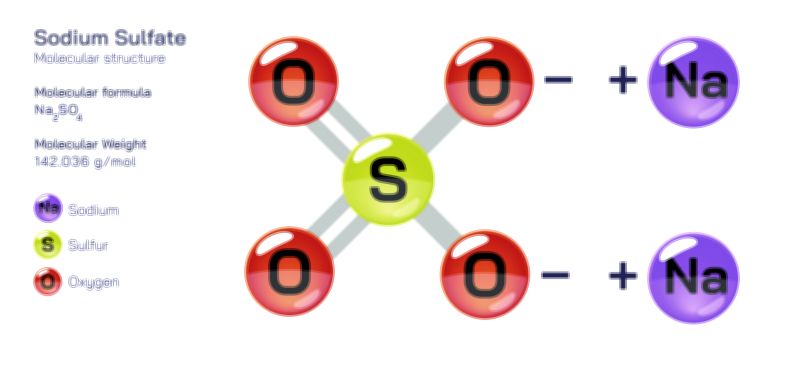
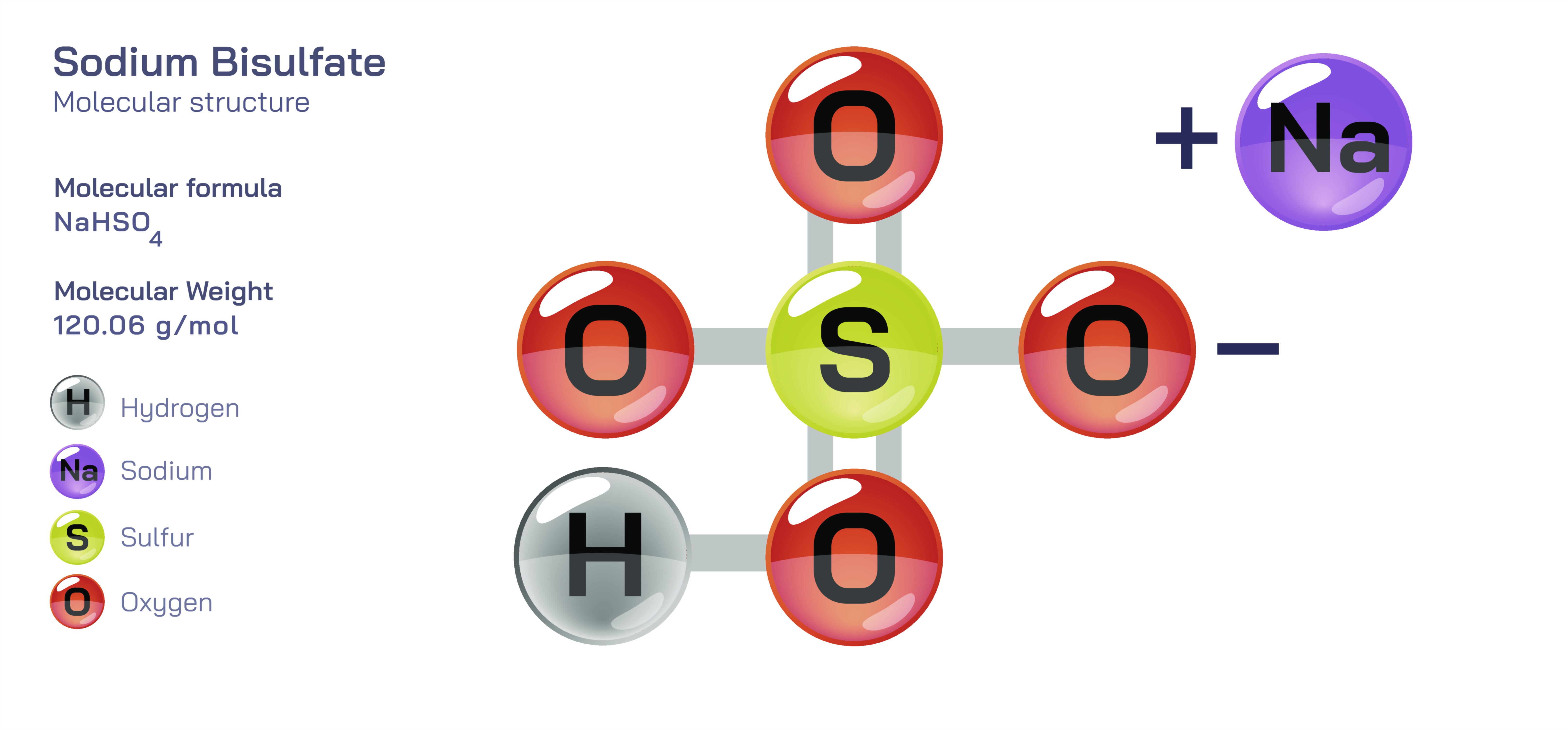
Sodium bisulfate, represented chemically as NaHSO₄, is an inorganic compound that stands at a unique position in acid–base chemistry due to its hybrid nature—possessing both the structural characteristics of a salt and the functional behaviour of an acid. It typically appears as a white crystalline solid that dissolves readily in water, producing highly acidic solutions. Although it is often confused with sodium sulfate (Na₂SO₄), the two substances are chemically distinct because sodium bisulfate contains one proton that remains attached to the sulfate group, giving the compound acidic reactivity that sodium sulfate does not possess. Understanding sodium bisulfate requires more than memorizing its formula; it involves exploring the intramolecular structure of the hydrogen sulfate (bisulfate) ion, the effect of resonance on charge distribution, and how the presence of that single acidic hydrogen atom shapes the compound’s reactivity, buffering ability, solubility and industrial role.
The core of sodium bisulfate’s behaviour lies in the structure of the bisulfate ion, HSO₄⁻. This ion is formed when sulfuric acid (H₂SO₄) loses only one proton instead of both, leaving behind a species that retains simultaneously the structural stability of a sulfate unit and the chemical reactivity of a weak acid. Structurally, the bisulfate ion consists of a central sulfur atom surrounded by four oxygen atoms arranged tetrahedrally, where one of the oxygen atoms is bonded to hydrogen. Many students imagine this proton as being weakly attached or easily removable, but the chemistry is more complex. The negative charge of the ion is not localized exclusively on any one oxygen atom; rather, it is delocalized across the sulfate framework through resonance. As a consequence, the S–O bonds within HSO₄⁻ do not exist as single or double bonds in the strict classical sense but share characteristics of both forms. This resonance stabilizes the anion but still permits proton dissociation in water. When sodium bisulfate forms, the Na⁺ ion pairs with HSO₄⁻ through simple ionic attraction, resulting in an ionic lattice in the solid state. Once the material dissolves, water molecules coordinate individually around Na⁺ ions and HSO₄⁻ ions, separating them completely, which explains the compound’s high dissolution rate and the immediate acidification of the solution.
One defining feature of sodium bisulfate is that it functions as an acid despite its identity as a salt. When dissolved in water, the bisulfate ion partially donates its hydrogen ion to form hydronium (H₃O⁺) and sulfate (SO₄²⁻). Because this proton transfer does not go to completion but instead establishes an equilibrium, sodium bisulfate behaves as a moderately strong acid, much stronger than acetic acid but weaker than sulfuric acid. This equilibrium highlights a key educational point: acidity is not simply the presence of hydrogen but the ease with which that hydrogen can dissociate under molecular forces. The negative charge stabilization that allows HSO₄⁻ to exist as a stable anion allows its remaining proton to dissociate more readily than protons in weak acids but not as aggressively as those in strong acids. In this way, sodium bisulfate demonstrates how acid strength arises from electron distribution and molecular geometry rather than merely from the number of acidic hydrogen atoms present.
Sodium bisulfate occupies an essential conceptual role in teaching acid–base conjugate relationships. It is formed from the first deprotonation step of sulfuric acid and is the conjugate base of the hydronium ion while simultaneously acting as the conjugate acid of the sulfate ion. Because of this dual identity, sodium bisulfate participates dynamically in pH regulation and buffering. If the surrounding solution becomes more basic, the bisulfate ion donates its proton and shifts toward sulfate formation. If the surrounding solution becomes strongly acidic, the bisulfate ion can accept a proton to regenerate sulfuric acid. These shifts illustrate the reversible proton transfer behaviour used to describe conjugate acid–base pairs in solution equilibrium. In educational contexts, NaHSO₄ helps demonstrate the principle that acidity is not binary but exists along a continuum, where molecular structure determines the relative ease of proton donation and acceptance.
The reactivity of sodium bisulfate depends on the environment in which it is placed. In neutral or mildly basic media, the compound acidifies solutions and shifts equilibria strongly toward hydronium formation. In strongly acidic solutions, however, sodium bisulfate behaves like a spectator ion and does not significantly alter pH because sulfuric acid dominates the equilibrium. In contrast, in highly alkaline environments, sodium bisulfate acts as a proton donor and is rapidly converted to sodium sulfate. These transformations illustrate that chemical identity depends on surroundings; a compound can either donate or retain a proton depending on the composition of the solution. This behaviour is extremely important in industrial and environmental applications where precise pH control determines the success of chemical processes.
The usefulness of sodium bisulfate in industry stems from its predictable acidity and stable dry form. Unlike liquid sulfuric acid, sodium bisulfate is handled safely as a dry solid, minimizing the hazards associated with liquid strong acids. When dissolved, it reduces pH without introducing chloride ions or volatile acidic fumes, which is why it is widely used in swimming pools, spas and water treatment systems to lower pH without generating corrosive vapours. In metal cleaning and pickling operations, sodium bisulfate removes rust and oxide layers by generating acidic conditions that dissolve metal oxides. In food processing, its acidifying nature is used for pH control and food preservation in regulated quantities. Its role in these applications reflects structural chemistry—because the proton dissociates controllably, sodium bisulfate provides acidic strength without uncontrolled exothermic reactions that liquid sulfuric acid would cause.
In laboratory contexts, sodium bisulfate acts as a safe substitute for strong mineral acids when precise pH reduction is required. When titrating weak bases, sodium bisulfate offers the advantage of providing a reliable source of hydronium ions without adding chloride from hydrochloric acid or nitrate from nitric acid, which may interfere with precipitation reactions or ionic equilibria. As an oxidizing agent, sodium bisulfate can contribute sulfate ions that maintain ionic balance in solution while the acidic environment accelerates redox reactions. These examples demonstrate that sodium bisulfate’s relevance in chemistry does not arise from novelty but from predictability—steady acidity and structural stability allow it to serve as both a reagent and a teaching model for acid–base systems.
The thermal behaviour of sodium bisulfate also reflects its molecular structure. When heated, it undergoes dehydration reactions to produce sodium pyrosulfate (Na₂S₂O₇). Continued heating can ultimately regenerate sodium sulfate and release sulfur trioxide. These transitions are educational because they illustrate the effects of temperature on oxygen-rich oxyanion chemistry. Instead of oxidizing or reducing, the system reorganizes internally as protons and sulfate groups recombine and separate. These thermal pathways further emphasize that chemical reactions are not isolated events but guided by the interplay between structural stability and energetic favourability.
While sodium bisulfate is safe when handled responsibly, improper use can lead to irritation or corrosive harm because of its acidity. The compound’s behaviour underscores that hazards arise not from formulas but from chemical interactions with biological tissue. In low concentrations, sodium bisulfate is safe in food processing and pool maintenance; in high concentrations or dry form, it can damage skin or eyes by generating localized hydronium ions. Environmental concerns are minimal when the compound is used correctly, since the sulfate species is naturally abundant in soil and water, and bisulfate equilibrates rapidly in aquatic systems.
Ultimately, sodium bisulfate demonstrates how a compound’s structure, rather than its name or appearance, determines its chemistry. NaHSO₄ behaves as a salt when forming crystalline solids, as an acid when dissolved in water, and as a buffer component in pH-dependent reactions. Its structural identity arises from the hydrogen sulfate ion—a resonancestabilized anion with a proton that can dissociate easily but not uncontrollably. All its behaviours—pH reduction, equilibrium participation, proton donation, buffering, thermal transitions and industrial reactivity—follow directly from this architecture. Thus, sodium bisulfate serves as a clear educational model for understanding how atomic arrangement and electron distribution shape chemical function across laboratory, industrial and biological settings.