𝐒𝐨𝐝𝐢𝐮𝐦 𝐂𝐡𝐫𝐨𝐦𝐚𝐭𝐞 — 𝐌𝐨𝐥𝐞𝐜𝐮𝐥𝐚𝐫 𝐒𝐭𝐫𝐮𝐜𝐭𝐮𝐫𝐞, 𝐈𝐨𝐧𝐢𝐜 𝐁𝐨𝐧𝐝𝐢𝐧𝐠, 𝐄𝐥𝐞𝐜𝐭𝐫𝐨𝐧𝐢𝐜 𝐁𝐞𝐡𝐚𝐯𝐢𝐨𝐮𝐫 𝐚𝐧𝐝 𝐄𝐝𝐮𝐜𝐚𝐭𝐢𝐨𝐧𝐚𝐥 𝐂𝐡𝐞𝐦𝐢𝐬𝐭𝐫𝐲 𝐒𝐮𝐦𝐦𝐚𝐫𝐲.
Sodium chromate, written chemically as Na₂CrO₄, is an inorganic salt composed of sodium ions and the chromate ion, and although it appears externally as a yellow crystalline solid that dissolves readily in water, its internal structure and chemical behaviour reveal deep relationships between oxidation states, resonance within polyatomic ions, ionic bonding and electrochemical reactivity. Sodium chromate is a fundamental compound in chemistry education because it illustrates how the oxidation state of a central metal atom—chromium in this case—determines the shape, charge distribution and reactivity of the entire molecular species. From an electron-level perspective, Na₂CrO₄ shows how ionic solids are not built from small molecular units but from extended ionic networks, and how the geometry and charge of a polyatomic ion control both its solubility and its redox profile. For this reason, sodium chromate is not just a salt with industrial applications; it is an excellent model for understanding the structural chemistry of transition metal oxyanions and the concept of structure-function relationships in inorganic compounds.
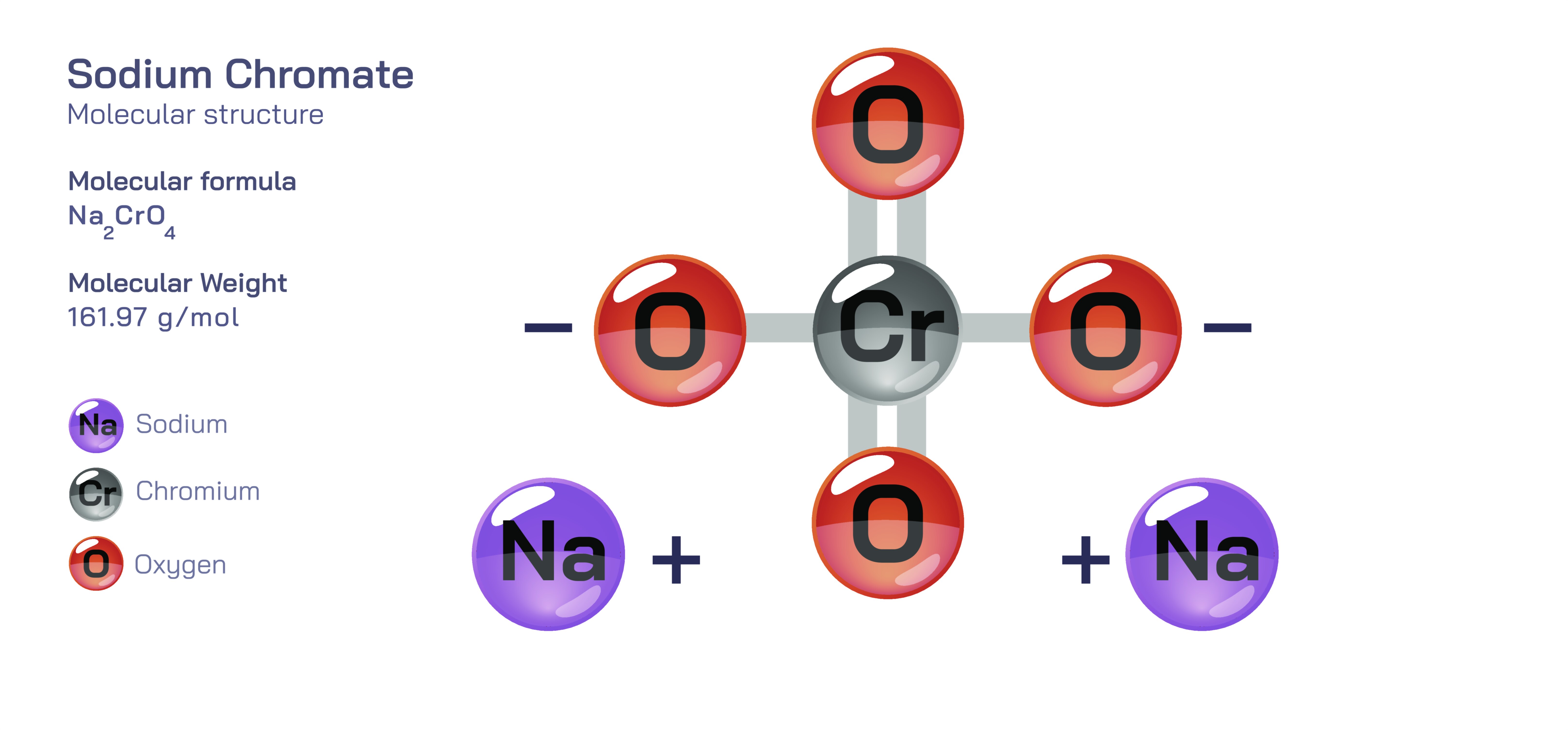
The structural heart of sodium chromate lies in the chromate ion, CrO₄²⁻. In this highly charged anion, chromium occupies the +6 oxidation state, an unusually high and electron-deficient oxidation state that drives the ion’s strong oxidizing properties and its robust bonding to oxygen. Chromium sits at the centre of a tetrahedral geometry, surrounded symmetrically by four oxygen atoms. This arrangement is not random; it arises because the chromium atom, after losing six electrons, has an empty set of d-orbitals that participate in bonding, allowing the metal centre to accommodate multiple double-bond-like interactions with oxygen. Even though simple drawings may show two or three double bonds between chromium and oxygen, the correct electronic description involves resonance: the electron density is distributed across all Cr—O bonds, making them equivalent. This resonance stabilization is a defining feature of chromate chemistry because it makes the chromate ion very robust within a wide range of temperatures and pH conditions, while still leaving the chromium centre highly electron-deficient and therefore strongly oxidizing.
Sodium ions play a much more structural and passive role. When sodium chromate forms, two Na⁺ ions—each originating from the loss of one valence electron from sodium atoms—electrostatically balance the overall 2– charge of the chromate ion. In the solid state, Na⁺ ions and CrO₄²⁻ ions pack into a crystalline lattice, held together by ionic attraction. No single “Na₂CrO₄ molecule” exists; instead, the material consists of a repeating three-dimensional lattice where cations and anions alternate according to charge. This ionic lattice explains the relatively high melting point and brittle crystalline structure of sodium chromate, and it also explains why the compound dissolves readily in water: the strong hydration energy produced when water molecules surround Na⁺ and CrO₄²⁻ ions outweighs the lattice energy holding the salt together. Hydration is selective: water’s partially negative oxygen atoms align toward sodium ions, while the hydrogen ends form hydrogen-bonding interactions with the oxygen atoms on the chromate ion. These targeted solute–solvent interactions show how the polarity of ions influences solubility and solution behaviour.
One of the most important educational aspects of sodium chromate is the connection between structure and electronic behaviour. Chromium in its +6 oxidation state is extremely electron-poor and strongly tends to gain electrons when in contact with reducing agents. This makes chromate ions powerful oxidizing agents. During redox reactions, chromate is commonly reduced to Cr³⁺, a far more stable oxidation state, while the reducing agent is oxidized. This transformation illustrates how oxidation and reduction do not occur randomly but follow the structural needs of atoms seeking stable electron configurations. The yellow colour of sodium chromate also originates from electronic transitions within the chromate ion: visible light causes electrons to jump between molecular orbitals associated with chromium and oxygen bonding, and the wavelengths absorbed versus reflected determine the perceived colour. Thus, the colour we see is not arbitrary—it is a direct consequence of electron energy states inside the material.
In aqueous environments, the behaviour of chromate becomes even more instructive. Chromate and dichromate ions (Cr₂O₇²⁻) exist in pH-dependent equilibrium. At high pH, chromate ions dominate; at low pH, they convert to the orange dichromate ion. This reaction demonstrates the link between proton concentration and the connectivity of polyatomic oxyanions. It also provides a practical way to teach equilibrium principles: adding acid shifts the equilibrium toward dichromate, and adding base shifts it back toward chromate. The structural explanation is that protonation affects the bridging oxygen arrangement between chromium centres, producing a different ion while maintaining the +6 oxidation state. Classroom experiments that shift chromate–dichromate equilibria visually reinforce how chemical structure adapts in response to environmental conditions.
Sodium chromate also plays an important conceptual role in precipitation chemistry. Because chromate ions form highly insoluble salts with many metal ions such as barium, lead and silver, they are used in quantitative and qualitative analysis. For example, when silver ions are present, silver chromate forms a brick-red precipitate. These precipitation reactions occur because chromate forms ionic lattices with these metals that are more energetically favourable than staying dissolved in water. The formation of precipitates demonstrates the balance between lattice energy and hydration energy and helps students understand why solubility is not simply a property of the anion or cation alone, but of their combination.
6. Such decomposition behaviour highlights why sodium chromate must be handled with care around heat sources or organic materials because the release of oxygen and strong oxidizing character can trigger combustion processes in reactive mixtures.
Although sodium chromate has long been used industrially—for corrosion inhibition, metal finishing, pigment manufacture and wood preservation—it must be handled responsibly because Cr⁶⁺ compounds are toxic and carcinogenic. Toxicity does not arise from the sodium ions but from the chromate ion's strong oxidizing behaviour, which allows it to interact aggressively with biological molecules such as DNA and proteins. This reinforces a key scientific message: the safety of a chemical depends not just on its presence but on its oxidation state, concentration and exposure route. Understanding sodium chromate’s structural chemistry promotes safer laboratory practice and informed environmental policies.
In its broadest educational significance, sodium chromate is a model that connects multiple foundational chemistry themes. It illustrates ionic bonding through the formation of Na⁺ and CrO₄²⁻, resonance stabilization within polyatomic ions, d-orbital participation in bonding, colour linked to electronic transitions, oxidizing behaviour rooted in oxidation state, dissolution driven by hydration energy, precipitation chemistry, acid–base-dependent structural equilibria and redox-driven decomposition. Each of these behaviours can be traced back to the microscopic organization of the chromate ion and the unreactive stabilizing role of sodium ions.
Thus, sodium chromate shows that chemistry is not defined by formulas alone but by the arrangement of electrons and atoms that give substances their properties. Through Na₂CrO₄, learners see how structure governs function, how oxidation state governs reactivity, how ions shape solution behaviour and how invisible electronic forces determine the observable nature of matter.