𝐒𝐨𝐝𝐢𝐮𝐦 𝐂𝐢𝐭𝐫𝐚𝐭𝐞 — 𝐌𝐨𝐥𝐞𝐜𝐮𝐥𝐚𝐫 𝐒𝐭𝐫𝐮𝐜𝐭𝐮𝐫𝐞, 𝐂𝐡𝐞𝐦𝐢𝐜𝐚𝐥 𝐁𝐨𝐧𝐝𝐢𝐧𝐠, 𝐒𝐨𝐥𝐮𝐭𝐢𝐨𝐧 𝐁𝐞𝐡𝐚𝐯𝐢𝐨𝐮𝐫 𝐚𝐧𝐝 𝐂𝐡𝐞𝐦𝐢𝐬𝐭𝐫𝐲 𝐄𝐝𝐮𝐜𝐚𝐭𝐢𝐨𝐧𝐚𝐥 𝐒𝐮𝐦𝐦𝐚𝐫𝐲.
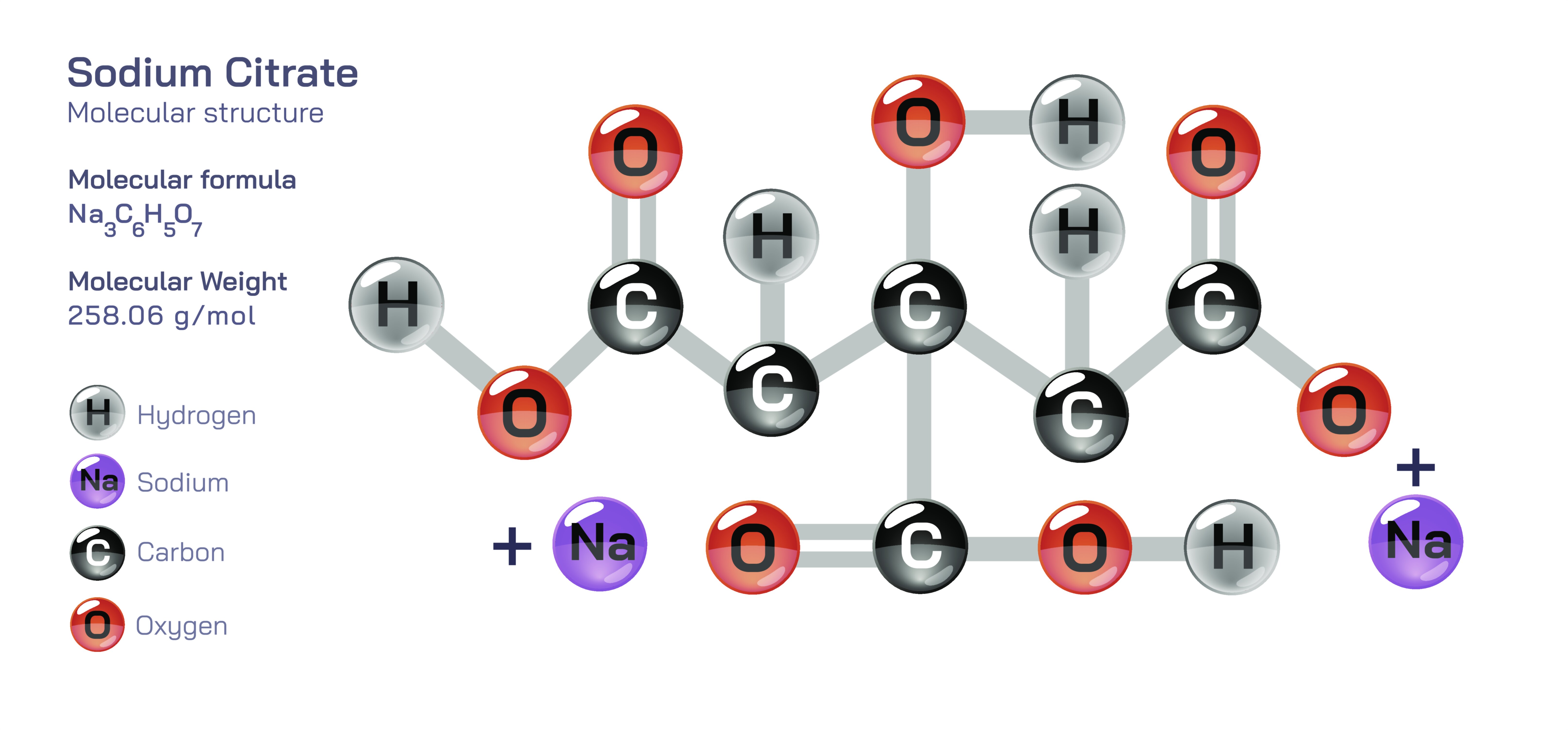
Sodium citrate, most commonly encountered as trisodium citrate and written chemically as Na₃C₆H₅O₇, is an inorganic–organic salt formed from the combination of sodium ions and the citrate anion. Although it appears as a harmless white crystalline powder used in foods and biochemistry laboratories, its scientific importance extends much deeper. The molecular architecture of sodium citrate reveals essential concepts of acid–base chemistry, resonance within carboxylate groups, ionic bonding, buffering behaviour and metal ion coordination. Unlike simpler inorganic salts like sodium chloride or sodium carbonate, sodium citrate bridges the boundary between mineral chemistry and organic chemistry, containing both ionic and covalent bonding within the same compound. For learners of chemistry, sodium citrate demonstrates how molecular structure determines function and how the distribution of electron density over complex ions gives rise to properties that make the compound vital in medicine, food science, biochemistry, and analytical chemistry.
The core structural feature of sodium citrate is the citrate ion, derived from citric acid. Citric acid is a tricarboxylic acid, meaning it contains three carboxyl groups (–COOH) attached to a three-carbon backbone along with a hydroxyl (–OH) group. When citric acid undergoes complete deprotonation, each of its three carboxyl groups loses a hydrogen ion, leaving behind three negatively charged carboxylate groups (–COO⁻). These three negative charges are distributed across the citrate ion, and each is balanced by a sodium ion when the salt is formed. Thus, trisodium citrate consists of three Na⁺ ions ionically associated with a single C₆H₅O₇³⁻ anion. Within the citrate ion itself, the bonds are covalent, linking carbon, oxygen and hydrogen atoms in a fixed molecular arrangement. However, the negatively charged oxygen atoms of the carboxylate groups engage in ionic attraction with sodium ions in the solid state. This dual bonding identity shows how sodium citrate unites organic molecular structure with inorganic ionic bonding.
A key aspect of the citrate ion is resonance. In a single carboxylate group, the extra electron density is not confined to one oxygen atom; instead, it is distributed across both oxygen atoms, making them equivalent in terms of bond length and electron density. Because the citrate ion contains three carboxylate groups, resonance occurs at three different positions within the molecule. This broad electron delocalization gives the citrate ion remarkable stability and helps explain its buffering behaviour in aqueous solution. The spatial arrangement of the citrate ion is not linear; instead, the three carboxylate groups extend outward in a roughly three-dimensional manner from the central carbon framework. This geometry creates an ion with multiple negatively charged sites capable of interacting with metal ions, protons and polar water molecules.
The sodium ions in sodium citrate fulfil a balancing role. During crystallization, the Na⁺ ions associate with the oxygen atoms of the carboxylate groups, forming a rigid lattice stabilized by electrostatic forces. However, these associations are not permanent or directional like covalent bonds. When sodium citrate dissolves in water, the hydration energy provided by water molecules is sufficient to break the ionic interactions. The hydrated sodium ions disperse through the solution, while the citrate ion becomes fully solvated and participates in acid–base and metal-binding equilibria. This dissolution behaviour demonstrates the distinction between ions that are structural in solids and mobile in solutions.
One of the most important chemical properties of sodium citrate is its buffering ability. Because the citrate ion has three acidic hydrogen sites in its original parent acid, each with a different tendency to release hydrogen ions, the citrate system can resist pH changes over a wide range. In aqueous solution, citric acid, hydrogen citrate ions, dihydrogen citrate ions and citrate ions coexist in dynamic equilibrium depending on the pH. When additional acid is added to the system, citrate ions accept protons to form less deprotonated species, preventing the pH from dropping sharply. When a base is added, hydrogen ions are released from partially protonated species to counteract the added hydroxide. Sodium citrate therefore acts as a biological and industrial buffer, providing stability to chemical systems that require controlled acidity, such as blood plasma storage, pharmaceutical formulations and biochemical assays.
Sodium citrate also exhibits prominent metal-chelating behaviour. The multiple negatively charged oxygen atoms of the citrate ion create binding sites that can coordinate with multivalent metal ions, such as calcium, magnesium, iron and aluminum. Through coordinate interactions, the citrate ion forms soluble complexes that prevent these metals from participating in unwanted precipitation or biological activity. This chelating property explains why sodium citrate is widely used as an anticoagulant in blood collection tubes: citrate ions bind calcium ions, disrupting the natural clotting pathways that rely on calcium-driven enzyme activity. In industrial settings, metal chelation helps prevent scale formation in boilers and heat exchangers and improves performance of detergents in hard water. All these behaviours originate from the geometry and electron distribution of the citrate ion.
In food science, sodium citrate plays a stabilizing role that reflects its molecular properties. In processed cheese, it helps disperse fat molecules by binding calcium that would otherwise crystallize casein proteins. In carbonated beverages, it regulates acidity, providing a balanced tartness while contributing to flavour stability. In beverages and pharmaceuticals, sodium citrate is valued because it modifies pH without contributing significant bitterness and does not undergo redox reactions the way metal salts might.
From a thermal and physical standpoint, sodium citrate exhibits strong crystallinity, high solubility in water and stability under normal temperatures. Because its bonding framework is primarily covalent within the citrate ion, sodium citrate does not decompose until heated to high temperatures, and decomposition yields carbon-based fragments rather than evolving gases rapidly as carbonate or bicarbonate salts do. When exposed to high temperatures in the absence of water, sodium citrate eventually decomposes through oxidation, producing carbonaceous residues and sodium oxide. These thermal pathways reflect the durability of organic carboxylate structures compared with simpler inorganic oxyanions.
The educational value of sodium citrate lies in its ability to illustrate hybrid chemical concepts: the coexistence of ionic and covalent bonding, resonance within polyatomic ions, acid–base equilibria, polyprotic buffering systems, chelation chemistry and biological ion regulation. Sodium citrate shows that chemistry is not separated into rigid inorganic and organic categories but is interconnected through electron distribution and molecular geometry. Every macroscopic behaviour of sodium citrate—its use in food, medicine, biochemistry and industry—can be traced back to the invisible arrangement of electrons within the citrate ion and the mobility of sodium ions in solution.
Ultimately, sodium citrate demonstrates how structure determines function. Its three carboxylate groups, resonance stabilization, spatial charge distribution and ability to interact reversibly with protons and metal ions are the reasons it buffers, chelates, stabilizes and solubilizes. The sodium ions provide balance without interfering chemically, ensuring solubility and crystallinity. Taken together, sodium citrate stands as an excellent learning tool for understanding how molecular bonding, charge distribution and hydration influence chemical behaviour in both industrial and biological systems.