𝐒𝐢𝐥𝐯𝐞𝐫 𝐂𝐡𝐥𝐨𝐫𝐢𝐝𝐞 — 𝐂𝐡𝐞𝐦𝐢𝐜𝐚𝐥 𝐂𝐨𝐦𝐩𝐨𝐮𝐧𝐝 𝐚𝐧𝐝 𝐌𝐨𝐥𝐞𝐜𝐮𝐥𝐚𝐫 𝐒𝐭𝐫𝐮𝐜𝐭𝐮𝐫𝐞 - 𝐄𝐝𝐮𝐜𝐚𝐭𝐢𝐨𝐧𝐚𝐥 𝐒𝐮𝐦𝐦𝐚𝐫𝐲.
Silver chloride, represented chemically as AgCl, is an inorganic compound well known for its striking physical transformation when exposed to light and its important role in analytical chemistry, photographic science, electrochemistry and material technology. It appears as a white, curdy, finely crystalline solid that is formed immediately when soluble silver salts react with chloride ions in aqueous solution. Although visually simple, AgCl possesses a highly organized ionic structure and displays complex behaviour that depends on light, temperature, crystal size and surrounding ions. Like many silver compounds, its unique reactivity can be traced to the electronic characteristics of the silver ion, which make the material simultaneously stable in the dark and remarkably sensitive to illumination. Silver chloride stands as a textbook example of how molecular structure shapes material properties, serving as an educational bridge between classical ionic chemistry and modern applications in optoelectronics and nanotechnology.
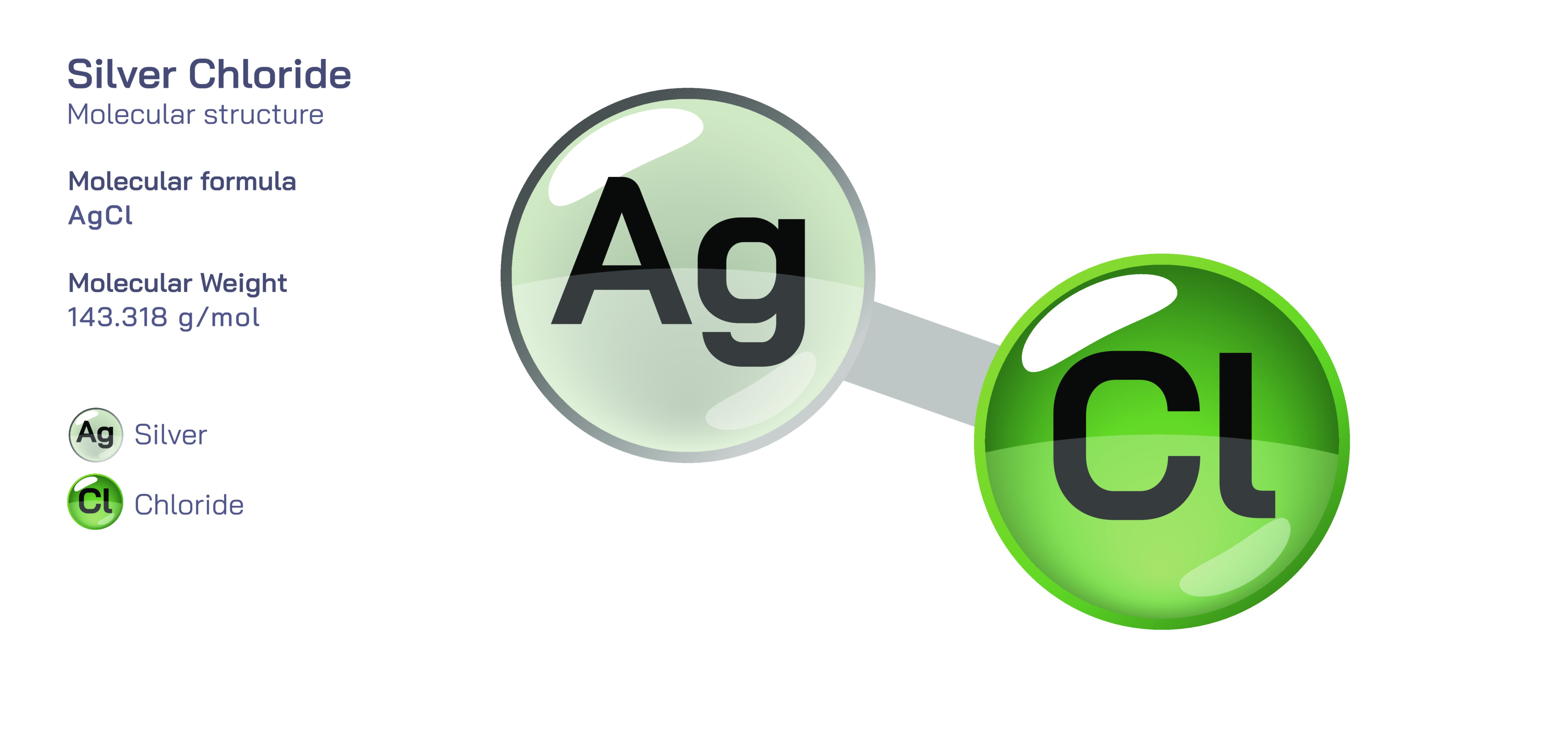
At the structural level, silver chloride is composed of monovalent silver ions (Ag⁺) and chloride ions (Cl⁻) held together through a strong ionic lattice. Each silver ion is coordinated by six chloride ions, and each chloride ion is surrounded by six silver ions, forming a face-centred cubic arrangement that is energetically stable and highly symmetric. The ions are distributed in a repeating three-dimensional network that extends throughout the crystal. In contrast to covalent molecules that exist as discrete units, AgCl forms no individual “molecules”; instead, its chemical formula reflects the 1:1 ratio of ions occupying positions in the solid lattice. The strong electrostatic forces binding the ions give the compound its solid form and low solubility in water. Water molecules are unable to disrupt the ionic network effectively, meaning the compound remains undissolved except in extremely low concentrations. This insolubility is central to its analytical use: when silver nitrate is added to a solution containing chloride ions, silver chloride precipitates instantly, confirming the presence of chlorides with high sensitivity.
The optical and photochemical behaviour of silver chloride is among its most distinctive features. When exposed to light—especially ultraviolet radiation—AgCl darkens gradually, eventually turning grey or purplish due to the formation of metallic silver particles within the lattice. This reaction reflects the reduction of Ag⁺ ions to metallic Ag⁰, accompanied by the oxidation of chloride ions. The process does not destroy the entire ionic lattice; rather, nanoscale silver clusters form in localized sites, altering the colour while the bulk remains intact. This light-sensitivity was foundational to the development of early photography. In traditional cameras, a film coated with silver halides, including silver chloride, captured light by undergoing photochemical decomposition. When an image was projected onto the film, the illuminated regions of AgCl decomposed more quickly than the dark regions, creating an invisible image that was later developed chemically. The ability of silver chloride to record light exposure in this way demonstrates that the compound is not merely a static solid but a responsive material in which ionic and electronic transitions play a defining role.
The chemistry of silver chloride in solution demonstrates the equilibrium between lattice stability and ion exchange. Although considered insoluble, AgCl does dissolve slightly in water, and the solution reaches equilibrium with a low but measurable concentration of Ag⁺ and Cl⁻ ions. The dissolution is greatly enhanced in the presence of complexing agents. For example, ammonia forms a soluble complex with silver ions: [Ag(NH₃)₂]⁺. When AgCl is treated with aqueous ammonia, the solid dissolves as silver ions enter this complex. Similarly, chloride ions in high concentrations shift the equilibrium in the opposite direction, producing soluble species like [AgCl₂]⁻. These behaviours reflect the principle that solubility is not absolute but depends on how competing equilibria redistribute ions. Silver chloride, therefore, becomes a powerful analytical tool not only for detecting chloride ions but also for demonstrating equilibrium principles and complex-ion formation.
Silver chloride also appears in electrochemistry, particularly in the silver/silver chloride reference electrode, one of the most reliable and widely used electrodes for measuring electrochemical potential. In this electrode, metallic silver is coated with a thin layer of AgCl and immersed in a chloride-containing electrolyte. Because the equilibrium between Ag, AgCl and Cl⁻ is stable, the electrode produces a steady and reproducible potential, making it vital in pH meters, corrosion studies, biomedical sensors and scientific instrumentation. The structural stability of the Ag/AgCl interface is the direct reason the electrode maintains precision over long periods and resist fluctuations that compromise measurement accuracy.
Thermally, silver chloride exhibits behaviour characteristic of ionic halides. When heated moderately, AgCl undergoes a phase transition in which the lattice reorganizes but does not decompose. At higher temperatures, decomposition occurs, producing metallic silver and chlorine gas. This decomposition pattern reinforces the idea that silver ions tend to be reduced to metallic silver when energy input is sufficient. The reverse process—chlorination of silver to form AgCl—occurs under oxidizing and halogenating conditions and is a common method of preparing high-purity silver chloride for laboratory and industrial use.
Silver chloride also exists in nanostructured and colloidal forms with different properties from bulk crystals. At the nanoscale, particle size influences optical absorption, colouration speed, catalytic performance and surface chemistry. That is because smaller particles have larger surface-to-volume ratios and modified electron confinement effects. These nanoscale variations open pathways for AgCl in fields such as antimicrobial coatings, photocatalysis, optical filters and sensing materials. In biological and environmental systems, the antimicrobial nature of silver ions is well-known. Silver chloride slowly releases trace amounts of Ag⁺ in the presence of moisture, giving the compound antibacterial activity without the rapid ion release associated with soluble silver salts. This controlled release makes AgCl suitable for some medical coatings and water sanitation systems when used responsibly.
Despite its beneficial roles, silver chloride must be handled with awareness of both safety and environmental impact. The compound itself is only mildly hazardous when handled properly, but improper disposal can lead to silver ion accumulation in aquatic ecosystems, which is harmful to microorganisms and biofilms. Therefore, laboratory and industrial waste containing AgCl should be recycled for silver recovery rather than discarded directly. Recycling is typically accomplished through thermal or chemical reduction that converts AgCl into metallic silver, allowing the precious metal to be reused.
Ultimately, silver chloride offers a clear demonstration of how an inorganic compound’s behaviour arises from its internal structure and electronic configuration. Its low solubility, high lattice symmetry, photochemical activity, complex-ion chemistry, electrochemical utility and biological effects can all be traced back to the nature of the Ag⁺ and Cl⁻ ions and their arrangement in the solid lattice. From early photography to modern electrodes and antimicrobial materials, silver chloride stands as a textbook example of a compound whose scientific and technological significance is rooted in the microscopic world of ions, electrons and crystal architecture.