𝐒𝐢𝐥𝐯𝐞𝐫 𝐍𝐢𝐭𝐫𝐚𝐭𝐞 — 𝐂𝐡𝐞𝐦𝐢𝐜𝐚𝐥 𝐂𝐨𝐦𝐩𝐨𝐮𝐧𝐝 𝐚𝐧𝐝 𝐌𝐨𝐥𝐞𝐜𝐮𝐥𝐚𝐫 𝐒𝐭𝐫𝐮𝐜𝐭𝐮𝐫𝐞.
Silver nitrate, represented chemically by the formula AgNO₃, is an inorganic compound of enormous importance in chemistry, medicine, industry and materials science. It appears as a colourless, crystalline solid that dissolves readily in water to produce a clear, highly conductive solution. Although one of the simplest silver compounds, silver nitrate occupies a unique position among metallic salts because of its exceptional reactivity, its ability to act as a precursor to nearly all other silver compounds and its applications ranging from photographic processes to antiseptic treatments and laboratory chemical analysis. Behind these diverse applications lies a molecular structure that defines how the compound behaves in chemical environments and how the nitrate and silver ions contribute individually and collectively to its properties.
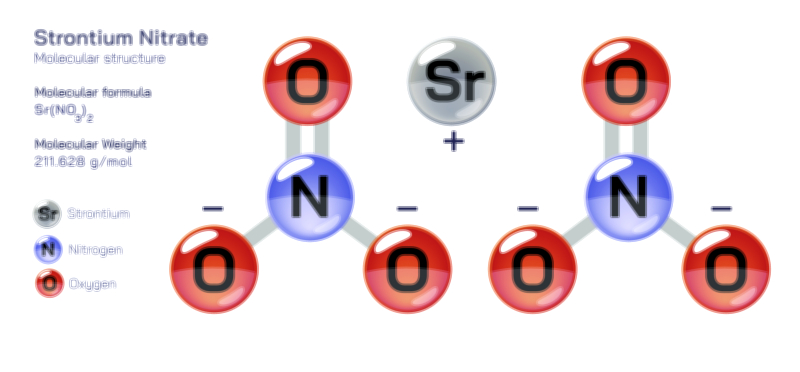
Structurally, silver nitrate consists of silver ions (Ag⁺) and nitrate ions (NO₃⁻) held together through strong ionic attraction. The silver ion possesses a +1 oxidation state and a filled d-electron configuration that gives it distinctive optical and redox characteristics. The nitrate ion is a trigonal planar anion composed of a central nitrogen atom surrounded by three oxygen atoms, with resonance distributing electron density evenly across the N–O bonds. This resonance stabilization gives the nitrate ion structural symmetry and high energetic stability. Together, the Ag⁺ and NO₃⁻ ions form an orderly ionic lattice in the solid state, but unlike many silver halides or carbonates, the lattice is easily disrupted by water because the hydration energy released upon solvation is sufficient to overcome the electrostatic forces holding the ions together. This explains why silver nitrate dissolves readily, releasing free ions into solution.
Once in aqueous form, silver nitrate becomes a powerful reagent because of its silver ion. Ag⁺ readily seeks coordination and participates in precipitation, complex formation and redox chemistry. One of its most defining properties is its ability to form insoluble salts with halide ions. When added to a solution containing chloride, bromide or iodide ions, insoluble silver halides immediately precipitate: AgCl (white), AgBr (cream) and AgI (yellow). These distinct colours make silver nitrate one of the most important qualitative reagents for detecting halide ions in analytical chemistry. This precipitation behaviour also forms the basis of volumetric titrations, in which silver nitrate solutions are used to determine halide concentrations with high precision. In addition to halides, silver nitrate reacts with a wide range of anions to form characteristic precipitates, reinforcing its role as a cornerstone of inorganic qualitative analysis.
Silver nitrate also has a deep-rooted connection to the history of photography. Before the digital era, nearly all photographic film and printing processes relied on the light sensitivity of silver salts. Silver nitrate was used to prepare silver halides that coated photographic plates and film. When exposed to light, these halide crystals partially decomposed to form metallic silver clusters that acted as latent images. Developers then amplified these metal nuclei into full visible photographs. The photochemical behaviour of photographic processes can be traced back directly to silver nitrate because without it, controlled synthesis of silver halides would not be feasible. Even though photography has largely transitioned to electronic technology, silver halide chemistry based on AgNO₃ remains an iconic example of molecular structure shaping cultural technology.
The interaction of silver nitrate with organic materials demonstrates another layer of structural reactivity. Ag⁺ ions can oxidize aldehydes under alkaline conditions in the well-known Tollens’ test, producing carboxylate ions while metallic silver deposits onto the glass surface as a reflective “silver mirror.” This reaction serves as a diagnostic test for aldehydes in organic chemistry but also illustrates the tendency of silver ions to accept electrons and be reduced. The bright metallic coating formed during the test reflects how a dissolved inorganic salt can transform into pure metal through redox chemistry driven by functional groups in organic molecules. Such behaviour reinforces why the silver ion is highly influential in synthesis, catalysis and surface modification.
In medicine, silver nitrate has long been valued for its antimicrobial and tissue-modifying properties. Even tiny quantities of silver ions can inactivate bacteria, fungi and viruses by binding to proteins and DNA, disrupting essential cellular processes. For this reason, silver nitrate solutions have been used historically to disinfect wounds and treat skin infections. Sticks tipped with solid silver nitrate—commonly called lunar caustic—are used to cauterize excessive granulation tissue, remove unwanted skin growths and stop nosebleeds through localized chemical cauterization. The compound works by releasing Ag⁺, which interacts with chloride ions and amino acid residues in tissue to produce controlled protein coagulation. However, medical use requires care because overexposure may lead to skin staining or tissue irritation.
In electrochemistry, silver nitrate is central to creating silver electrodes and conducting coatings. When subjected to electrolysis, the Ag⁺ ions in solution are reduced at the cathode to form metallic silver, allowing uniform silver deposition on various substrates. This makes silver nitrate a prime electrolyte for electroplating jewellery, mirrors and components requiring high electrical conductivity. In addition, it is used in the fabrication of silver conductive inks and printed electronic circuits. The structural simplicity of AgNO₃ enables predictable migration of ions under electric fields, which is essential for controlled deposition technology.
The nitrate ion itself plays a crucial role in the reactivity of the compound even though it is not the focus of most applications. Because nitrate is a strong oxidizing anion in high-energy environments, silver nitrate exhibits oxidizing capability when heated strongly. Decomposition produces silver metal, nitrogen dioxide and oxygen, illustrating again how structural bonds break to release stored oxygen. Thermal decomposition also explains why the compound must be stored away from flammable materials and strong reducing agents.
Despite its versatility and usefulness, silver nitrate must be handled with environmental responsibility. Because Ag⁺ ions are toxic to aquatic organisms even in small concentrations, laboratory and industrial solutions must not be discharged into wastewater without proper recovery. Fortunately, silver can be reclaimed by reducing silver nitrate with suitable agents or by precipitation as silver chloride followed by purification. This ability to recover silver emphasizes the compound’s economic value, considering the high price of metallic silver.
From a structural viewpoint, silver nitrate demonstrates how ion arrangement governs chemical behaviour. The dissolution of the ionic lattice provides free Ag⁺ ions, and these ions form the foundation for reactions ranging from halide precipitation and redox transformations to electroplating and antimicrobial responses. Meanwhile, the nitrate ion contributes resonance stabilization, structural symmetry and oxidizing power under extreme conditions. AgNO₃ stands as a multifunctional material whose behaviour—whether in medicine, photography, catalysis or electrode manufacture—can be predicted from the properties of its constituent ions.
In essence, silver nitrate is not merely a reagent but a gateway compound whose structure unlocks pathways to countless other silver materials. It links ionic coordination chemistry with photochemistry, metallurgy, biological science and industrial technology. The compound’s significance lies in how its simple formula conceals a world of structural and functional depth—illustrating once more that the true meaning of a chemical substance is found not in the letters of its formula, but in the behaviour arising from the microscopic relationships between its ions and their environment.