Monel Metal — Composition and Alloy Structure
Monel is a high-performance metallic alloy revered for its exceptional mechanical strength, corrosion resistance, thermal durability, and long-term reliability in some of the harshest industrial environments on Earth. Its identity is rooted in the detailed arrangement of atoms and the controlled balance of chemical elements blended together to form a complex solid solution, and understanding Monel requires appreciating both its composition and its alloy structure. The primary component of Monel is nickel, making up the majority of the alloy—typically around two-thirds of its weight—while copper forms most of the remaining fraction. Small but meaningful additions of iron, manganese, carbon, and silicon fine-tune its physical and metallurgical behavior. This specific combination produces a microstructure in which nickel and copper atoms substitute for one another within the same face-centered cubic (FCC) lattice, creating a single-phase solid solution rather than separate layers or segregated particles. Because the two dominant atoms have similar atomic radii and crystalline preferences, they integrate seamlessly into a shared lattice without forming brittle intermetallic compounds. The result is an alloy that combines the ductility and chemical nobility of nickel with the reinforcement and additional corrosion resilience provided by copper, generating intrinsic toughness even when subjected to extreme temperature, stress, and chemically aggressive surroundings.
What makes Monel unique is that its structural integrity holds steady across an unusually wide temperature range and through prolonged exposure to corrosive chemicals. Whereas many alloys experience rapid grain boundary deterioration or oxidation at high temperatures, Monel preserves its strength and resists scaling because the nickel-rich matrix protects internal atomic layers from chemical attack. Conversely, at extremely low temperatures—such as those found in cryogenic processing or deep-sea operations—Monel does not become brittle or fracture-prone. Its face-centered cubic lattice allows energetic vibrations to disperse across the structure without building points of weakness. Most alloys stiffen dramatically and lose ductility as they approach cryogenic states, but Monel maintains elasticity and impact resistance. This stability reflects the cooperative relationship between nickel and copper atoms embedded in a uniform atomic grid. Even small additions of iron and manganese further strengthen the lattice by acting as solid-solution hardening agents, meaning they block slip planes and increase resistance to deformation without compromising flexibility. Carbon and silicon, kept in very minor quantities, help control grain growth during manufacturing and influence the final mechanical profile of the alloy.
Because of its composition, Monel demonstrates a level of corrosion resistance that surpasses common steels, copper alloys, and many nickel-containing materials. It resists hydrochloric acid, hydrofluoric acid, alkalis, saline environments, and organic acids, particularly in reducing conditions where oxidation-driven corrosion might overwhelm other metals. The presence of copper enhances resistance to sulfuric and hydrofluoric compounds, while nickel preserves structural stability in contact with chlorides. As a result, Monel withstands marine environments extraordinarily well, even in turbulent, oxygen-rich seawater where many alloys lose integrity. It resists both pitting and crevice corrosion—mechanisms that often attack stainless steels in chloride-rich settings—and it is also immune to stress corrosion cracking under many conditions. These corrosion behaviors emerge from the alloy’s microstructure: the nickel-copper matrix forms a passive layer much more resistant to attack than the oxide layers found on iron-based alloys. In an electrochemical sense, Monel stands closer to noble metals in reactivity, which explains its long lifespan in briny, acidic, and alkaline environments where most metals steadily decay.
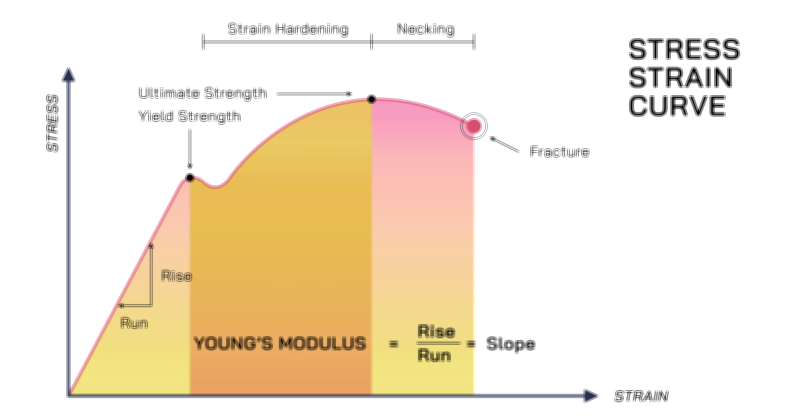
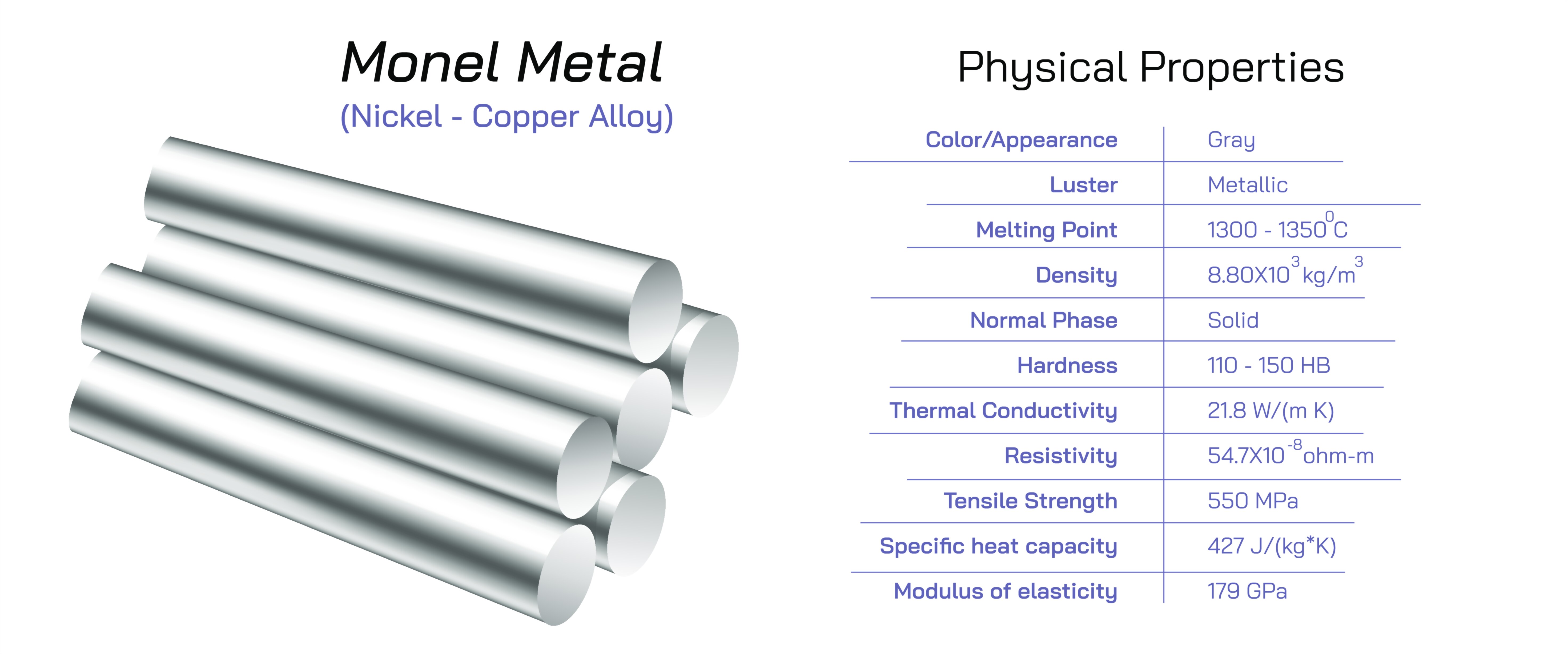
The alloy’s mechanical strength is another defining attribute directly tied to its structure. Monel retains high tensile strength and fatigue resistance even after long-term vibration, pressure cycles, or deformation. It endures repeated mechanical loads without sudden or catastrophic failure, and this makes it indispensable in pressure vessels, offshore pipelines, seawater valves, critical fasteners, propeller shafts, submarine components, and heat-exchange tubing. Its resilience under cyclical stress also benefits aerospace and petrochemical equipment, where movement, torque, and fluctuating thermal gradients are constant. Work hardening contributes significantly to the alloy’s mechanical capabilities: when Monel is cold-worked—through rolling, drawing, hammering, or other deformation—the crystal lattice becomes increasingly resistant to further displacement of atomic planes, resulting in higher hardness and strength. Alloys with controlled levels of impurities and adjusted trace elements can be tailored to optimize formability, machinability, wear resistance, or weldability depending on the industrial setting. The same structure that enables Monel to withstand embrittlement at low temperatures allows it to absorb significant thermal expansion without warping during high-heat cycles.
One of the most intriguing aspects of Monel is how its alloy composition influences its manufacturing challenges. The very properties that make it exceptionally durable—strength, spring-back elasticity, and resistance to slippage among atomic layers—also make it notoriously difficult to machine using conventional tooling. Cutting edges wear out faster, heat accumulates quickly at the machining interface, and deformation hardening can increase resistance unexpectedly during shaping. To compensate, manufacturers use optimized tool geometries, slower RPMs, greater lubrication, and controlled feed rates to avoid premature tool failure. Yet these machining difficulties underscore a valuable truth: the industrial performance of Monel often justifies the extra effort required to shape and refine it during production. It is not an alloy designed for convenience—it is designed for environments where reliability, safety, and structural longevity matter more than ease of fabrication.
In chemical processing industries, Monel is indispensable because it remains stable in the presence of aggressive reagents that destroy many metals rapidly. Components such as pumps, tanks, heat exchangers, evaporators, reaction vessels, and distillation columns are constructed from Monel to maintain integrity in contact with hot salts, acids, brines, and polymerizing compounds. In petroleum refining, Monel withstands sour gas and acidic crude that corrode carbon steels and many stainless steels. In mining, it survives chemical leaching operations and exposure to abrasive slurries. In the marine world, Monel is so resistant to seawater that it is used in propeller shafts, seawater piping, valve trim, condenser tubing, and fasteners for naval ships and offshore platforms. The alloy has also found extensive use in desalination plants, where evaporation and condensation stages subject materials to concentrated saltwater under heat and pressure. Wherever equipment failure would be catastrophic because of environmental hazard, economic loss, or safety risk, Monel provides long-term assurance that few metals can match.
The structure of Monel even influences its behavior in heat-transfer environments. Because nickel and copper both conduct heat well, and because their atomic bonding remains intact at high temperatures, Monel serves effectively in thermal cycling equipment where a metal must repeatedly conduct and withstand heat without deformation or fatigue. In jet engines, exhaust systems, and heat exchangers, Monel is valued not only for thermal resistance but also for stability under oxidation. Copper in the matrix helps form a protective surface film that shields deeper material from chemical attack at elevated temperatures, while the nickel-rich lattice retains toughness and strength. These properties help maintain the dimensional stability and performance of components over years of exposure to violent thermal gradients that destroy many other alloys.
Monel alloys have diversified into several commercial grades, each engineered to optimize performance in targeted roles. Monel 400—the most widely used grade—has the core composition of nickel and copper with additions of iron and manganese in controlled ranges, providing a classic balance of corrosion resistance and mechanical strength. Monel 401 and 404 serve the electronics industry due to their controlled thermal expansion behavior. Monel K-500 incorporates aluminum and titanium into the alloy to create precipitation-hardening reactions that further increase strength and hardness without sacrificing corrosion resistance, making it ideal for high-stress marine and aerospace components. These developments demonstrate how modification at the atomic scale changes the mechanical character of the alloy and reflects the intentional engineering that goes into balancing elemental composition, microstructure, and industrial purpose.
The overall success of Monel is best understood not by looking at one property in isolation but by recognizing how its alloy elements reinforce each other within a unified atomic structure. Nickel offers corrosion resistance, copper enhances chemical durability and toughness, iron and manganese reinforce mechanical strength through solid-solution strengthening, carbon and silicon refine grain boundaries, and optional alloying additions introduce precipitation hardening or thermal expansion control. The collective effect is an alloy whose longevity and trustworthiness far exceed those of many competing materials. It acts as a material of choice in systems where structural integrity must persist for decades in the presence of mechanical stress, corrosive chemistry, or extreme climate. In this way, Monel illustrates the philosophy of alloy design: when the composition and microstructure are deliberately engineered, the resulting material performs in environments where ordinary metals fail.
Ultimately, the identity of Monel rests on the harmony between composition and structure—two aspects that determine how atoms behave in concert. By blending nickel and copper into a single crystalline solution, and by controlling trace elements to guide grain boundaries and mechanical behavior, metallurgists have created a material that stands at the intersection of strength, stability, and durability. Whether holding its shape at subzero depths of the ocean, resisting acid attack inside a refinery, maintaining precision in aerospace assemblies, or powering desalination plants that feed entire cities, Monel exemplifies how the microscopic arrangement of atoms dictates performance on the world’s largest stages. It reminds us that materials are not just metals—they are engineered answers to demanding environments, and their usefulness begins with the science of structure held inside every grain of alloy.