Fluorine — Atomic Structure, Properties, and Chemical Behavior Explained
Fluorine stands as one of the most distinctive and powerful elements in the entire periodic table, remarkable for its intense reactivity, its electronegativity, and its unique role in both natural processes and technological applications. Although vector illustrations often depict fluorine using simplified atomic models, electron shells, or symbolic representations such as its atomic number and electron configuration, the true meaning and importance of fluorine emerge through a deep conceptual exploration of its atomic structure, characteristic properties, and chemical behavior. Understanding fluorine requires examining why it is the most reactive nonmetal, what gives it its extraordinary ability to form strong bonds, why it behaves so aggressively in chemical reactions, and how its basic atomic principles translate into real-world phenomena and uses—from industrial processes to biological systems and material science.
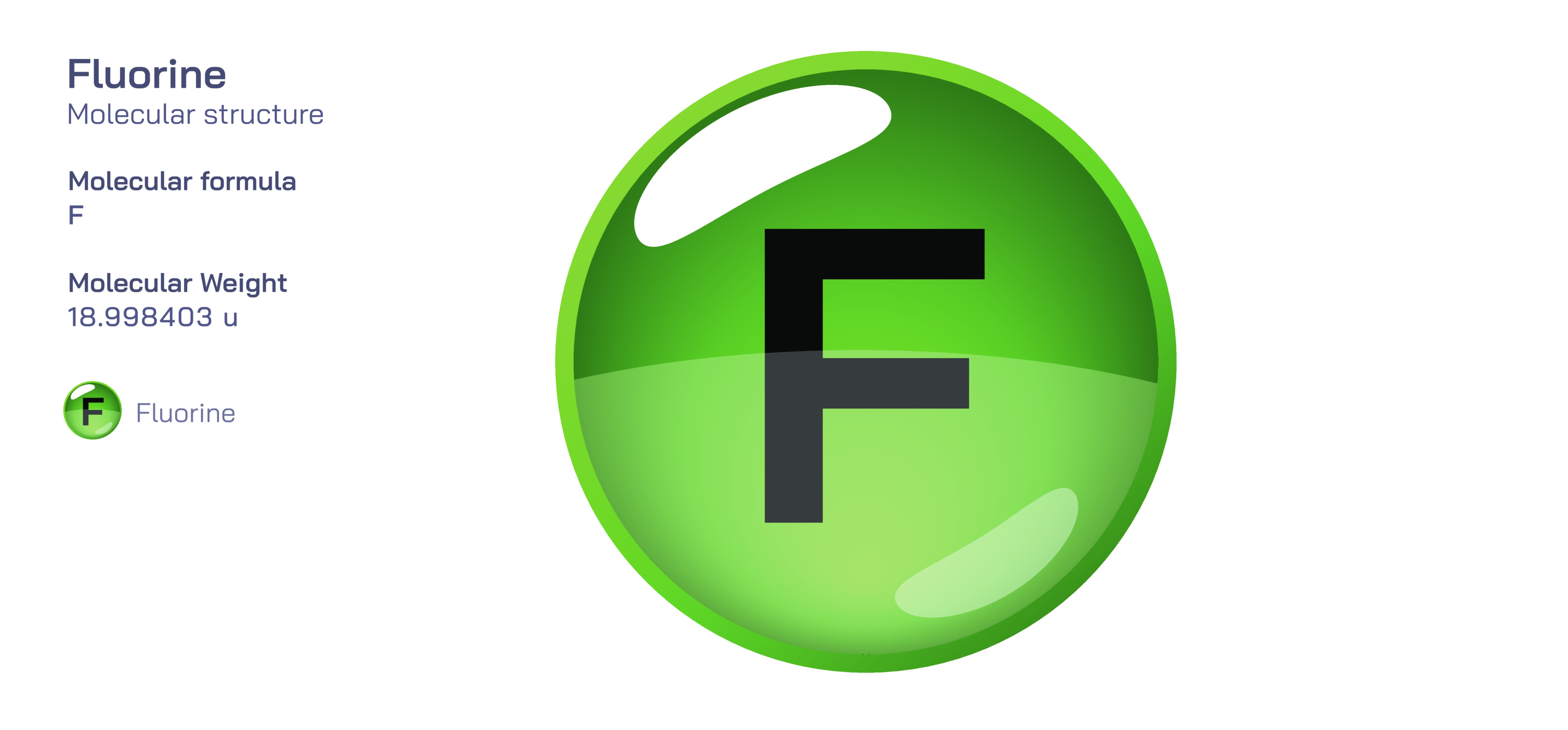
Fluorine occupies the top position of Group 17 in the periodic table, the group commonly known as the halogens. As the smallest and most electronegative member of this group, fluorine immediately stands out from its neighbors. Its atomic number is nine, meaning it contains nine protons in its nucleus and nine electrons distributed around that nucleus. These electrons arrange themselves into two principal energy levels: two electrons in the first shell, close to the nucleus, and seven electrons in the second shell, which serves as the valence shell—the outermost region involved in bonding and chemical reactions. Because the valence shell has room for eight electrons, fluorine needs just one more to achieve the stable electron configuration that atoms naturally tend to seek. This relentless drive to gain a single electron defines much of fluorine’s chemical personality. It makes fluorine extraordinarily eager to interact with other atoms that can donate or share electrons, and it gives fluorine unparalleled strength in forming bonds.
A central reason for fluorine’s extreme reactivity lies in its position at the top of the halogen group. Being the smallest halogen, fluorine’s valence electrons are held very close to the nucleus, tightly bound by the strong positive charge of its protons. This compact atomic structure contributes to fluorine’s record-high electronegativity—the strongest ability of any element to attract electrons toward itself. In chemical reactions, fluorine’s pull on electrons is so intense that other atoms find it nearly impossible to resist. This is why fluorine forms compounds with almost every other element, including some that are otherwise remarkably inert. Even noble gases like xenon, which rarely form chemical bonds, can react with fluorine under the right conditions. Fluorine’s exceptional electronegativity also ensures that once it gains an electron, it holds onto it with extraordinary strength. The resulting fluoride ion is extremely stable, a fact that underlies fluorine’s behavior in biological systems, dental health products, and mineral structures.
Fluorine’s small size and high electronegativity also contribute to its ability to form one of the strongest known single bonds in chemistry: the carbon–fluorine bond. This bond’s strength comes from the tight overlap between fluorine’s compact orbitals and the orbitals of the carbon atom. Once formed, carbon–fluorine bonds are extremely resistant to chemical attack, heat, and oxidation. This property makes fluorine-based polymers such as Teflon exceptionally durable, chemically inert, and thermally stable. These materials resist acids, bases, solvents, and high temperatures, making them indispensable in non-stick cookware, laboratory equipment, electrical insulation, aerospace components, and countless other applications. The remarkable stability of carbon–fluorine bonds also explains why certain fluorinated chemicals persist in the environment for long periods, reflecting both the benefits and challenges of fluorine chemistry.
Elemental fluorine itself, however, is extremely reactive and dangerous. In its pure form, fluorine exists as a pale yellow diatomic gas (F₂), meaning two fluorine atoms bond together for stability. Even in this state, this gas is one of the most reactive substances known. It reacts violently with many materials, including metals, organic compounds, glass, and even water. When fluorine comes into contact with organic matter, it can cause spontaneous ignition or explosive reactions. Its reactivity is so great that storing and handling pure fluorine requires carefully designed containers, often made of special materials that develop a protective fluoride coating resistant to further attack. The reason fluorine is so reactive as a diatomic gas is tied to the relatively weak bond holding the two fluorine atoms together. Because the F–F bond is weaker than many halogen–halogen bonds—an effect caused by electron repulsion between the tightly packed valence electrons—the molecule readily breaks apart during reactions, allowing each fluorine atom to aggressively seek electrons from other substances. This makes fluorine an extremely powerful oxidizing agent, capable of forcing electron transfer from nearly any other substance.
In aqueous systems and biological environments, fluorine typically appears as the fluoride ion, F⁻. In this form, fluorine has already gained its desired electron and is no longer dangerously reactive. Fluoride ions are stable, predictable, and participate in many biological processes. In human health, fluoride plays a critical role in dental protection. It strengthens tooth enamel by interacting with hydroxyapatite, the mineral that forms the structural framework of teeth. When fluoride replaces hydroxide ions in hydroxyapatite, it forms a more stable mineral called fluorapatite. This mineral is more resistant to acid attack, reducing the risk of tooth decay. For this reason, small amounts of fluoride are often added to toothpaste and, in some regions, drinking water. Although excessive fluoride intake can be harmful, controlled amounts provide significant dental benefits.
In nature, fluorine is never found in its elemental form because its reactivity prevents it from existing freely. Instead, it is found in stable minerals such as fluorite (calcium fluoride), cryolite, and various fluorosilicates. These minerals form when fluorine bonds strongly with metals or silicon, producing crystalline structures that lock the fluoride ions into stable lattices. Fluorite, with its characteristic violet or green crystalline appearance, is one of the most common fluorine-containing minerals and a major source of industrial fluorine. The mining and processing of fluorite supply fluorine for chemical synthesis, metallurgy, and industrial applications.
Fluorine plays a significant role in metallurgy, where it is used to produce aluminum through the Hall–Héroult process. In this process, molten cryolite—an aluminum fluoride-containing compound—serves as a solvent for aluminum oxide, lowering the melting point and allowing efficient extraction of pure aluminum through electrolysis. Fluorine-based compounds in metallurgy enhance conductivity, reduce energy consumption, and improve the solubility of raw materials. Without fluorine, large-scale aluminum production would be far more difficult and energy-intensive.
Fluorine chemistry also extends to the field of refrigerants, pharmaceuticals, and specialty chemicals. Many refrigerants and propellants, historically known as CFCs and HCFCs, were developed due to fluorine’s ability to create stable, non-flammable compounds. Although some of these substances were later restricted because of environmental concerns, fluorine remains essential in the production of modern alternatives designed to minimize environmental impact. In pharmaceuticals, fluorine atoms are often deliberately added to drug molecules to enhance their stability, increase membrane permeability, or modify biological activity. The small size of fluorine and its high electronegativity can dramatically influence how a drug interacts with enzymes, receptors, or metabolic pathways. Thus, fluorine plays a quiet but critical role in modern medicine.
In the realm of energy, fluorine-based materials appear in advanced batteries, fuel cells, and high-performance polymers. Some lithium battery technologies rely on fluorinated electrolytes or protective coatings that enhance performance and stability. Fluorinated membranes used in fuel cells help conduct ions while resisting chemical degradation, enabling sustained operation in harsh conditions. These applications depend on the unique combination of stability and reactivity that fluorine offers: stable when bonded tightly, reactive when unbound.
Even in environmental and atmospheric science, fluorine-containing substances have important implications. Certain fluorinated compounds, known as perfluorinated chemicals, have remarkable stability due to strong carbon–fluorine bonds. While this stability provides useful properties in industrial applications, it also means these chemicals can persist in the environment, raising concerns about long-term ecological and health effects. This dual nature—powerful utility and potential persistence—demonstrates the need for careful and responsible use of fluorine-based technologies.
A deeper conceptual understanding of fluorine also reveals why it stands alone as a chemical powerhouse. Its small atomic radius, high nuclear charge relative to size, tightly bound valence electrons, and nearly complete valence shell create a perfect storm of electronegative force. These properties combine to produce an element that is both highly reactive and capable of forming some of the strongest bonds once it has gained an electron. This duality—extreme reactivity in elemental form and extreme stability in certain compounds—makes fluorine a fascinating study in chemical contrast.
Fluorine also plays a role in advanced materials science, especially in the development of surface coatings, optical materials, and fluorinated polymers that resist degradation and provide exceptional performance. Its presence alters surface energy, increases hydrophobicity, prevents corrosion, and enhances chemical resistance. These characteristics have made fluorinated materials foundational in high-tech industries, from aerospace engineering to semiconductor manufacturing.
Through deeper reflection, one sees that fluorine’s behavior embodies a fundamental theme of chemistry: the drive of atoms to achieve stable electron configurations. Fluorine, with its nearly complete valence shell, is poised on the edge of stability, pushing it to react aggressively in pursuit of a full octet. Once it achieves that state, its chemistry shifts dramatically from reactive to stable. The interplay between these two modes of behavior underpins nearly all of fluorine’s fascinating interactions across different fields.
Ultimately, fluorine is far more than an element with a high electronegativity. It is a powerful force in chemical reactions, a cornerstone of industrial processes, a key component of biological systems, and a defining element in materials science. By exploring its atomic structure, intrinsic properties, and broad chemical behavior through a richly detailed conceptual lens, one gains a full appreciation of the profound influence fluorine has on science, technology, industry, and the natural world.