Fitts’s Law — Human-Computer Interaction and the Predictive Movement Model Explained
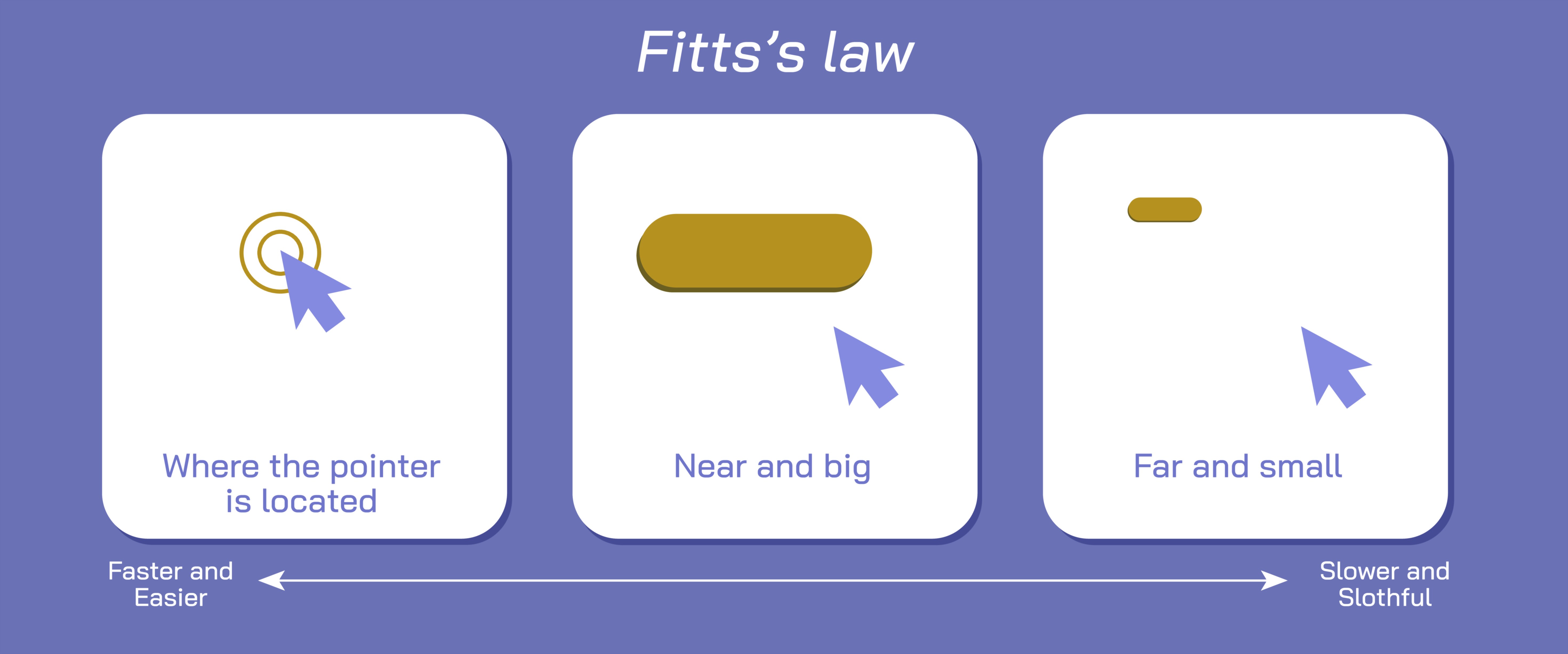
Fitts’s Law stands as one of the most influential, enduring, and foundational principles in the entire field of human-computer interaction, describing with elegant clarity how people move their hands, fingers, or pointing devices toward targets in an interface. Although it is often represented in vector illustrations showing arrows, targets, distances, and widths, the true significance of Fitts’s Law becomes far richer when explored through a detailed conceptual explanation. At its heart, the law predicts the time it will take a user to acquire a target based on two simple factors: the distance to the target and the size of the target. Yet beneath this apparent simplicity lies a deep understanding of human motor behavior, perceptual processing, decision-making, ergonomics, and interaction design. Fitts’s Law connects the physical limits of the human body with the structural principles of digital interfaces, making it a cornerstone of usability research, interface optimization, gaming performance studies, industrial ergonomics, and even virtual reality design. By moving beyond formulaic expressions and describing its meaning through narrative text, it becomes clear why this principle is so powerful and why it continues to influence every domain where humans must point, tap, click, or otherwise direct movement toward a goal.
1954. He sought to understand how quickly humans could perform repeated pointing tasks using their arms and hands, and why some movements felt easier or faster than others. Fitts observed that movements toward small targets required greater precision and therefore took longer, while movements toward larger targets allowed broader trajectories and therefore felt quicker and more natural. He also noted that movements spanning long distances took more time than movements spanning short distances, a pattern reflecting basic physical constraints in human motor control. His experiments involved tapping two plates alternately, adjusting their width and distance to test how those variables affected movement time. Through this work, he discovered a predictable relationship: movement time increased as the distance to the target increased and decreased as the size of the target increased. This relationship became the basis for Fitts’s Law, which, in essence, predicts that the harder a target is to hit—whether because it is far away or because it is small—the longer the movement will take.
This seemingly straightforward observation reveals fundamental truths about how humans interact with objects in physical and digital space. Humans rely on a complex interplay of neural signals, muscular activity, sensory feedback, and perceptual judgment to guide motion. When a target is small, the motor system must move precisely, requiring slower movement to avoid overshooting. When a target is large, the movement can be quicker and more relaxed, as errors are less costly. When the target is far away, the movement requires greater acceleration and deceleration, increasing the time required to start and stop motion. Fitts’s Law elegantly captures these natural constraints and expresses them not in mathematical equations but in descriptive forces that govern human behavior. It shows that human movement is not random but highly predictable, structured by principles of speed, accuracy, and biomechanical control.
The importance of Fitts’s Law becomes even more apparent when applied to human-computer interaction. In graphical user interfaces, users frequently point to and click on icons, buttons, menus, sliders, text fields, and interactive elements. Each of these actions involves a movement from one point on the screen to another, mimicking the same physical properties that governed Fitts’s original experiments. Designers therefore rely on Fitts’s Law to create interface elements that are easy to reach, simple to click, and efficient to use. Larger buttons are faster to click than smaller ones. Menu items positioned closer to the user’s cursor require less effort. Essential functions become more accessible when placed near the edges of the screen, where movement is stabilized by the boundary of the display. Even small changes in layout can significantly affect usability because they alter movement time, cognitive load, and user comfort.
One of the most practical applications of Fitts’s Law in interface design is the principle of target size optimization. Because target size directly influences movement ease, designers frequently enlarge key interactive elements to reduce user effort. This is why modern mobile interfaces, recognizing the limitations of finger accuracy compared with mouse precision, rely on generously sized buttons, wide touch regions, and large tap targets. Touchscreens demand greater tolerance for imprecision, and the human hand’s motor control constraints align perfectly with Fitts’s findings. Smaller targets require finer movements and cause frustration when users repeatedly miss their intended selection. Larger targets reduce errors, lower cognitive demand, and improve overall interaction satisfaction.
Fitts’s Law also explains the value of edge and corner-based UI elements. When a target lies at the edge of a screen, it becomes infinitely tall or wide in one dimension, because the pointer cannot overshoot beyond the boundary. This makes edges extraordinarily easy to hit. Corners are even more accessible because a pointer naturally “funnels” into the vertex, making movement highly efficient. This principle explains why some operating systems place essential controls in corners or along the screen edges, maximizing speed and minimizing error. Even the simple act of moving a cursor to the upper-left corner feels easier because the movement is naturally constrained by the physical limits of the screen.
Movement direction also plays a role in Fitts’s Law. Horizontal and vertical movements typically feel easier than diagonal or curved movements because they align more closely with human biomechanics. Although the law itself does not explicitly differentiate directions, designers often consider direction when arranging interactive elements or organizing menu structures. For example, linear menus with vertically stacked options allow users to maintain consistent movement paths, reducing the cognitive and motor challenges of navigating the interface. These considerations all stem from the principles that define Fitts’s Law: human movement is structured, predictable, and influenced by the spatial layout of available targets.
Beyond standard user interfaces, Fitts’s Law influences the design of video games, where precision targeting, cursor movement, and controller-based selection demand careful consideration of movement distance and target size. In gaming environments, the difficulty of aiming at small targets at long distances mirrors the predictions made by Fitts’s Law. Game designers often adjust aim-assist mechanisms, target hitboxes, and control sensitivities to align with user motor capabilities. These adjustments ensure that gameplay remains fair, accessible, and enjoyable, rather than frustrating or overly demanding. Virtual reality and augmented reality interfaces also rely heavily on Fitts’s Law to structure selection tasks, gesture recognition, and spatial interaction. In immersive environments, the user’s entire body may act as a pointing device, and the principles of distance, target size, and required precision become even more critical. Designing effective VR interfaces involves creating target zones that feel natural to reach and do not require excessive arm or wrist strain, demonstrating the enduring relevance of Fitts’s insights.
Fitts’s Law also finds applications in ergonomics, where workplace tools, machinery controls, and physical interface panels must be designed to minimize discomfort, fatigue, and error. By ensuring that frequently used controls are larger, closer, and easier to reach, engineers create safer and more efficient environments. In industrial settings, emergency shutoff buttons are deliberately oversized and placed within quick reach, taking advantage of the fact that larger and closer targets can be hit faster. Aviation, too, relies on Fitts’s Law to structure cockpit layouts, positioning key instruments and controls within natural reach to reduce pilot workload and enhance safety. These real-world applications demonstrate that Fitts’s Law is not solely a principle of digital interface design but a universal rule that applies to all situations where humans must move toward targets.
At a deeper level, Fitts’s Law reflects principles of information processing in the human nervous system. The act of moving toward a target requires the brain to process visual information, plan trajectories, and adjust motion through continuous feedback. When the target is small, the brain must process more information to refine the movement. When the target is far away, the path must be planned with greater precision. Fitts’s Law effectively quantifies this informational burden, showing that higher task difficulty corresponds to greater cognitive and physical processing requirements. This connection between motor control and information theory reveals the sophistication of human movement: every action is a decision involving uncertainty, precision, and feedback loops. Fitts’s Law integrates these concepts into a single predictive framework that unites psychology, physiology, and physics.
The law also highlights the importance of feedback loops in movement. As a user approaches a target, their motion becomes more refined, slowing near the final region of accuracy. Researchers describe this as a transition between fast ballistic movements and slower corrective movements. The initial phase of motion is rapid and imprecise, aiming to cover the majority of the distance. The second phase is slower and more accurate, adjusting the trajectory to ensure the final position aligns with the target. The predictable nature of this two-phase process underlies Fitts’s Law. Designers who understand this phenomenon can optimize interfaces so that the corrective phase requires minimal effort, reducing user fatigue and speeding up interactions.
Fitts’s Law also provides insight into the challenges faced by users with disabilities or motor impairments. People with tremors, limited fine motor control, or reduced coordination may find small targets disproportionately difficult to acquire. Through the lens of Fitts’s Law, accessibility guidelines recommend increasing target sizes, reducing required movement distances, and spacing elements to minimize accidental selection. Assistive technologies such as dwell-clicking, magnification tools, and predictive pointing algorithms also rely on Fitts’s principles to compensate for motor difficulty. In this way, the law not only explains normal human behavior but also helps create inclusive interaction designs that support diverse user needs.
From a research perspective, Fitts’s Law provides a standardized method for evaluating the efficiency of input devices. Keyboards, touchscreens, mice, trackpads, styluses, joysticks, VR controllers, and gesture-based systems can all be compared based on how quickly users can acquire targets under controlled conditions. Researchers create tasks where distance and target size vary systematically, then measure response times to determine whether the device aligns with human motor capabilities. These tests allow designers to refine input hardware, improve responsiveness, and match device characteristics to ergonomic needs.
Ultimately, Fitts’s Law offers a powerful conceptual framework for understanding human movement in any context that requires pointing or selecting. It reveals why some tasks feel easy and others feel difficult, why certain interface designs succeed and others fail, and why movement time can be predicted with remarkable reliability. When explored deeply, the law becomes more than a formula—it becomes a window into the structure of human performance. It shows that our movements are shaped by spatial constraints, cognitive processes, motor capabilities, and environmental conditions. It demonstrates that efficiency arises from thoughtful alignment between human ability and design structure. And it reminds us that even the simplest actions, such as clicking a button or tapping an icon, involve profound coordination between perception, thought, and movement.
Through this rich conceptual lens, Fitts’s Law stands not merely as a mathematical curiosity but as an essential model of human-machine interaction, merging psychology, physiology, ergonomics, and design into a unified explanation of how people move and interact with the world around them.