Conservation of Mass — Example Explained in Depth
The conservation of mass, one of the foundational principles of physical science, states that in any ordinary chemical process or physical transformation, mass is neither created nor destroyed; it is merely rearranged or redistributed among the substances involved. Although this idea appears simple on the surface, its implications are profound and form the basis of modern chemistry, environmental science, engineering analysis, material processing, biological systems, and every branch of science that deals with matter transformations. An example often used to illustrate the conservation of mass involves the reaction between vinegar and baking soda, where the visible bubbling and gas formation might appear to show a change in total mass. When examined closely, however, this familiar process demonstrates beautifully that mass remains constant when all reactants and products—including gases—are accounted for.
To understand the conservation of mass through this example, imagine a sealed container holding a small cup of vinegar and a packet of baking soda suspended above it. In the beginning, the total mass of the container and its contents is constant because nothing has reacted yet and all components—liquid vinegar, solid baking soda, and the air inside—exist in equilibrium. If one releases the baking soda into the vinegar without opening the container, an energetic reaction begins immediately. Bubbles rapidly form as carbon dioxide gas is produced, accompanied by the formation of new dissolved substances. Inside the sealed container, the solid sodium bicarbonate reacts with the acetic acid in the vinegar to create carbon dioxide gas, water, and a new dissolved compound. Even though the reaction looks chaotic—foaming, fizzing, swirling—the total mass remains identical to what it was before the reaction took place because the system is closed and no material escapes. The gas produced remains trapped inside the container, simply changing its position and form rather than disappearing.
This example helps us see that what changes during a reaction is not mass but arrangement. The atoms that made up the vinegar and baking soda before the reaction still exist afterward; they are simply reorganized into new combinations. The carbon dioxide gas that appears is not “new matter” emerging from nowhere—it comes from the atoms originally present in the solid and liquid. The visual transformation from solid and liquid into a bubbling mixture with gas bubbles rising might create the illusion that mass is being lost or gained, but when measured precisely in a closed system, mass remains constant. This is why the conservation of mass is best demonstrated in sealed or controlled environments: the gases cannot escape, so the principle becomes clear.
If the reaction were carried out in an open container, one might mistakenly conclude that mass has been lost because the gas visibly escapes into the air. The container, after the reaction, appears to weigh slightly less than before, giving an impression of mass disappearing. In reality, the mass has not vanished; it has simply left the container and mixed with the surrounding air. The principle of conservation still holds true, but the boundaries of the system must be expanded to include the entire environment into which the gas disperses. When the mass of the gas in the surrounding air is accounted for, the total mass remains unchanged. This distinction between open and closed systems illustrates another important idea: the law of conservation of mass applies universally, but the definition of the system boundaries determines how easily we observe it.
This simple example extends naturally to countless real-world processes. In cooking, ingredients mixed together do not lose mass; they form new structures and textures. In combustion, the burning of a piece of wood does not destroy matter; the carbon and hydrogen atoms join with oxygen to form carbon dioxide and water vapor that drift away as gases. The ash left behind is merely the remaining components that do not volatilize easily. If the combustion occurred inside a sealed chamber, one would find that the mass before burning and after burning is exactly the same when all gases and solids remain contained. Similarly, in industrial chemical processing, reactors are designed with closed systems to track material flows precisely, ensuring compliance with the conservation of mass as engineers manage raw materials, by-products, emissions, and reactions.
Biological processes also follow conservation of mass. When a plant grows, it does not create mass from nothing; it converts carbon dioxide, water, and nutrients into biomass. When an animal digests food, the transformation of energy and matter obeys the same principle. The mass lost by breathing out carbon dioxide or excreting waste products matches the mass processed metabolically, even if the transformations are not immediately visible. Human metabolism, respiration, photosynthesis, and decomposition are all governed by mass conservation, although their complexity often disguises the principle beneath layers of biological function.
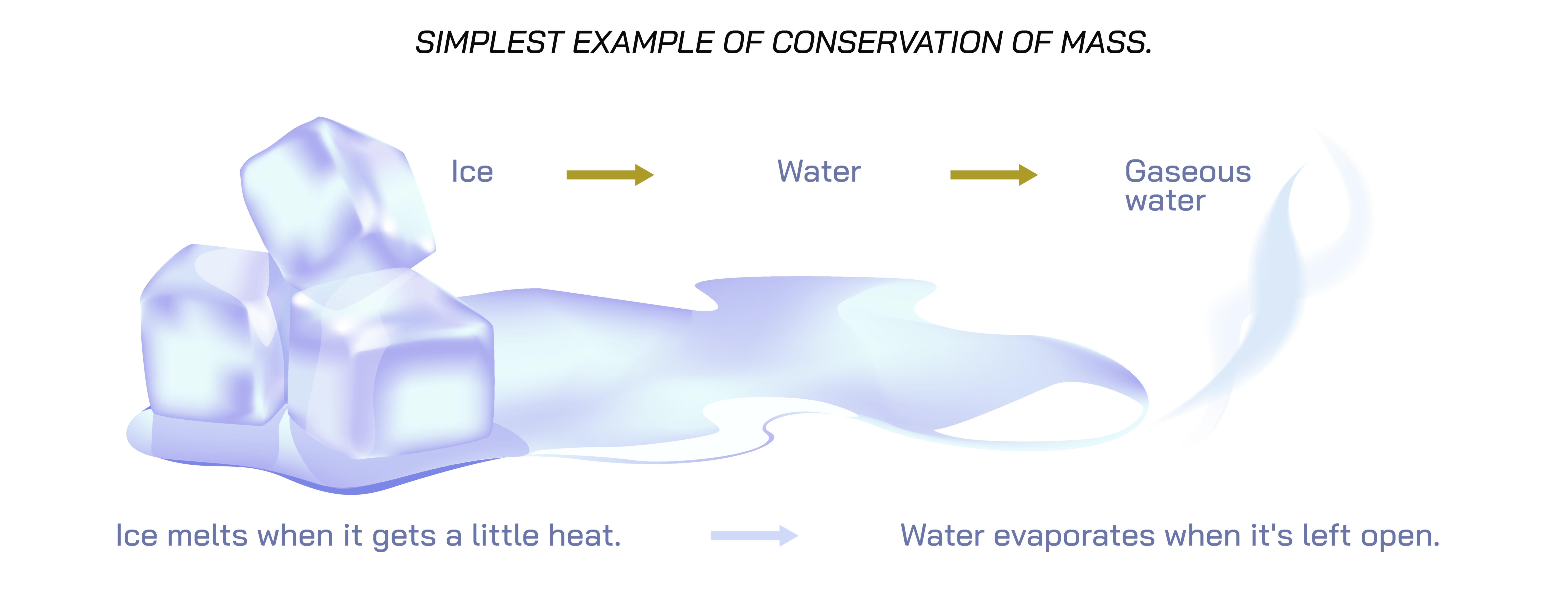
Environmental systems—from carbon cycles to water cycles to nutrient cycles—depend on the conservation of mass to function predictably. The movement of water from oceans to the atmosphere, to land, and back again, does not create or destroy water; it transfers it among states and locations. In climate science, tracking carbon through the atmosphere, oceans, living organisms, and geological reservoirs relies on the same fundamental truth that matter persists while changing form.
Manufacturing, engineering, and materials science all depend on this principle, especially in mass balance calculations. Whether designing wastewater treatment systems, creating alloys, refining petroleum, synthesizing pharmaceuticals, or operating large-scale chemical reactors, engineers calculate inputs and outputs with the assumption that mass must be conserved. This principle ensures accurate scaling, efficient resource use, pollution control, and safe process operation across industries.
In every example—from a simple kitchen reaction to planetary-scale cycles—the law of conservation of mass holds because the building blocks of matter, the atoms themselves, remain constant in ordinary chemical transformations. They rearrange, shift position, form new bonds, break old ones, and transform into entirely different substances, but the total amount of matter remains unchanged. The vinegar and baking soda demonstration captures this beautifully: even when the appearance of the matter changes dramatically, the underlying quantity of matter stays the same. This reveals the foundational truth that underlies all chemistry and much of physics: matter is persistent, transformable, and endlessly reconfigurable, but not spontaneously created or destroyed in any ordinary process.