Torricelli’s Law — Fluid Dynamics and the Liquid Flow Velocity Concept Explained
Torricelli’s law is one of the most intuitive and elegant principles in fluid dynamics, and yet its true meaning is often misunderstood when reduced to only a mathematical expression. At its core, the law describes how fast a liquid flows out of an opening in a container due to gravity, and it reveals that flowing water behaves very much like a falling object. But beyond this simplified description lies a much deeper physical story involving energy conversion, pressure distribution within fluids, velocity generation, and the interaction between potential and kinetic energy within a liquid column. Torricelli’s law is not just an equation: it represents the natural tendency of fluids to convert stored gravitational potential energy into directed motion. To appreciate the concept in its full depth, it is necessary to examine how a fluid accelerates inside a reservoir, how gravity shapes the velocity of the escaping stream, and why the flow speed depends entirely on the height of the liquid rather than the size of the aperture.
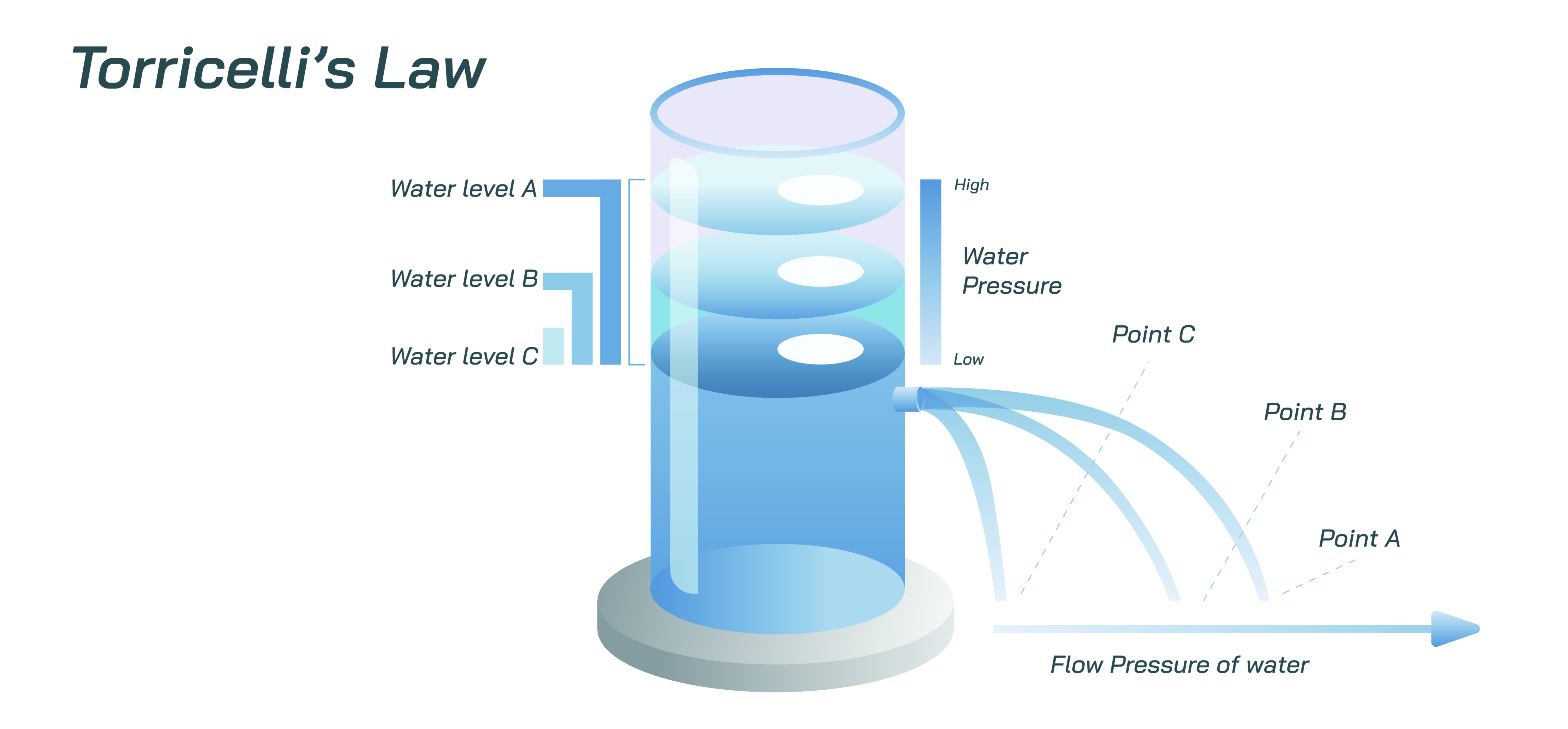
Imagine a large tank filled with water and a small opening near the bottom. The water above the opening exerts a weight, producing hydrostatic pressure at the exit point. Although the water inside the tank appears still, it possesses stored energy in the form of gravitational potential energy. Every layer of water pushes downward on the layers beneath it, creating a pressure gradient that increases with depth. The deeper the opening, the greater the hydrostatic pressure at that point. When a hole is pierced or a valve is opened at the bottom portion of the container, the liquid immediately accelerates outward, forming a horizontal stream. According to Torricelli, the force driving that flow is equivalent to the effect of gravity acting on a freely falling object dropped from a height equal to the depth of the liquid above the hole. Because the water column has been storing gravitational potential energy, the moment the exit becomes available, that energy converts into kinetic energy, which expresses itself as velocity — the speed of the emerging jet.
One of the most striking aspects of Torricelli’s insight is that the velocity of the escaping liquid is determined not by the volume of water in the tank or by the surface area at the top, but by the vertical distance from the free surface to the opening. The flow is essentially powered by height rather than quantity. Even if a reservoir is enormous, the water will not exit faster unless the height of water above the hole increases. This is why deep reservoirs produce high-strength jets and why tall water towers can generate strong water pressure for distribution systems despite containing relatively modest volumes. The water at the bottom is pushed not by the weight of all water molecules individually but by the continuous pressure transmitted through the fluid. That transmission of force through the liquid enables the pressure at the bottom to remain high even as the water is not actively falling inside the container, illustrating a fundamental principle of hydrostatics: fluids at rest generate pressure without requiring motion.
As water flows from the opening, the liquid level inside the tank gradually lowers, reducing the pressure at the exit over time and therefore decreasing the flow velocity. The stream weakens because the driving energy — the gravitational potential of the water column — diminishes as the height of the water decreases. In an ideal scenario with no friction or energy loss, the decreasing level of water creates a steady reduction in exit velocity until the stream finally stops when the water surface drops to the level of the opening. Thus, Torricelli’s law shows that what begins as potential energy stored in the elevated water eventually becomes kinetic energy of motion and finally dissipates as the stream exits the container.
Although these observations seem intuitive when watching water drain from a tank, Torricelli’s work reveals something more profound about energy conservation within fluids: when liquids move due to gravity, they undergo the same conversion of stored energy into motion as physical objects do under free fall. For this reason, Torricelli’s law is closely related to the deeper principle of conservation of mechanical energy. The liquid does not leave the tank because it is pushed by some external mechanism — the driving force originates entirely within the fluid as gravitational energy becomes motion. The water accelerates inside the opening until its energy reaches the balance dictated by height, and the resulting velocity matches that of falling water under gravity.
The elegance of this phenomenon becomes even more clear when fluid behavior is observed outside of controlled containers. Natural springs emerge from underground through pathways where water under pressure finds an exit point. The velocity at which the spring water erupts depends on the elevation of the water table above the exit, not the reservoir’s horizontal extent. The same principle governs the behavior of fountains, hydroelectric systems, aqueducts, and irrigation channels. Engineers use the reasoning behind Torricelli’s law to design water supply networks, drainage systems, and dam outlets, ensuring that the energy of stored water becomes controlled and predictable flow. Even everyday tasks — such as draining a water tank, opening a tap connected to gravity-fed plumbing, or operating a siphon — are guided by this principle.
Yet the simplicity of Torricelli’s law does not mean that real-world liquid flow is always uncomplicated. The flowing stream interacts with air resistance, the roughness of the container’s walls, and turbulence at the exit. These effects reduce the actual flow rate compared with the ideal case, but they do not change the fundamental energy conversion mechanism — friction and turbulence simply dissipate some of the energy that gravity supplies. The law still holds because the height of the liquid column continues to govern the driving pressure. Moreover, real openings do not always behave as perfect smooth-edged orifices. If the opening is sharp, rounded, tapered, or fitted with a nozzle, the flow pattern changes, but the underlying reason the liquid exits with speed remains: gravitational potential energy is being transformed into kinetic energy.
Torricelli’s concept becomes especially important when fluids are used as sources of mechanical power, such as in hydroelectric turbines. Here, water stored at an elevated height inside a dam develops tremendous potential energy. When released, the water accelerates according to the same gravitational principles that drive the simple draining of a tank. But instead of forming a free jet into the air, the high-velocity stream strikes turbine blades, converting kinetic energy into rotational work that can then be transformed into electrical energy. The entire process — from water distributed in high reservoirs to electricity powering homes — is ultimately rooted in the same mechanism that Torricelli described centuries ago: the conversion of height-driven gravitational energy into flow velocity.
One of the reasons Torricelli’s law is regarded as an iconic idea in fluid dynamics is that it shows the unity of natural motion. The same acceleration that governs falling objects — the acceleration due to gravity — applies to water accelerating through an opening. There is no special “fluid force” or “pressure mechanism” distinct from physics; instead, fluid motion is directly connected to gravitational potential energy. Because of this connection, Torricelli’s law forms a bridge between hydrostatics and hydrodynamics, linking the behavior of fluids at rest to the behavior of fluids in motion. It also forms part of the foundation of Bernoulli’s principle, which elaborates further on the relationship between pressure, height, and velocity in moving fluids.
Ultimately, Torricelli’s law offers a remarkably clear picture of why water accelerates, why flow velocity changes over time, and how gravitational energy shapes the movement of liquids. It shows that the behavior of fluids is not arbitrary but follows recognizable patterns governed by energy balance. Whether watching water stream from a tank, a fountain rise in a courtyard, or a hydroelectric dam release power through turbines, the invisible engine behind the motion is the same: gravity turning stored potential into directed kinetic energy. Torricelli’s insight remains one of the most compelling illustrations in physics of how nature combines simplicity with elegance, transforming height into velocity and stillness into motion with perfect consistency and beauty.