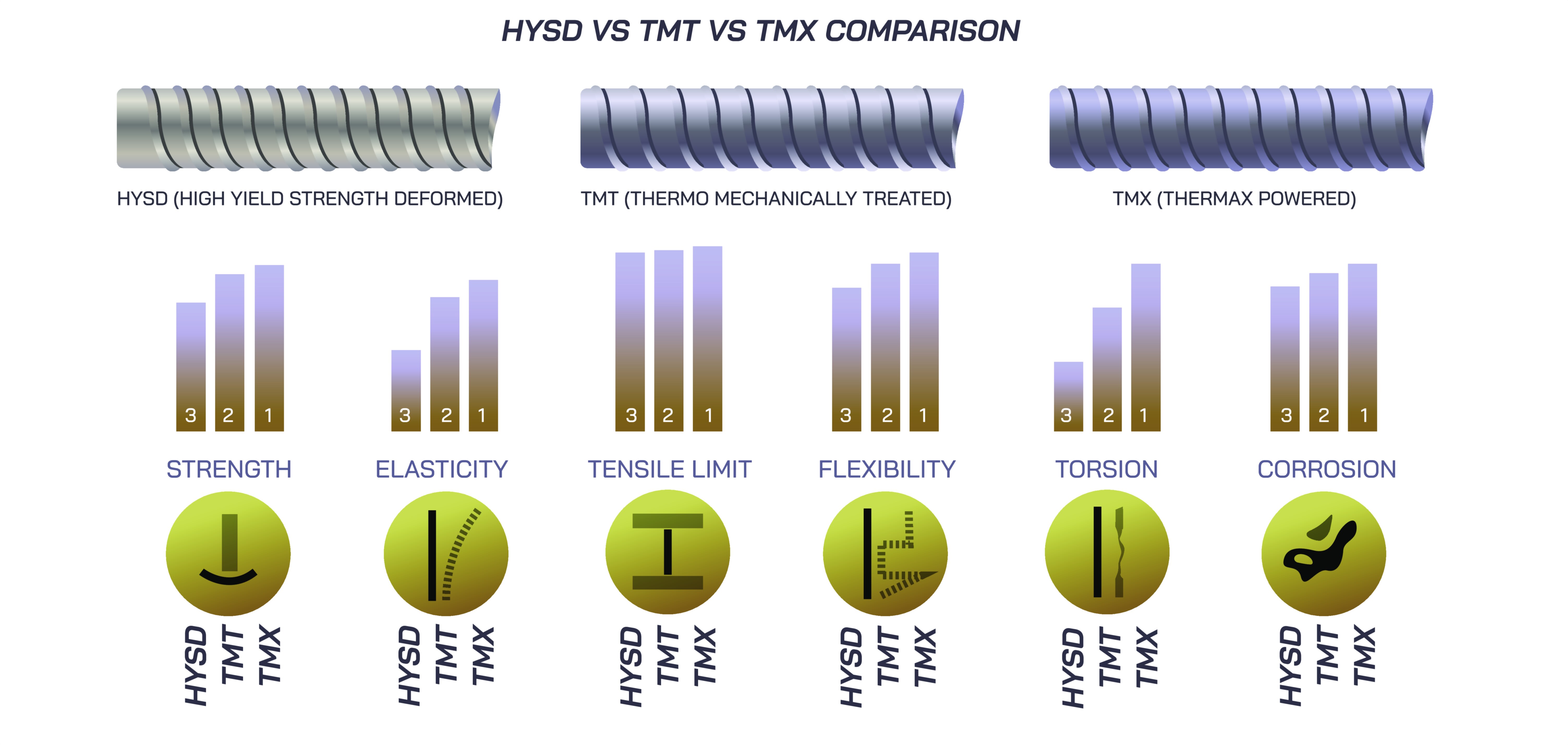
HYSD vs TMT vs TMX — Steel Reinforcement Bars Comparison
Steel reinforcement bars form the skeletal framework of reinforced concrete, and the choice of the right bar type significantly influences the strength, ductility, durability, and long-term performance of a structure. Among the many types of reinforcement steel available in modern construction, HYSD, TMT, and TMX bars are the most widely used categories, each representing different manufacturing methods, mechanical properties, and suitability for varying structural demands. Although they all serve the fundamental purpose of resisting tensile forces in concrete, their internal structures, production processes, and performance under stress differ considerably. Understanding these differences is crucial because the reinforcement steel must respond appropriately to dynamic loads, temperature variations, environmental exposures, and extreme events such as earthquakes, wind loads, or impact forces. Thus, comparing HYSD, TMT, and TMX bars is not just a material selection exercise but a foundational decision that influences safety, functionality, and durability of the built environment.
HYSD bars, or High Yield Strength Deformed bars, represent one of the earliest advancements in reinforcement technology. They are manufactured through a process involving cold twisting or work hardening, which increases their yield strength beyond that of mild steel. HYSD bars possess ribs or lugs on their surface, improving their bond with concrete and reducing the likelihood of bar slippage. Their strength makes them suitable for general reinforcement applications, especially in regions without intense seismic activity. However, the downside of HYSD bars lies in their manufacturing method: the process of cold twisting introduces residual stresses into the bar. These internal stresses affect ductility and make the bars more brittle under dynamic or cyclic loading conditions. During earthquakes, when bars experience rapid tension–compression reversals, brittle failure of HYSD bars becomes a concern. Over time, as more research and building code revisions emphasized ductility, HYSD bars gradually began being replaced by more advanced steel types in seismic and high-performance structures. Nonetheless, HYSD bars remain useful in conventional construction where ductility demands are moderate and cost considerations are central.
TMT bars, or Thermo-Mechanically Treated bars, represent a major technological leap beyond HYSD bars. Their manufacturing process involves rapid cooling of the bar’s outer surface immediately after rolling, followed by self-tempering and atmospheric cooling. This produces a dual-structured bar: a tough, tempered martensitic outer layer and a softer, ductile ferrite-pearlite core. This composite structure grants TMT bars exceptional ductility, high yield strength, and improved toughness. Unlike HYSD bars, they are not cold-twisted, meaning they do not contain residual torsional stresses. This allows TMT bars to bend, deform, and elongate much more efficiently, making them highly suitable for seismic-resistant structures. The rib patterns on TMT bars enhance bonding with concrete, reducing the risk of slip even under heavy loading conditions. Another significant advantage is their superior corrosion resistance. The manufacturing process refines grain structures and reduces surface impurities, helping TMT bars resist chloride-induced corrosion, which is particularly critical in coastal regions, water tanks, marine structures, and bridges. Their fire resistance also surpasses that of HYSD bars, making them safer in high-temperature zones. Because of these well-rounded properties, TMT bars have become the standard choice in modern construction worldwide.
TMX bars represent an even more advanced generation of reinforcement steel. TMX (Thermo-Mechanically eXtended) bars are produced using German-engineered processes that further refine the microstructure beyond conventional TMT techniques. The key difference lies in the technology used during quenching and self-tempering. TMX bars undergo a more controlled, longer-duration treatment using a high-precision cooling system that stabilizes their structural phases at a microscopic level. This results in an ultra-fine-grained, exceptionally tough outer layer and a highly ductile core. TMX bars maintain all the advantages of TMT bars but with improved parameters such as higher elongation, better crack resistance, and enhanced seismic energy dissipation. They show superior resistance to fatigue and stress-reversal cycles, making them suitable for complex, tall, or high-load structures like high-rise buildings, bridges, elevated roadways, power plants, and industrial foundations. Their corrosion resistance is exceptional due to improved microstructural uniformity, and many TMX bars adhere to stricter quality control standards compared to general TMT varieties.
When comparing HYSD, TMT, and TMX bars in terms of ductility, HYSD is the least ductile due to cold working stresses, while TMT and TMX are markedly superior. Ductility is a crucial parameter because it determines how much deformation a structure can undergo before failure. In real-world conditions, especially during earthquakes or accidental impacts, ductility prevents sudden failures. TMX bars, with their refined internal structure, provide the highest ductility among the three. TMT bars also provide excellent ductility suitable for seismic design, whereas HYSD bars may crack or fail under intense cyclic strains. This difference alone has shifted modern structural engineering preference strongly toward TMT and TMX varieties.
Bond strength is another major distinguishing factor. While HYSD bars have improved bond characteristics compared to plain mild steel, TMT and TMX bars outperform them due to better rib patterns and absence of internal twisting. The uniform stress distribution in TMT and TMX bars allows concrete to anchor onto them more securely. This helps prevent pull-out failures, especially in beams and columns where reinforcement bars experience high tensile forces. TMX bars, being a higher-grade refinement, offer even better bonding characteristics, which is valuable in critical structural zones like beam-column junctions and foundation connections.
Corrosion resistance varies significantly among the three types. HYSD bars are more prone to corrosion because cold twisting disturbs the bar’s surface and microstructure, creating micro-cracks that allow moisture and chlorides to penetrate. This leads to earlier onset of corrosion and expansion, which can crack surrounding concrete. TMT bars resist corrosion better due to uniform grain structure and the absence of cold-working flaws. They retain strength and shape longer in moisture-rich or chloride-rich environments. TMX bars offer still stronger corrosion performance because their refined microstructure and precise manufacturing reduce microscopic stress points that would otherwise initiate corrosion. In marine or industrial environments, TMX bars are considered among the most durable reinforcement choices.
Fire resistance is another dimension where TMT and TMX bars excel. HYSD bars lose strength more quickly under elevated temperatures, which compromises their load-carrying ability during fires. TMT bars, due to their tempered martensitic surface, maintain structural integrity longer under fire exposure. TMX bars provide the highest resilience thanks to improved metallurgical stability. This makes TMX particularly suitable for structures requiring long fire resistance ratings such as commercial complexes, high-rise buildings, tunnels, and critical infrastructures.
Economic considerations also influence the choice among HYSD, TMT, and TMX bars. HYSD bars, being older technology, are typically cheaper but offer comparatively lower performance. TMT bars are cost-effective because they provide high strength and ductility at reasonable prices, making them the most preferred reinforcement type for general construction. TMX bars are more expensive but deliver superior performance, making them worthwhile in applications where enhanced safety, longevity, and structural resilience justify the cost. Engineers decide based on a balance of performance requirements, design codes, environmental conditions, and project budget.
From a structural engineering perspective, TMT and TMX bars align better with the performance expectations of modern building codes, which emphasize ductility, earthquake resistance, and long-term durability. Seismic design in particular prioritizes reinforcement that can deform without breaking, dissipate energy efficiently, and remain stable through repeated load cycles. TMX bars, given their high elongation and toughness, provide superior performance in seismic zones. TMT bars also satisfy seismic requirements and are widely accepted in earthquake-prone regions. HYSD bars, however, are not recommended for seismic zones due to their brittleness and susceptibility to sudden failure.
In durability-critical structures such as coastal buildings, water-retaining structures, bridges, or those exposed to harsh chemicals, TMT and TMX bars far outperform HYSD. Their resistance to corrosion and fatigue ensures that the reinforcement will maintain its integrity over decades. Additionally, modern sustainability approaches in construction emphasize materials that reduce maintenance needs and extend lifespan, further favoring TMT and TMX varieties.
Ultimately, comparing HYSD, TMT, and TMX bars reveals a progression in reinforcement technology—from older, strength-focused steel (HYSD) to modern, highly ductile, corrosion-resistant bars (TMT), and to advanced, fine-controlled, ultra-tough reinforcement (TMX). Each step in this evolution reflects improvements in safety, reliability, and performance. HYSD bars still have their uses in non-seismic, budget-sensitive projects, but TMT has become the standard choice for most construction needs, balancing cost and performance. TMX bars stand at the top tier, ideal for critical, high-stress, long-span, or high-rise applications where engineering precision and superior durability are non-negotiable. Through these distinctions, the comparison highlights how material science continually advances structural resilience and helps create safer and longer-lasting infrastructure for the modern world.