Staggered Bar Arrangement — Reinforcement Pattern Design
Staggered bar arrangement is a vital reinforcement pattern design strategy in structural engineering, particularly within reinforced concrete construction, where steel bars must be arranged not only to satisfy strength requirements but also to ensure proper spacing, workable congestion levels, and efficient transfer of stresses throughout the structural member. The concept of staggering refers to the intentional offsetting of reinforcement bars, whether longitudinal, transverse, or both, so that the bars do not align in a single straight plane. Instead, they are distributed in alternating positions along the length or across the cross-section of the member. This technique emerges from a combination of practical construction challenges, structural behavior requirements, and code-based spacing limitations. It ensures that reinforcement remains effective even when multiple bars must be placed within limited space. As building designs become more complex, with high loads, slender members, dense reinforcement regions, and intricate geometries, staggered bar arrangements provide a powerful means of maintaining clarity, control, and efficiency in reinforcement detailing.
The foundation of staggered bar arrangement lies in understanding congestion. In many structural elements—particularly beams, columns, footings, transfer girders, and heavily loaded slabs—there are times when the required reinforcement ratio is high enough that bars placed directly side by side would violate minimum clear spacing rules. These rules, found in most building codes, ensure proper concrete flow, compaction, and bonding. Concrete must be able to flow easily around steel bars during casting; otherwise, voids, honeycombing, and insufficient compaction may compromise strength and durability. When bars are aligned in a single row without spacing flexibility, the concrete mix struggles to fill narrow pathways, especially around corners and intersections where reinforcement clusters. Staggered bar arrangements solve this by arranging bars in a layered, offset, or alternate pattern. This layout increases the effective space between bars without compromising the amount of reinforcement required for structural performance.
Another essential advantage of staggered bar arrangement is improved stress distribution. When bars align along a single plane, stresses tend to concentrate along that plane, creating uneven behavior across the cross-section of the concrete. This concentration may lead to localized cracking, reduced ductility, and lower performance under bending or shear. By staggering bars, engineers distribute reinforcement more evenly within the member depth or width, ensuring that tensile stresses are resisted uniformly. This becomes critical in beams where flexural stresses vary across the depth, or in footings where bending occurs in multiple directions. Through staggering, reinforcement patterns better reflect the internal stress flow, allowing structures to behave more predictably under load.
In columns, staggered bar arrangements often arise when designers need to reduce bar congestion at beam–column joints. These joints, especially in multi-story buildings or seismic frames, require heavy reinforcement from beams connecting into columns. If column bars were arranged in a single layer, beam reinforcement would struggle to pass through the joint without clashes. Staggering column bars—particularly in circular or rectangular columns—creates additional pathways for beam bars, ensuring continuity and proper anchorage. This approach directly impacts seismic behavior. In earthquake-resistant design, columns must maintain ductility and avoid brittle failures. Staggered vertical bars, combined with closely spaced ties, help reduce the risk of reinforcement buckling by creating clear confinement zones and preventing bars from pushing outward against ties in a concentrated pattern.
Beam reinforcement often uses staggered bar layouts when dealing with top and bottom reinforcement cages. For example, in deep beams or transfer beams, multiple layers of longitudinal bars might be required. Placing these bars directly above one another in straight vertical stacks would create congestion that hinders concrete placement. Instead, bars in the top and bottom layers are staggered both horizontally and vertically to create space, promote better compaction, and maintain the cover requirements. This staggering also allows ties or stirrups to wrap around reinforcement effectively without creating tight corners or restricted regions where concrete cannot penetrate. As a result, beams maintain high flexural capacity while avoiding constructability problems.
In slabs, staggered reinforcement is used when two-way reinforcement—top and bottom layers in perpendicular directions—would otherwise cluster at intersections. By offsetting bars by half a spacing distance, the reinforcement grid becomes more open, allowing concrete to flow easily through the mesh. This method is particularly important in ribbed slabs, waffle slabs, and raft foundations where reinforcement density is high. Staggering maintains the structural integrity of the slab without compromising the ease of construction.
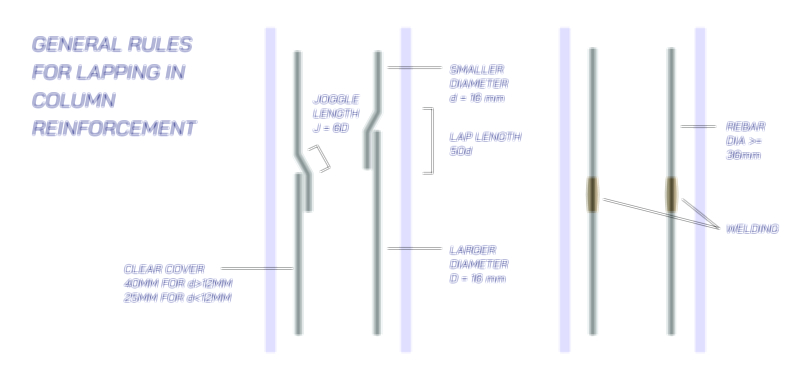
Lap splicing is another domain where staggered bar arrangement plays a crucial role. When reinforcement bars are overlapped to maintain continuity, placing all lap splices in the same region creates a weak point because stress transfer is concentrated in one zone. Staggered lap splicing distributes these overlaps along the length of the member, avoiding planes of weakness. Modern codes and seismic standards often require staggered laps specifically to enhance performance during cyclic loading. Under repeated tension and compression cycles, staggered splices prevent local failures by ensuring that not all splices experience peak strain simultaneously. This is one of the simplest but most effective examples of how staggering contributes directly to structural resilience.
When designing reinforcement in retaining walls, water tanks, silos, chimney shafts, and other cylindrical or curved structures, staggered bars help maintain uniform reinforcement distribution across curved surfaces. Such structures experience stresses in multiple directions, including hoop stresses, bending stresses, and shear stresses. Staggering bars ensures that reinforcement does not accumulate in one line along the curved surface but spreads evenly, forming an integral mesh that better transfers stresses throughout the structure. In circular water tanks, staggering improves crack control under hydrostatic pressure and ensures uniform confinement of the cylindrical shell.
From a constructability perspective, staggered bar arrangements greatly assist contractors. Construction sites must deal with practical challenges such as proper placement of vibrators, ease of tying reinforcement, mobility of workers, space for concrete pumps and tremie pipes, and managing reinforcement alignment during pours. If reinforcement is too congested, workers cannot vibrate concrete properly, leading to honeycombing or insufficient bonding. Staggering bars opens pathways for equipment and manual operations. It improves visibility and reduces the chance of bars shifting during pouring. Furthermore, staggered reinforcement cages are easier to lift and position because weight distribution is more balanced. The resulting structural member is not only stronger but also more reliable, since its construction quality is significantly improved by better reinforcement accessibility.
Staggering also supports durability. When bars are properly spaced and offset, concrete covers each bar uniformly, protecting steel from corrosion. Proper cover reduces the risk of steel rusting, which can expand within the concrete matrix and cause cracking or delamination. In marine environments, basements exposed to groundwater, chemical plants, and wastewater systems, staggering provides better environmental protection by ensuring adequate concrete cover even in complex reinforcement zones.
In seismic engineering, staggered reinforcement becomes an even more refined technique. Earthquake forces create complex multi-directional stresses, requiring structural members to flex, deform, and absorb energy. Staggered bars increase the ductility of reinforced concrete members, enabling them to redistribute stresses when localized yielding occurs. This prevents brittle fractures and supports the “strong column–weak beam” design philosophy. With staggered reinforcements, structural members can undergo controlled, gradual deformation rather than sudden collapse, preserving life safety.
Beyond structural performance, reinforcement arrangement also affects architectural expression. Slim columns, cantilevered balconies, floating stairs, long-span beams, and open interiors often rely on reinforcement patterns carefully arranged to maximize strength while preserving form. Staggered bars enable designers to achieve aesthetic goals by concentrating strength where needed without increasing overall member size. This technique allows sleek architectural features while maintaining load-bearing capacity and safety.
Even advanced materials and modern technologies incorporate staggered reinforcement strategies. Carbon fiber reinforced polymer (CFRP) strengthening, glass fiber strips, and hybrid steel systems take advantage of staggered layouts to optimize load transfer and minimize stress concentrations. Prefabricated reinforcement cages, used in modular construction, often employ staggered layouts to reduce weight and improve transportability. In 3D-printed concrete structures, staggered reinforcement meshes ensure bonding between layers and maintain stability.
Ultimately, staggered bar arrangement embodies the core philosophy of structural engineering: balancing strength, efficiency, safety, and constructability. It represents the intelligent use of geometry, spacing, and distribution to solve practical challenges and enhance structural performance. Though invisible once the concrete hardens, staggered reinforcement patterns quietly uphold the strength and longevity of buildings, bridges, foundations, and infrastructure. They demonstrate how subtle modifications in placement can yield profound advantages, showing that true engineering mastery lies as much in thoughtful arrangement as in raw material strength. Staggered reinforcement is a reminder that good design is not merely about adding more steel, but about placing each bar in its most effective position—ensuring that structures endure gracefully across their entire lifespan.