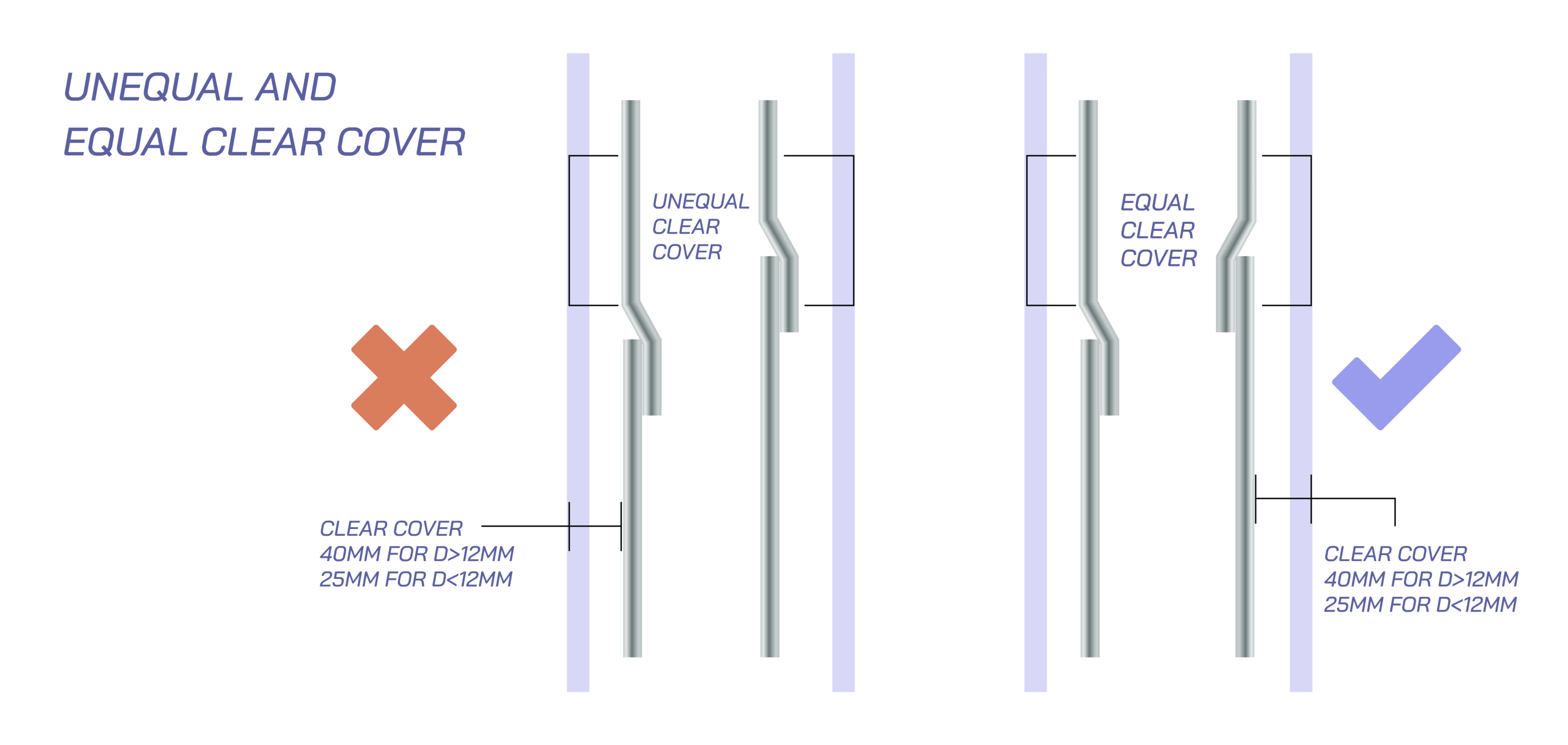
Unequal and Equal Clear Cover — Reinforcement Protection Concept
Clear cover is one of the most essential concepts in reinforced concrete design, representing the protective layer of concrete placed between the surface of a structural member and the outermost reinforcement bars. This seemingly simple distance performs multiple critical roles: it protects steel reinforcement from corrosion, ensures proper fire resistance, allows adequate space for concrete compaction, and anchors reinforcement safely within the structural member so it can resist tension, compression, and shear forces effectively. Within this broader concept, the distinction between unequal and equal clear cover highlights different approaches used in reinforcing patterns depending on the structural shape, load behavior, environmental exposure, construction practices, and detailing constraints. These two categories capture the nuanced design strategies engineers use to maintain both performance and durability in reinforced concrete members across a wide variety of real-world situations.
Equal clear cover refers to the uniform placement of reinforcement so that the distance from the outer concrete surface to the reinforcement cage remains consistent along all sides of a structural element. For example, in a symmetrically loaded rectangular column or a uniformly stressed footing, engineers often ensure equal cover along all faces. This symmetric distribution allows the reinforcement to behave predictably under axial or multi-directional loads. Equal cover also simplifies detailing, ensures uniform corrosion protection, and promotes balanced confinement of reinforcement. When equal clear cover is applied, the reinforcement cage sits precisely in the center of its protective layer, allowing the structural member to experience even performance under bending, compression, or environmental exposure. This uniformity is particularly beneficial in columns, beams, slabs, and walls when the stresses applied to the structure affect all sides equally or nearly equally. With consistent spacing between the reinforcement and the concrete surface, the structural component becomes more resilient to weathering, fire exposure, and chemical attack.
Unequal clear cover, by contrast, involves placing reinforcement bars at different distances from different faces of the member. This approach is not a deviation from good practice but a deliberate engineering choice based on how each side of the structural member is expected to behave under load or environmental conditions. For example, in a retaining wall, the soil-facing side is subjected to moisture, aggressive chemicals, and pressure from backfill. The external face exposed to weather or groundwater often requires greater clear cover to provide additional protection for the reinforcement. Meanwhile, the interior face might experience different or milder exposure conditions, allowing for a smaller cover if needed to maintain structural geometry or reinforcement placement. Unequal cover also appears in beams where one face may be exposed to fire risk or chemical contact and thus requires a thicker cover for protection, while another face may be interior or less exposed.
One of the most important factors influencing the use of unequal or equal clear cover is environmental exposure. Reinforced concrete structures located in marine environments, industrial zones with chemical emissions, wastewater treatment plants, basements, and other aggressive environments demand greater cover thickness to shield reinforcement from chloride penetration, carbonation, and chemical attack. Engineers often designate increased cover on the faces most exposed to these harsh conditions while maintaining standard cover on the opposite faces to control structural depth and bar positioning. This targeted use of uneven clear cover ensures durability while preserving structural efficiency. On the other hand, structures located indoors or far from environmental threats benefit from equal cover that balances cost, ease of construction, and predictable performance.
Load behavior plays a major role in determining whether clear cover should be equal or unequal. Reinforced concrete members subjected to bending stresses—such as beams and slabs—experience tension on one face and compression on the other. Because reinforcement is placed primarily on the tension side, the clear cover for tensile bars must ensure enough protection while still maintaining correct depth to resist bending. Compression zones of a beam may require a lesser cover, particularly if reinforcing bars are not positioned near the extreme compression fiber. In deep beams or transfer beams carrying massive loads, engineers may vary the cover to control effective depth without compromising protection. The tension face may need precise reinforcement positioning at a minimal acceptable clear cover for maximum moment resistance, while the compression face might have slightly greater or lesser cover depending on detailing. This intentional variation creates what is effectively unequal cover, tailored to structural demands.
Fire resistance is another factor where clear cover decisions become critical. Concrete acts as a thermal barrier that insulates reinforcement from extreme temperatures during a fire. The amount of cover influences how long a member can retain strength before steel temperatures rise to dangerous levels. Faces of a structural member exposed to fire risk—such as soffits of slabs, underside of beams, or column faces near open spaces—often receive increased clear cover. Other faces shielded by walls, partitions, or adjacent members may not require the same amount of fire cover. Therefore, unequal clear cover is used strategically to maximize fire safety and comply with fire-resistance ratings without overdesigning all faces unnecessarily.
Construction constraints also influence the use of unequal and equal clear cover. In heavily reinforced members such as pile caps, mat foundations, junctions of beams and columns, or areas with congested reinforcement, equal cover might not always be feasible. Bars may need to be pushed slightly inward on one face or adjusted upward or downward to accommodate other reinforcement or to ensure proper concrete flow and compaction. In these situations, unequal cover emerges as a practical necessity. As long as minimum code requirements are satisfied and structural performance remains intact, slight adjustments to clear cover allow for smoother concreting operations and improved constructability. Engineers and contractors often coordinate these decisions on-site, balancing theoretical design intent with real-world feasibility.
In circular columns or piers, equal clear cover is typically used because the load and environmental exposure are more uniformly distributed. The circular shape allows the reinforcement cage to sit at equal distance from the surface all around, resulting in uniformly distributed confinement and axial performance. However, in rectangular columns where architectural or structural requirements lead to different reinforcement patterns or orientations, unequal cover may be used to optimize load resistance or reduce congestion. At times, equal cover is maintained for standardization, yet when a column is part of a boundary frame or adjacent to a shear wall, one face may need more robustness, prompting unequal cover.
The concept of concrete cover also intersects with durability design. When analyzing future deterioration scenarios—such as carbonation depth, chloride diffusion, and freeze-thaw cycles—engineers may adjust clear cover tailored to where deterioration is most likely to occur. This is particularly relevant in bridge decks where the top surface exposed to vehicle traffic, de-icing salts, and weather requires thicker cover compared to the underside. Similarly, coastal structures facing predominant wind direction carry salt-laden moisture on one side more than the other, encouraging the use of unequal cover to counter long-term degradation.
Despite these complexities, equal clear cover remains the simplest and most common arrangement in everyday construction because it streamlines detailing, reduces the chances of construction errors, and maintains consistent performance. For residential buildings, internal columns, interior beams, and ordinary slabs, equal cover is generally applied because the structural and environmental conditions do not demand variation. Equal cover also helps ensure that reinforcement does not drift from its intended position during concrete placement, a frequent problem in members with dense cages. Equal cover reduces ambiguity during construction because workers can align reinforcement consistently without referring to multiple cover values on different faces.
Reinforcement placement devices, such as cover blocks and spacers, support both equal and unequal clear cover strategies. When equal cover is needed, uniform cover blocks of one thickness are placed around the perimeter of reinforcement. When unequal cover is necessary, different sizes of spacers are used strategically on particular faces. Proper selection and spacing of cover blocks ensure that reinforcement does not shift or lose cover during concreting, which is essential for maintaining the intended protection and structural capacity. A well-implemented cover system protects reinforcement from exposure and ensures uniform bonding between concrete and steel.
In seismic design, the distinction between equal and unequal cover becomes especially important. Structural members that form part of a ductile frame—including columns, beams, shear walls, and boundary elements—must behave reliably under repeated and reversed loading. Variations in clear cover affect the confinement zone, the depth of reinforcement, and the overall plastic hinge behavior. Unequal cover may influence ductility if not properly accounted for. Therefore, seismic codes often specify minimum and maximum cover limits and, in many cases, encourage uniformity to keep seismic response predictable. However, certain faces that experience higher inelastic deformation may warrant enhanced cover due to fire risk or spalling, requiring engineers to carefully analyze whether unequal cover should be applied.
The interaction between architectural requirements and reinforcement also shapes clear cover decisions. Architectural finishes, plaster thickness, embedded utilities, and dimensional constraints sometimes require cover adjustments. For instance, a column face aligned against a wall may have reduced exposure and thus permit smaller cover compared to a face that remains visible and requires more protection. The interplay between architecture and structure often results in unequal cover being used to satisfy both aesthetic and structural considerations.
Ultimately, the concepts of equal and unequal clear cover represent the adaptability of reinforced concrete design. Equal cover offers simplicity, uniformity, and balanced behavior, making it ideal in most ordinary structural members. Unequal cover offers precision, allowing engineers to respond to unique load patterns, exposure conditions, constructability challenges, and durability requirements. Both approaches serve the primary purpose of protecting reinforcement and ensuring long-term structural performance. By understanding when and why each is used, engineers create reinforced concrete structures that are not only strong but also resilient, durable, and suited to their environmental and functional context.