Staggered Bar Arrangement — Reinforcement Layout Pattern
Staggered bar arrangement is a reinforcement layout pattern in structural engineering that plays a deeply important role in ensuring the strength, stability, durability, and constructability of reinforced concrete members. While reinforcement bars are primarily responsible for resisting tensile stresses and providing ductility to concrete, their placement within a structural element has just as much influence on performance as their quantity or diameter. Staggered arrangements reflect a purposeful offsetting of reinforcement bars so they are not aligned in a single straight layer or plane but instead are distributed in alternate or interlaced positions along the length or across the depth of the member. This pattern allows engineers to manage congestion, maintain adequate concrete flow, improve stress distribution, control cracking, and meet code requirements that prevent weak planes from forming within a structural member. Because reinforced concrete depends on the effective bonding between steel and concrete, staggered placement supports the interaction between these materials and ensures structural behavior remains consistent and reliable under a wide variety of loading conditions.
The concept of staggering arises most clearly when reinforcement becomes dense. When bars are placed too closely together in a single plane, there is insufficient space for concrete to flow properly, resulting in honeycombing, voids, or uneven compaction. Concrete must envelop every bar to create the composite action that allows reinforced concrete to resist stresses, and any obstruction to this process weakens both strength and durability. Staggered bar arrangements intentionally offset bars vertically or horizontally so that the spaces between them open up, allowing concrete to flow smoothly between layers during casting. This is particularly important at beam–column joints, foundation pedestals, heavily loaded transfer beams, deep slabs, pile caps, and regions where multiple reinforcement layers intersect. In these zones, staggering becomes a practical necessity that ensures the integrity of the concrete mass by preventing the formation of pockets where concrete cannot penetrate. A staggered pattern therefore contributes not only to structural performance but to construction quality.
Staggering also improves structural behavior by distributing reinforcement more evenly across the cross-section of the member. When bars are aligned in a single straight row, stresses tend to concentrate around that row, reducing the effectiveness of the concrete section around it. Staggering bars allows the reinforcement to follow the natural stress distribution within the concrete, which becomes especially important in members subject to bending. In beams, positive bending moments cause tension at the bottom, while negative moments cause tension at the top, and staggered top and bottom reinforcement ensures smoother stress transfer. When many layers are required, staggering prevents the formation of a rigid cluster of steel that does not align with the structural depth or moment capacity requirements. By arranging bars in a staggered manner, engineers ensure that steel participates more uniformly in resisting tension, compression, and shear, creating a more predictable and robust structural response.
In columns, the need for staggered bar arrangements becomes more pronounced when dealing with multi-storey buildings or seismic structural systems. Columns often contain significant amounts of vertical reinforcement, particularly in high-rise structures or in areas where loads accumulate, such as lower storeys. In beam–column joints, where reinforcement from both beams and columns intersects, the risk of congestion is high. Placing all column bars in perfectly straight rows would block the entry of beam bars, hindering anchorage and disrupting continuity. Staggered vertical bars open up pathways that allow beam reinforcement to pass through the joint without obstruction. This is critically important in seismic zones, where beam–column joints must remain strong, confined, and able to dissipate energy during intense shaking. By staggering reinforcement within these joints, engineers avoid situations where bars cluster too tightly, which would compromise concrete confinement, reduce ductility, and heighten the likelihood of brittle failures.
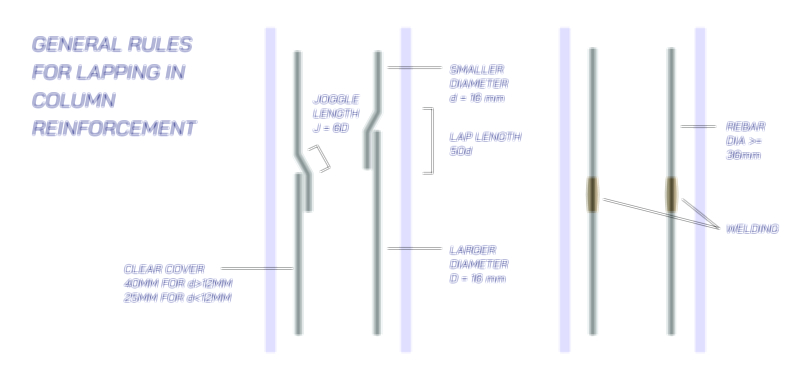
Staggering is also central to the practice of lap splicing, a technique used to extend reinforcement when bar lengths fall short or when reinforcement continues into new structural levels. If all lap splices occur at the same height, the column or beam experiences a concentrated weak zone where multiple splices must transfer stresses through the same region of concrete. Such clustering can lead to local cracks, bond failure, and even buckling of reinforcement during seismic events. Staggering the splice locations ensures that only a portion of the reinforcement is overlapped at a given level, distributing stress transfer along the height of the member. This prevents overloading of the concrete at any single point and enhances the ductility and resilience of the structural system. Modern codes often require staggered lap splices in critical regions, recognizing that staggering improves performance during cyclic or dynamic loading conditions such as earthquakes.
Slabs also benefit from staggered bar arrangements. Reinforced concrete slabs typically carry loads in one direction or two directions, and the reinforcement pattern must accommodate these load paths. In two-way slabs or waffle slabs, reinforcement from both directions intersects frequently. If bars were placed in straight rows without staggering, intersections would create concentrated nodes where bars stack directly on top of each other, causing congestion and raising the slab thickness unnecessarily. By staggering slab bars, intersections are spread out, making it easier for workers to tie reinforcement, for concrete to flow and compact, and for stresses to spread without creating rigid regions that do not behave uniformly. This technique is essential in thin slabs or slabs requiring multiple layers of reinforcement, as staggering allows full reinforcement participation without increasing the structural depth.
In foundation elements such as pile caps and rafts, staggered bar arrangements also solve practical challenges. These elements often require heavy reinforcement due to the large loads they transfer into the soil. With multiple layers of reinforcement extending in both directions, staggering becomes the only viable method to place bars while maintaining clear cover and providing adequate spacing for aggregate flow. In pile caps, staggered bars help navigate the geometry of piles projecting into the cap, enabling the reinforcement cage to envelope the piles without creating gaps or voids in the concrete. The robustness of these foundation elements depends heavily on proper reinforcement alignment, and staggering ensures that forces from piles, columns, and ground pressure are distributed uniformly across the cap.
Staggering extends beyond longitudinal reinforcement and applies equally to transverse reinforcement such as ties, stirrups, and ladder-like confinement bars. In columns where ties confine the vertical bars, staggering ensures that the ties wrap around each bar without interference. This prevents torsional distortions, improves confinement of the concrete core, and prevents buckling of longitudinal bars during compression. In beams where stirrups must be threaded through dense bottom reinforcement layers, staggering the bars creates channels through which stirrups can pass. This integration ensures that transverse reinforcement performs its role in controlling shear cracking and providing confinement without causing reinforcement clashes or improper alignment.
The staggered pattern is also deeply connected to the principle of preventing weak planes. If reinforcement bars were arranged in a single continuous line across the width or depth of a concrete cross-section, any failure plane could form along that line with little resistance. Staggering breaks up the possibility of such planar weaknesses by distributing reinforcement in multiple vertical or horizontal layers, making it difficult for cracks to propagate in straight paths. This reduces the risk of sudden fractures and enhances the ductility of members under high loads. Especially in seismic zones, preventing straight-line crack paths is essential to avoiding brittle collapse mechanisms.
Constructability also plays a major role in why staggered arrangements are so valuable. Reinforcement cages must be assembled, tied, lifted, placed, and vibrated in real construction environments, not in idealized conditions. Workers need access to tie wires, lifting points, and clearances. Concrete vibrators must be able to penetrate the rebar cage to ensure proper compaction. Staggered reinforcement arrangements open pathways and workspaces within the cage, making the process safer, faster, and less prone to errors. Poorly arranged reinforcement can shift during concrete placement, reducing cover and compromising durability. Staggering provides stability by allowing reinforcement bars to rest more securely on each other and by preventing multiple bars from touching or interfering.
Durability considerations further justify staggered bar use. Proper concrete cover must be maintained on all faces to protect steel from corrosion. When bars cluster tightly, maintaining consistent cover becomes difficult. A staggered arrangement offers more predictable cover and reduces the likelihood of bars migrating toward the surface. Structures exposed to aggressive conditions such as coastal environments, chemical plants, wastewater systems, or chloride-laden roads benefit significantly from reinforcement arrangements that allow concrete to envelop steel fully and uniformly. By preventing bars from aligning too closely or creating surface bulges, staggering safeguards long-term durability.
The influence of staggered patterns extends to advanced applications in modern construction. With the rise of high-performance concrete, fiber-reinforced systems, and hybrid reinforcement methods, staggering remains relevant because these innovations still depend on effective reinforcement distribution. Even in prefabricated or precast concrete systems, where reinforcement cages are manufactured in controlled environments, staggering helps ensure that panels, beams, columns, and walls achieve consistent quality while maintaining structural performance at connection points. In 3D-printed concrete structures where reinforcement must be inserted layer by layer or in prefabricated cages, staggering ensures that reinforcement integrates smoothly with the printing process and maintains consistent bonding.
Ultimately, staggered bar arrangement is an expression of engineering precision. It is not merely a response to congestion but a deliberate strategy to improve the structural behavior of reinforced concrete members under diverse loading conditions. It enhances ductility, improves load transfer, reduces the risk of weak planes, allows proper concrete compaction, supports seismic resistance, and promotes long-term durability. Though it remains invisible once concrete hardens, the staggered reinforcement pattern shapes the internal strength of buildings, bridges, foundations, and infrastructure. It ensures that structures do not just stand but remain resilient, reliable, and safe throughout their service lives.