General Rules for Lapping in Column Reinforcement — Civil Engineering
General rules for lapping in column reinforcement stand at the core of reinforced concrete design, forming a crucial link between structural integrity, construction practicality, and long-term durability. Lapping refers to the method of overlapping two reinforcement bars to transfer stress from one bar to another, allowing continuity of reinforcement when bars are shorter than the required structural length or when bars must be extended upward from one storey to the next. In reinforced concrete columns, which are the primary vertical load-bearing elements of a structure, proper lapping is not merely a matter of connecting steel pieces but a sophisticated design practice governed by the principles of structural engineering, material science, and code-based safety standards. The rules ensure that lapped bars act together as a single, continuous reinforcement capable of resisting axial compression, bending moments, lateral loads, seismic forces, and long-term stresses. Understanding these rules is essential for civil engineers, designers, and construction professionals because incorrect lapping remains one of the most common causes of reinforcement failure, local buckling, insufficient load transfer, and structural deficiencies in columns.
Fundamentally, the purpose of lapping is to develop the required bond strength between the overlapping bars so the stresses in one bar can flow seamlessly through the concrete into the adjoining bar. Columns carry heavy axial loads, frequently combined with bending stresses from lateral forces such as wind or earthquake effects, making precise lap detailing essential. The general rule is that laps must be placed where the stress is relatively lower to ensure safer force transfer. Because the ends of a column normally experience high moment demand, especially at beam–column junctions, lapping in these regions can cause severe stress concentration. Thus, codes and engineering practice strongly discourage lapping at the critical top and bottom zones of a column. Instead, lapping is positioned at the mid-height half of the column where bending moments are comparatively reduced, allowing safer load transfer through the spliced bars. This rule reflects a deep understanding of the moment diagram of a typical column: the highest bending moments appear near supports, while mid-heights have more uniform and lower stress distributions.
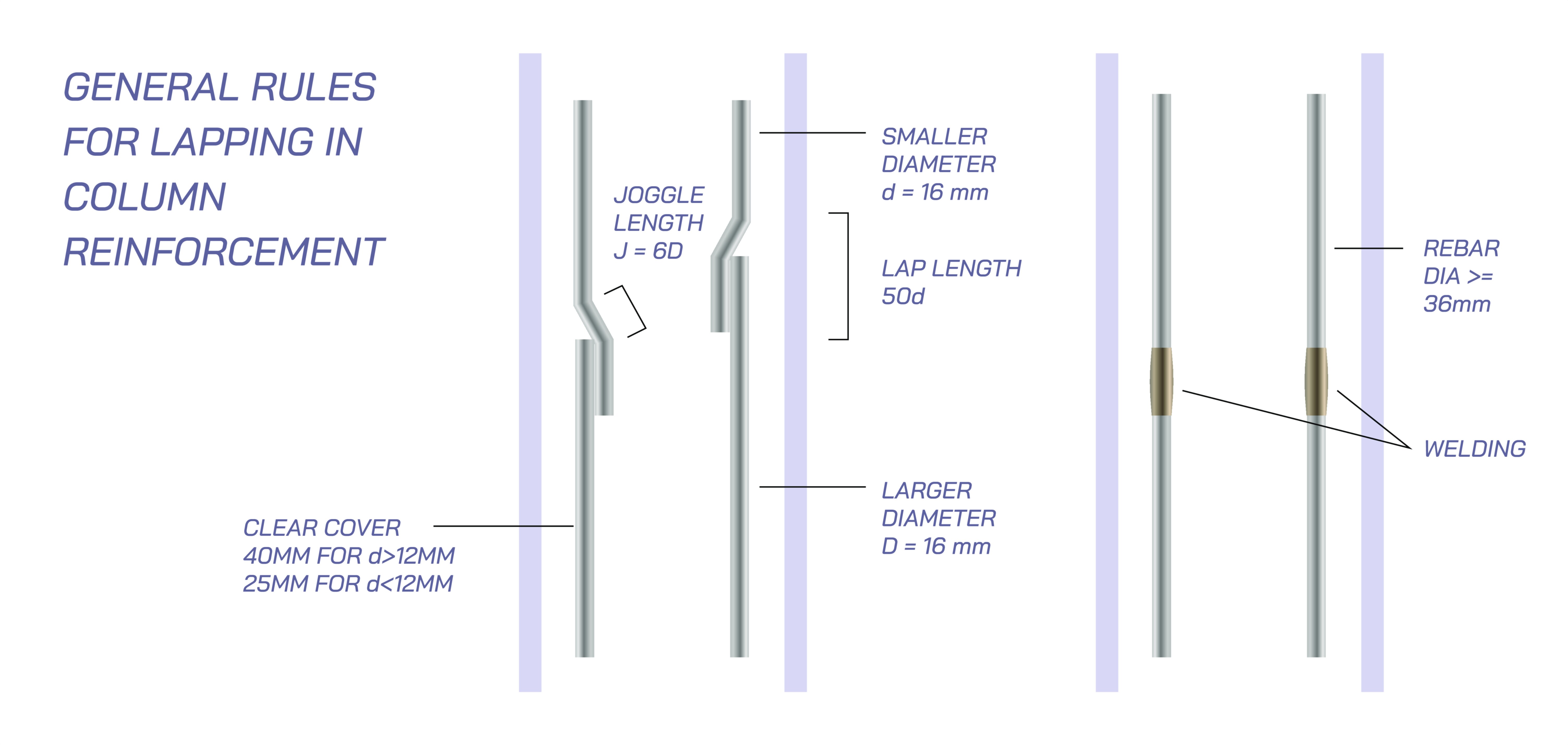
Another fundamental rule relates to the length of the lap splice. Lapping requires adequate overlap to ensure proper bonding between the bars and the surrounding concrete. Although specific lengths depend on factors such as bar diameter, concrete grade, confinement, and the presence of transverse ties, the general guideline is that lap length is significantly longer in columns than in lightly stressed regions to ensure reliable compressive and tensile load transfer. Larger diameter bars require longer lap lengths because their circumference is greater, demanding more surface area for proper bonding. In seismic zones, lap lengths are typically increased further due to the intense cyclic loading conditions that continuously reverse tension and compression forces along reinforcement. This enhanced lap length ensures that splices do not fail prematurely under repeated or vigorous stress cycles.
The arrangement of lapped bars is also critical. Engineers avoid lapping all bars in the same vertical plane or at the same height, as this would create a plane of weakness and a localized region with reduced stiffness and strength. Instead, bars are staggered in such a way that only a portion of the reinforcement is lapped at any given level. This staggering distributes the stress transfer more evenly along the height of the column and eliminates the possibility of a single splice zone becoming overstressed. Staggering laps enhances ductility and prevents sudden localized failure. In earthquake-resistant design, staggering becomes even more important because it ensures that the structure has sufficient energy dissipation capacity and that plastic hinges do not form abruptly around clustered splice zones.
Another significant rule concerns the confinement provided by transverse reinforcement. In columns, ties or spirals play a major role in maintaining the stability of vertical bars during loading. When bars are lapped, the central region of the splice becomes a potential weak point susceptible to slipping, buckling, or premature yielding. To counter this, codes require close spacing of ties around the lapped region to provide enhanced confinement. Well-confined lap zones prevent bar buckling during compression, maintain alignment, and improve bonding strength between bars and concrete. Proper tie spacing ensures that forces are distributed uniformly and prevents the accidental crushing or splitting of concrete around densely lapped areas. This confinement requirement reflects the interplay between longitudinal and transverse reinforcement that gives columns their characteristic strength and deformation capacity.
Another guiding principle is that lapping should ideally not occur near joints where beams frame into columns. Beam–column junctions are zones of high stress, shear concentration, and complex force transfer. At joints, columns must resist the combined effects of vertical loads from above, reactions from beams entering the joint, and lateral forces. Introducing laps in these regions increases the risk of bond failure and weakens the joint’s ability to transfer bending and shear forces effectively. Therefore, lapping is generally placed well above or below the beam–column junction, ensuring that the splice remains in a region of lower shear and bending demand. This separation protects the integrity of the joint and ensures that the reinforcement cage functions cohesively under all loading conditions.
Columns may often contain bars of large diameter, particularly in high-rise buildings, heavy industrial structures, or structures located in seismic zones. Because these bars demand long lap lengths, engineers sometimes choose mechanical couplers instead of conventional lap splicing. Couplers eliminate the need for overlapping bars and thereby reduce congestion. The general rule is that couplers may replace laps, especially when spacing becomes insufficient for concrete placement. This approach reflects how lapping rules evolve in response to modern construction technologies. However, when laps must be used, the bars must be placed with adequate clear spacing, ensuring that concrete can flow freely between bars during casting. Proper spacing avoids honeycombing and prevents weak concrete zones that could reduce the bond strength needed for splice performance.
Bar hooks or bends are sometimes used to improve anchorage, but in column lapping, straight laps are far more common. Because columns primarily experience axial and bending forces, hooks might complicate placement and cause congestion. The general rule is that straight laps along the length of the bar are preferred, provided that the required lap length and confinement conditions are satisfied. Straight splices provide simple, predictable stress transfer without causing interference with ties or beams intersecting the column.
Lap length also depends on whether the bars are in tension or compression. In columns, bars are often in compression, and compression lap lengths may be shorter than tension lap lengths under certain design conditions. However, because columns also experience bending, parts of the column reinforcement experience tension at various times. Hence, conservative practice often uses tension lap requirements to ensure reliability under all load combinations. This careful consideration demonstrates how engineers anticipate fluctuating load patterns and design for safety across multiple failure scenarios.
Environmental exposure also influences lapping rules. In aggressive environments such as marine structures, bridge columns, water tanks, and chemical plants, corrosion risks are high. When bar splices occur, any deficiencies in cover or compaction create a vulnerability for moisture or chemicals to reach steel surfaces. Therefore, lapping rules require even greater attention to cover, alignment, consolidation, and protection. In such environments, engineers may use epoxy-coated bars, stainless steel, or enhanced concrete mixes at splice regions. Good lapping practice ensures long-term durability by eliminating weak points that corrosion might exploit.
In structures subjected to heavy loads, dynamic forces, or long-term creep, engineers consider additional factors in lapping, including the type of concrete, bar positioning tolerances, and potential for bar slipping. Columns in high-load regions such as transfer floors, podium levels, or industrial structures often involve additional detailing requirements to ensure that laps can carry the high stresses associated with massive vertical loads. Here, the general rule is to verify that splice zones have not only adequate length but also adequate confinement and clear geometry for concrete vibration.
Finally, lapping rules emphasize quality control during construction. Even the best engineering design cannot compensate for poorly executed splices. Bars must be placed with correct overlap, securely tied so they do not shift during concreting, aligned so that they remain straight, and confined by ties that meet spacing requirements. Lapping rules thus extend beyond design to include supervision, inspection, and workmanship on site. Proper lapping ensures that columns behave as continuous units under load, transferring forces seamlessly from storey to storey and maintaining structural stability through decades of service.
Ultimately, the general rules for lapping in column reinforcement reflect the broader philosophy of structural engineering: anticipating how loads flow, how materials behave, how construction challenges arise, and how safety is preserved through meticulous detailing. Lapping is not merely a mechanical connection between bars but a critical component of the column’s ability to stand tall, resist collapse, and maintain resilience over time. Through thoughtful placement, adequate length, proper confinement, staggering, avoidance of critical zones, and attention to practical constructability, reinforcement laps help ensure that the column remains strong, durable, and capable of withstanding the forces that shape the life of any structure.